
How Do F1 Cars Work?: When More Power Hurts Braking
Honda’s Zandvoort upgrade explains why hybrid power, braking recovery, tyre temperature and deployment must work as one system.
The short version
- F1 cars convert hybrid power into speed only when braking, energy recovery, aerodynamics and tyre grip cooperate.
- Honda’s Zandvoort upgrade left positive torque lingering under braking, increasing stopping distance and reducing Alonso’s confidence.
- Power-unit upgrades should be judged by usable corner-entry control and tyre performance, not dyno output alone.
How do F1 cars work when more power makes them harder to stop?
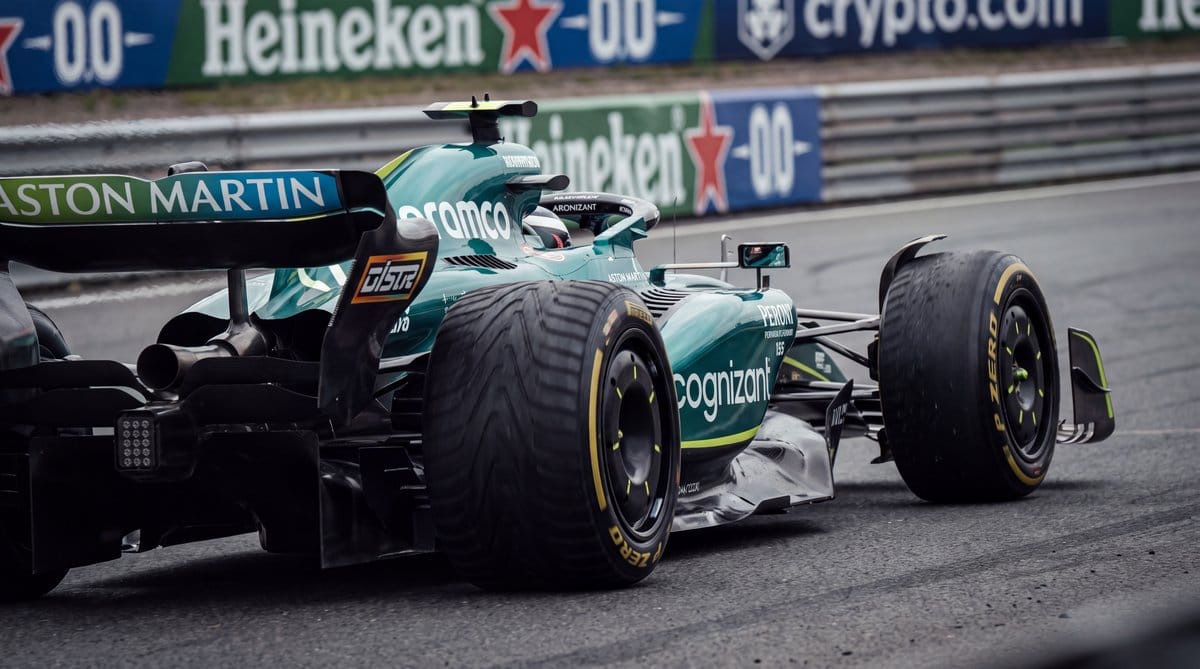
Fernando Alonso braked for Turn 1 and the engine kept helping him accelerate. Honda had brought Aston Martin more power at Zandvoort; first, the car had to learn when to stop using it. That sounds absurd until you understand how F1 cars work. Change combustion and torque arrives differently, affecting braking, electrical recovery and the car’s attitude on corner entry. The tyres inherit the mess.
Honda expected its updated power unit and Aston Martin’s improved chassis to strengthen the midfield package. Instead, both drivers reported drivability problems, while an active-aero failure cost Alonso a sprint-qualifying attempt.
More horsepower had entered the group chat. Cooperation had not.
More power changed the braking problem
Honda said the updated RA626H gained power through internal-combustion improvements, with smaller battery and component changes. It published no verified gain, so precise horsepower figures come with homemade parmigiano. What mattered was how output reached the rear axle. Revised combustion changes engine response between throttle, coasting and braking, requiring new control maps. Honda chief engineer Shintaro Orihara told Motorsport.com that this drivability work had to be repeated for the new specification. Alonso found its unfinished edge under braking: the car kept delivering more propulsion than expected. Extra power became extra stopping distance.
Alonso told Autosport on August 21, 2026:
When you brake and the throttle is open, it’s difficult to stop the car.
The driver need not touch the throttle for the rear axle to feel like it is pushing. The combustion engine and electrical system jointly deliver or recover torque through each corner phase. Under braking, the electrical system recovers energy into the battery, but must do so predictably alongside the mechanical brakes and engine. If positive torque lingers when Alonso expects deceleration, he must brake earlier or harder. The first costs time; the second can upset the balance and lock a tyre, especially with inconsistent grip. He then reaches the next corner with altered tyre temperatures and less pedal confidence. You gained dyno output and donated corner-entry confidence. Magnificently expensive.
Zandvoort makes calibration particularly rude. Pirelli said Turn 3 has 19 degrees of banking versus 18 at Turn 14, with both imposing heavy vertical and lateral tyre loads. Beach sand reduces grip; resurfaced asphalt changes adhesion again. A tyre struggles to absorb unexpected rear-axle torque when its surface keeps changing. It slides, its temperature shifts and the next acceleration zone offers less grip than the control model predicted. The deployment map is now solving yesterday’s problem at several hundred kilometres per hour.
Electrical rules added another constraint. Recovery and deployment must obey circuit- and session-specific limits, though the supplied readable sources do not publish them. Honda said FIA adjustments reduced their effect on speed and lap time, giving software more freedom to use available energy. Public material cannot reveal the benefit or separate gains from combustion, battery revisions, chassis setup and aero work.
Honda’s optimism deserves a fair hearing. More engine output and an improved Aston Martin chassis should have made a stronger package, and neither power unit suffered a headline mechanical failure. But drivability determines whether that output is usable. Alonso had more power and less certainty about the rear axle when he braked.
The tyres decide whether deployment becomes lap time
Zandvoort made Honda’s calibration issue a tyre problem because deployment works only if the rears can transmit torque. The floor and wings create aerodynamic load; the suspension tries to preserve the ride height that makes it predictable. Corner speed sets aero load, while tyre temperature determines how much becomes grip. A small slide adds heat, delays acceleration and moves the efficient deployment point. Push too hard and the tyre slips; hold back and the straight ends with energy left in the battery. Earlier braking also changes recovery for the next section. The deployment map follows available grip around the circuit. It is not a PlayStation boost button.
Ferrari provided the cleanest tyre failure. Lewis Hamilton said the rubber stayed outside its useful temperature window after an out-lap and preparation lap, denying him the response needed at the opening corner.
He told Motorsport.com on August 23, 2026:
Just do an out-lap and a prep lap, and the tyres are still not ready for Turn 1, it’s just nuts.
Ferrari could create aerodynamic load, but cold rubber could not turn enough of it into early-lap cornering force. The driven axle follows the same rule: engine torque becomes acceleration only if the rear tyre transfers it into the asphalt. Below its working window, deployment can create wheel slip instead of speed. That slide heats the surface unevenly and changes the next corner’s balance. Engineers can alter setup and energy delivery, but each fix costs elsewhere: gentler deployment sacrifices acceleration; chasing temperature can damage the tyre later. Growing up in Italy, I learned this from espresso machines. Plenty of pressure, gorgeous hardware, cold cup, disappointing result. Ferrari built the carbon-fibre edition.
Race strategy extended the problem across longer stints. The red flag let drivers change compounds during the interruption, rewriting tyre-life calculations and making some strategies cheaper. Alonso changed from Softs to Hards and planned one more stop. Lando Norris stopped twice more after his red-flag tyre change. Pirelli credited Alonso’s saved stop with helping him finish ninth and score points. Strategy software continuously compared remaining tyre performance with pit-stop time loss, while later neutralisations kept changing the trade. A fastest plan could expire before the next sector.
Teams made 60 pit stops across roughly 10 Dutch Grand Prix strategies, and every top-ten finisher used a different sequence. Interruptions combined with tyre temperature and degradation across cars with different strengths.
The longest Soft stint was 32 laps, versus 31 on Mediums and 35 on Hards. Different cars, fuel loads, traffic and setups mean those figures cannot prove one compound independently superior. They show how wide the usable window became after the red flag changed stopping costs.
I used to consider power-unit upgrades the simple bit: make more power, go faster, open prosecco. Zandvoort killed that comforting theory. By the end of 2027, I expect every serious upgrade to arrive with braking calibration and tyre models already signed off in simulation. Anyone selling horsepower alone will meet Alonso’s Turn 1 problem: the car reaches the corner faster, and the driver trusts it less.
Frequently asked questions
How do F1 cars work?
F1 cars combine an internal-combustion engine, electrical deployment and recovery, aerodynamic load, suspension control, mechanical braking and tyre grip. Control maps coordinate torque through acceleration, coasting and braking, while the tyres determine whether available power becomes acceleration or wheel slip. Usable lap time depends on the systems cooperating.
Why can more power make an F1 car harder to stop?
More power can make an F1 car harder to stop when positive torque lingers after the driver expects deceleration. The driver must brake earlier or harder, which either costs time or unsettles the car, risks a tyre lock-up, changes tyre temperature and reduces confidence on corner entry.
How does tyre temperature affect F1 power deployment?
Tyre temperature controls how much aerodynamic load and power can become grip. If the rear tyres sit below their working window, electrical deployment or engine torque can cause wheel slip instead of acceleration. Sliding then heats the surface unevenly, changes balance and forces engineers to compromise later deployment or tyre life.
Sources
- Alonso finishes P9 at the Dutch GP to score two points
- Sixty pit stops in Norris’s winning farewell at Zandvoort
- What to expect from Honda's long-awaited F1 power unit upgrade at Zandvoort
- Verstappen highlights "big priority" for Red Bull in second half of F1 2026
- McLaren and Ferrari lead development charge as every upgrade for Dutch Grand Prix revealed
- Why Alpine is banking on ‘powerful’ F1 car upgrade only Gasly will get in Zandvoort