
DRS F1 explained: why the wing no longer wins passes
The wings now move for every driver, while a timing line unlocks the battery profile that gives eligible…
The short version
- In 2026, Straight Mode replaced DRS wing behavior, reducing drag for every car in approved dry zones.
- Overtake Mode eligibility at Monza required a pursuer to be within one second at the detection point.
- Viewers must separate visible active aerodynamics from the battery profile that creates the following car’s selective passing advantage.
The rear wing opened at Monza and half the internet yelled “DRS.” The selective passing tool had already been awarded at a timing line and would arrive through battery deployment one lap later.
For 2026, Formula 1 replaced the former DRS system with two separate tools. Straight Mode changes the car’s aerodynamics in approved zones. Overtake Mode gives an eligible pursuer a different electrical-energy profile. At Monza, eligibility meant being within 1 second of the car ahead at the detection point; anything greater than 1 second meant no access on the following lap.
That split changes how I watch a straight. The moving wing is the shiny object, like burrata arriving at the next table while you pretend to listen to your friend. The consequential moment may have happened earlier, when timing software measured the gap and decided which electrical profile would be available next time around.
I stared at the flap too. Fifteen years of muscle memory will do that.
Why both wings move now
Formula1.com’s Monza circuit guide describes Straight Mode as a low-drag aerodynamic configuration available to every car in designated dry-condition areas. The rear wing opens a gap, much as it did under the old DRS rules, while the upper front-wing elements drop at the same time. With both ends in their Straight Mode positions, the car produces less drag and accelerates more efficiently towards top speed. Before the corners, it returns to the higher-downforce configuration. The visible movement tells you which aerodynamic state the car is using. Eligibility for overtaking assistance comes from a separate system.
Think of Corner Mode as cycling into a headwind while wearing a winter coat. Straight Mode unzips the coat. The analogy becomes dangerous if I push it any further, because a Formula 1 car is slightly more complicated than a confused Italian on a bicycle, but the basic trade remains useful: aerodynamic load helps in corners and creates resistance on the straight. The regulations allow the car to change that compromise at specific places around the lap.
Every driver gets the same aerodynamic opportunity in those zones during dry running. The leader can use Straight Mode. So can the pursuer and the lonely car between groups whose television director has forgotten it exists. If two cars activate the same permitted configuration, the chasing car receives no special regulatory advantage from the wing movement itself. Its tow may still help, and the underlying aerodynamic packages can respond differently, though the supplied sources publish no comparative speed traces.
That last gap matters. Formula1.com does not quantify the straight-line gain from Straight Mode, so any universal kilometre-per-hour figure currently floating around social media has been marinated in confidence and served without ingredients.
Monza put active aero on a map
Monza contained four Straight Mode zones, compared with no proximity requirement for using them: the start-finish straight and the sections between Turns 3–4, 7–8 and 10–11. Drivers could use the low-drag configuration in those approved dry-condition areas regardless of the gap to another car. They could not flatten the wings wherever they fancied some extra speed. The circuit map defined where the configuration change was permitted, the front and rear elements moved there, and the car returned to higher downforce for the corners. F1 had effectively written an aerodynamic schedule into the track layout. Engineers still had to make that schedule work with the car they built.
The same permission can produce different outcomes because the cars underneath it remain different. Floor performance influences the broader aero package. Ride height and suspension behaviour can affect how consistently that package works, while cooling demands and bodywork choices also shape the car engineers bring to Monza. The research supplied here contains no comparative data that separates those effects, so I cannot assign a Straight Mode advantage to one design. Equal access to a configuration does not make the machinery equal.
George Russell gave a useful clue while discussing teamwork and the tow in Formula1.com’s Monza coverage on September 3, 2026:
It’s not maybe as powerful as it once was with the wings open in [Straight Mode] the whole time, but we’ll work as a team. That’s how we do things.
I would not build a grand theory of slipstreaming from one Russell quote. His wording does capture the engineering relationship, though: both cars are already shedding drag through the zone, which changes the relative value of the tow. The follower needs enough speed difference for that tow to become useful, and Straight Mode alone grants no exclusive boost to the pursuer.
Eligibility lives at one timing line
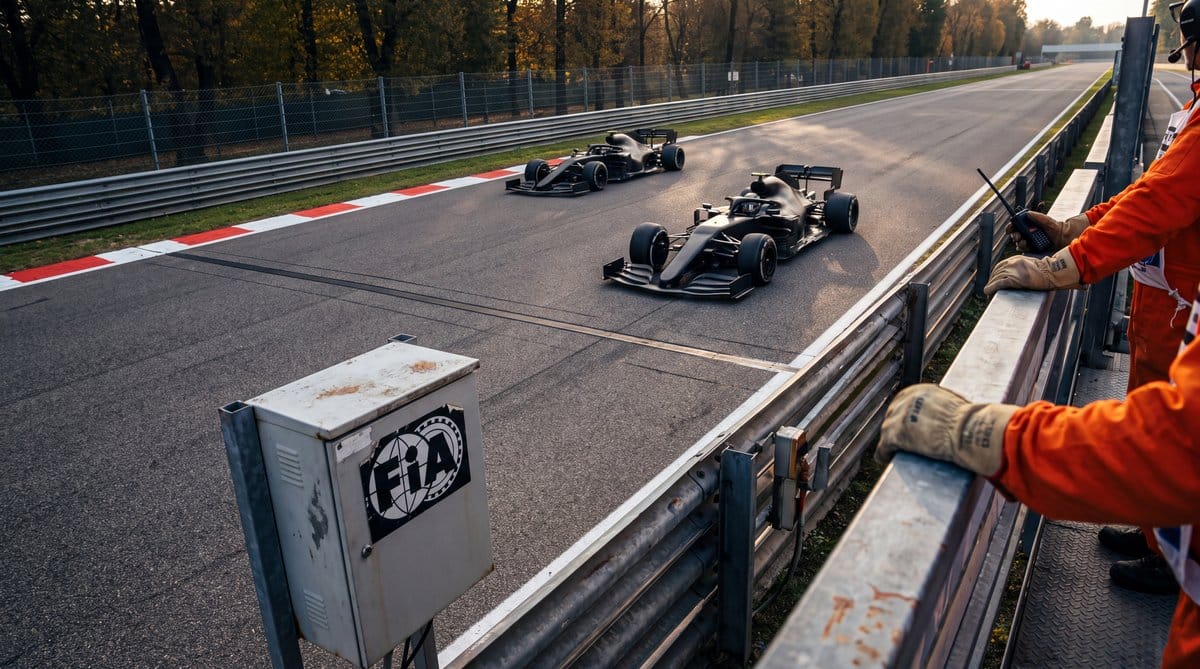
Overtake Mode supplies the selective advantage. At Monza’s single detection point, a pursuer within 1 second of the car ahead qualified for the following lap; a gap greater than 1 second failed the condition. Formula1.com says the mode permits more electrical-energy recharge and an additional electrical-power profile. That profile allows the eligible car to sustain higher speed for longer. The chain is wonderfully bureaucratic: reach the required gap, cross the detection point, receive permission, then use the alternative profile next lap. Meanwhile, both cars can still change their wings in the designated Straight Mode zones.
The delay is the clever part. A driver does not cross the detection line and immediately receive a Mario Kart mushroom. The timing result creates an option for the following lap, which forces the team to think beyond the straight currently filling the television screen. First the car has to get close enough to qualify. Then it must stay close enough for the unlocked electrical profile to matter. If it loses ground after detection, the permission becomes less valuable; if it remains attached, the additional profile can sustain speed for longer while both cars use the same aerodynamic mode.
This makes the system a software problem as much as a power-unit problem. The timing loop allocates eligibility, and the car’s controls execute the permitted energy profile. Engineers must decide how to manage the available electrical energy around that opportunity, yet the public material does not expose the telemetry needed to compare deployment maps. We can see whether a car met the threshold. We cannot see how aggressively each team handled its energy or how much straight-line speed the mode produced.
There is another unknown worth saying plainly. The supplied sources offer no comparative race data showing whether Overtake Mode produces more passes, fewer passes or simply different kinds of passes than former DRS. They also give no measured speed gain for either Straight Mode or Overtake Mode. I would love a tidy figure to paste beside a wing diagram, but inventing one would be peak startup-founder behaviour. I have committed enough spreadsheet crimes.
Ferrari’s diagnosis needs telemetry
Ferrari deserves scrutiny at Monza because the circuit puts low-drag efficiency and electrical deployment under a microscope, and because Italian television can turn one suspicious sector into a constitutional crisis. The available evidence still sets a hard limit. Timing screens reveal gaps, while broadcast footage shows the wings moving. Neither source reveals Ferrari’s comparative deployment trace, isolates floor behaviour or proves where the car gained and lost aerodynamic efficiency. Without those traces, blaming a Ferrari battery map would be fan fiction wearing a team polo. Praising a secret Maranello breakthrough would be the same genre with nicer lighting.
The threshold also cannot explain how a car arrived there. Aero efficiency shapes the gap along the straight. Corner performance affects whether the pursuer begins that straight close enough, and energy use influences how long it can maintain speed. The detection point then converts the measured gap into a future option. A tiny difference at that line can give two nearly matched cars different tools on the following lap, even though the regulation says nothing about which engineering weakness created the difference. That is why access data and diagnosis are separate jobs.
My bet is that teams will start discussing the lap before Overtake Mode far more openly before 2026 ends. Strategy software will model the cost of reaching the detection point against the value of the electrical profile it unlocks, and broadcast graphics will eventually have to catch up.
The rear flap will keep getting the screenshots. Engineers will be watching the timing line where the next lap’s battery advantage was decided.
Frequently asked questions
What replaced DRS in Formula 1 in 2026?
In 2026, Formula 1 replaced former DRS with Straight Mode and Overtake Mode. Straight Mode changes both front and rear wings to reduce drag in approved dry zones for every car. Overtake Mode selectively grants an eligible pursuer an alternative electrical-energy profile on the following lap.
How does Straight Mode work in F1?
Straight Mode moves the upper front-wing elements and opens a gap in the rear wing, creating a low-drag configuration. Every driver can use it in designated dry-condition areas, regardless of proximity to another car, before returning to the higher-downforce configuration for corners.
How does a driver qualify for Overtake Mode?
At Monza, a pursuer qualified for Overtake Mode by being within one second of the car ahead at the single detection point. Qualification unlocked more electrical-energy recharge and an additional power profile for the following lap, allowing the eligible car to sustain higher speed for longer.
Sources
- CIRCUIT GUIDE: Everything you need to know about the Autodromo Nazionale Monza
- Doc 6 - Competition Notes - Circuit Map, Pit Lane Drawing, Emergency Exits Map and Red Zone
- F1 Active Aero Explained: What Replaced DRS in 2026
- F1 2026 Rules Explained: Every Big Change On The Grid
- Norris wins dramatic Dutch Grand Prix from Antonelli and Russell as Verstappen crashes out
- Russell surges to victory in Zandvoort Sprint ahead of Leclerc and Norris