
How do you build a digital front door worth opening?
Sierra reports over $400 million in ARR, but outcome-based AI pricing still depends on what counts as…

The short version
- Sierra’s announced $30 billion valuation accompanies company-reported ARR above $400 million, not disclosed proof of profitability or customer savings.
- Outcome-based AI pricing depends on contract-specific definitions of completion, including how suppliers handle escalations, shared credit and later reversals.
- Buyers need verified completion costs that include failed attempts and retries, rather than treating token-cost returns as all-in returns.
Sierra’s $30 billion bet: sell the result, eat the retries
I like making AI vendors pay for their retries. Less so when “problem solved” means the customer stopped replying.
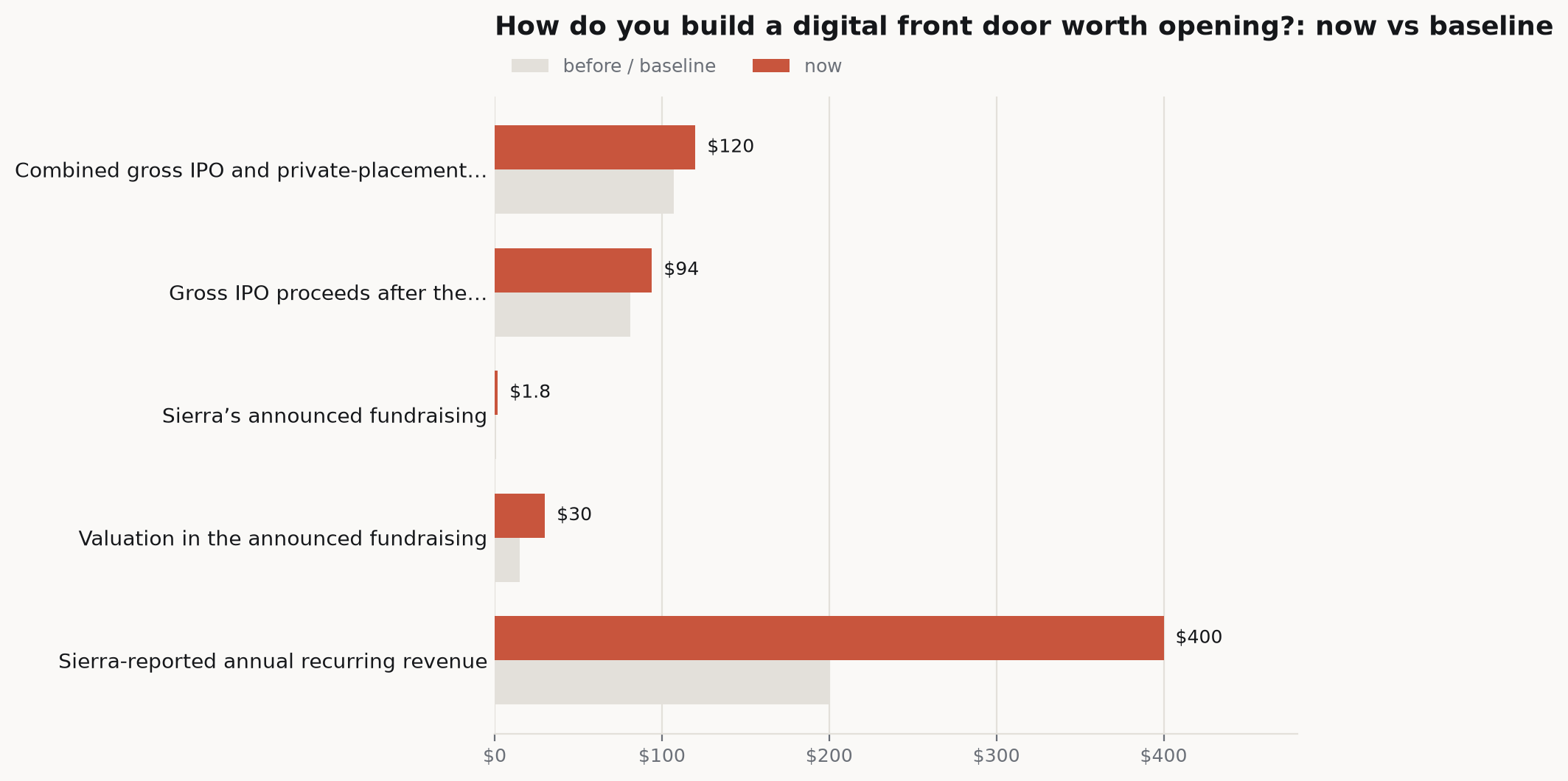
Sierra says it is raising about $1.8 billion, versus about $1 billion last round, at an announced $30 billion valuation, double the previous $15 billion, according to TechCrunch. That buys patience to figure out what completed work costs.
Sierra reports over $400 million in annual recurring revenue, up from $200 million in five months. That’s a company-reported run rate, not audited annual revenue or profit. As a founder, I’d happily take that growth problem. I’d still want the delivery bill.
Ghostwriter still needs a working workflow
I learn more watching an agent finish a task than from a polished demo. Sierra says enterprises define goals and guardrails; Ghostwriter builds, tests and deploys agents, then reviews conversations to suggest improvements. In healthcare, Sierra says electronic health record integrations let agents book appointments, explain bills and check authorizations. Integrations let agents act beyond chat. Whether that helps patients depends on the workflow: a smoother conversation can reach the same broken authorization dead end faster.
Sean Robbins put it well in Sierra’s account of HLTH:
If you just apply AI to the same old workflows, you’re just accelerating, in many cases, broken workflows.
I care about the boring buying-process question: what happens after the agent says it helped? Did the appointment reach scheduling? Must the patient call again? I’d make the acceptance test follow the work so a polite answer can’t pass for completion.
Sierra’s traction makes me take it seriously, not let a hospital skip that test. NextNow likewise distinguishes supplier-wide growth from evidence that a buyer’s deployment saves money.
I want “resolved” defined before the invoice
I like outcome pricing’s premise: suppliers earn when customers get something useful. Sierra says contract-defined charges focus it on measurable customer impact. I buy the incentive. Proving it worked takes more than agreeing on “outcome.”
Rod Baptie told ITPro:
Outcome pricing is the customer ideal. It’s, however, very, very difficult to get to.
I’d give his objection more airtime than another funding headline. Baptie argues that several suppliers can contribute to a result, while customer behavior can decide whether it happens. Take a hypothetical cancellation: an agent offers a discount, a human approves, the subscriber stays. I’d want the contract to define when that’s a save, and what happens if they cancel before the next payment. Otherwise, both sides can accurately describe their contribution and still dispute the invoice.
I think that narrows where outcome pricing works best. I’d start with tasks whose completion both parties can inspect, explicitly negotiating shared credit and later reversals.
Attify’s review says Sierra generally doesn’t charge for unresolved conversations or escalations, though reporting also describes blended consumption pricing for some interactions. Outcome criteria are contract-specific.
Other vendors show why details matter. Attify documents rules counting non-escalation as resolution without affirmative customer confirmation. Intercom counts confirmed and assumed resolutions. Silence might mean happiness, or someone abandoning the chatbot to complain to their spouse. But Attify also says Intercom deducts a billed resolution if the customer returns to that conversation for more help, even in a later billing period. That’s a material billing safeguard, not proof of durable resolution quality. I haven’t found independent, comparable evidence in the reporting I’ve seen that billed resolutions stay solved after repeat contacts or later reversals.

The retries belong in the margin calculation
I want cost per verified completion. Sierra uses a constellation of models; agents can require repeated calls. A tool returns information, which enters the conversation; the agent calls a model again, potentially carrying earlier context and adding cost before the vendor knows whether it will succeed. Failure leaves that spending without a completion. A retry might rescue the task, but belongs in the same calculation.
Tetrate tested that accounting on terminal-agent tasks. In a matched Claude Opus comparison, lower reasoning effort cut estimated model cost per verified success from about 77 cents to about 30 cents on the 61 pairs with complete cost data. Both settings passed 43 of those 61 runs. Three additional rated pairs lacked complete costs and were excluded from that estimate.
Across the broader rated sample, both settings passed 44 of 64 runs. Tetrate cautions that matching observed pass rates does not establish equal quality; the sample is too small to rule out a meaningful quality loss. Estimates used normalized API prices, not actual bills, including failures in the cost numerator. I’d borrow the method, not generalize the result: other tested configurations lost completions, and none of this establishes Sierra’s margins.
I’d read customer evidence just as carefully. Fiserv reported a return of 5–10 times token costs for its Sierra call center. That denominator excludes implementation, staffing and other costs; the supplied account doesn’t establish all-in return.
Sierra’s gross margin and fully loaded cost per verified outcome remain unknown, as do contract-specific prices, minimum commitments and implementation fees across customers.
I want the failed-conversation demo: every retry, through to the invoice. Then I’d ask who paid for the human who finally fixed it.
Frequently asked questions
What do Sierra’s reported ARR and $30 billion valuation tell us?
Sierra says it is raising about $1.8 billion at an announced $30 billion valuation and reports over $400 million in annual recurring revenue. That ARR is a company-reported run rate, not audited annual revenue or profit. Sierra’s gross margin and fully loaded cost per verified outcome remain unknown.
How does Sierra’s outcome-based pricing define a resolved conversation?
Sierra’s outcome criteria are contract-specific. Attify’s review says Sierra generally does not charge for unresolved conversations or escalations, while reporting also describes blended consumption pricing for some interactions. A conversation ending does not necessarily establish that a customer’s task was completed or that the result survived a later reversal.
Why do retries matter for AI agent economics?
AI agents can make repeated model and tool calls before completing a task. Failed attempts still incur costs, and retries add spending even when they eventually succeed. Cost per verified completion includes that spending, making it more informative than the cost of an individual model call.
Sources
- Primary trending article
- Releasing Personal Agent Protocol 1.0
- Tinker Taylor Founder Guy
- Bret Taylor’s Sierra in Talks to Raise at $30 Billion Valuation
- Sierra’s funding is not buyer proof
- Sierra doubles valuation to $30B within six months as demand for AI in CX takes off