
Has vibe coding made open-source synths the default setting?
AI-assisted development can shorten the path to a playable instrument, but plugin access, open-source rights…
The short version
- Vibe coding reduces development work, but available evidence does not establish open-source firmware as the norm for synths.
- Akai’s external-plugin support opens a supported extension route while leaving MPC OS closed and plugin capabilities controlled by the host.
- Synth owners should check modification rights, hardware compatibility, saving behaviour and preset recovery before relying on community software.
Vibe coding won’t make your synth open source by magic
Give me a synth I can change without permission. Just don’t sell me a plugin slot and call the whole box “open source.”
Has vibe coding made open source the new normal for synths? The evidence doesn’t establish that. We lack a market-wide count of products running open-source firmware, let alone how many owners use it. What we have is more interesting: less work between “I wish this instrument did that” and a playable result.
A working demo is seductive. Synths add a cruel acceptance test: someone expects the thing to behave while making music.
Someone still had to find the way into the box
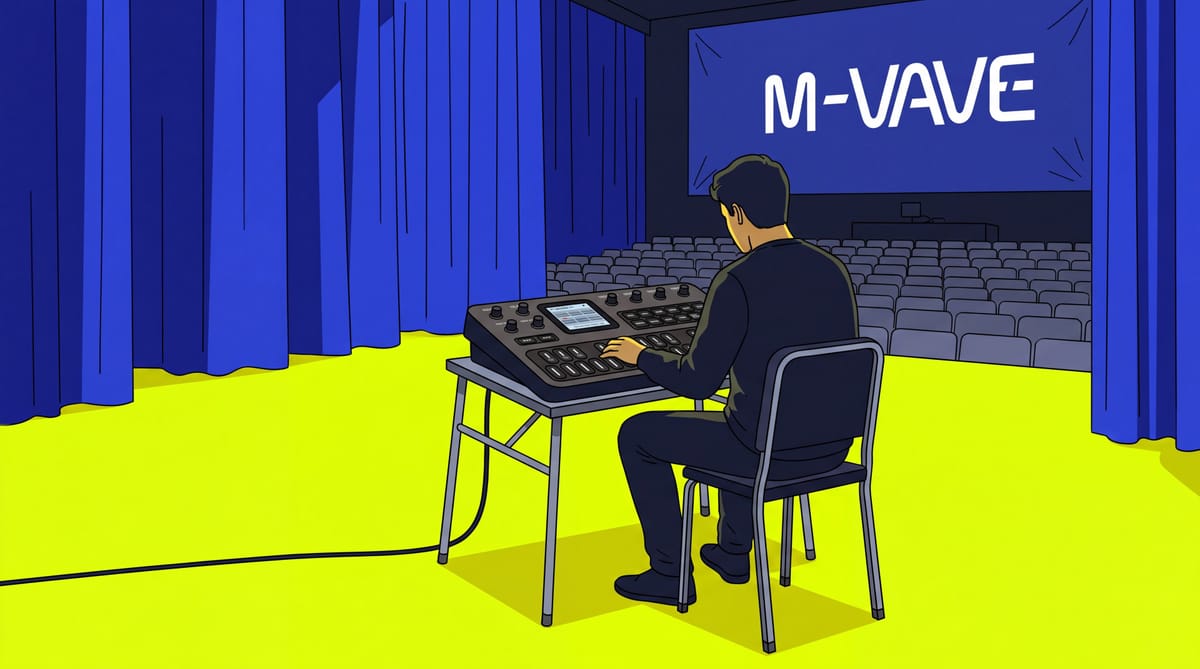
Before Claude gets another standing ovation, I’d like AL-255’s name mentioned. According to Hackaday, AL-255’s reverse engineering of the M-Vave FM-1 laid groundwork for subsequent community firmware, giving other developers somewhere to start.
Reverse engineering means discovering how a device behaves without the manufacturer’s design. Replacement software needs enough knowledge of the hardware and its interfaces to run there. Published findings spare the next developer, or agent, some investigation. Once that route exists, existing synthesis code supplies another foundation. Each contribution reduces the next person’s work. I find that more convincing than a chatbot suddenly discovering synthesis.
Hackaday also reports that AL-255 identified signatures of the older open-source msfa engine inside the FM-1, citing Mutable Instruments’ earlier work as precedent. Claude didn’t invent the oscillator, ragazzi. That finding doesn’t settle whether M-Vave infringed Dexed’s licence: Hackaday discusses different possible code lineages, which matter here.
InfeKt-FM1 shows what agent-assisted development involved. According to its developer, one team of agents measured and documented a reference instrument; another approximated those measurements. Deviations prompted investigation, new measurements and reevaluation. People then adjusted the sound by ear.
“Made with AI” tells me almost nothing. That feedback loop tells me someone checked. It doesn’t make the release finished: InfeKt-FM1 version 1.19.8 is explicitly a beta, still in development and tested on only a few devices. Its developer warns that errors are possible and directs users to the known issues.
The developer, j0kerpack, also supplies a useful limit:
What the InfeKt-FM1 cannot give you is the incomparable hands-on feel and the unmatched sound quality of the original.
InfeKt publishes its source. Using agents doesn’t grant another project that status; a free download doesn’t establish an open-source licence either. Before buying hardware on that promise, I’d check the rights to modify and redistribute.
Hackaday says humans’ and agents’ relative contributions to the reverse engineering and later firmware projects remain unclear. We also don’t know how much of the broader firmware catalog was substantially AI-assisted. A busy release feed answers neither question.
Akai opened a plugin entrance, with boundaries
Akai’s official external-plugin feature gives me something concrete: a documented route for compatible instruments and effects into the MPC. But Akai labels External Plugin Support an Experimental Enhancement, provided for testing and exploration, and warns that these enhancements may affect performance or stability. Previously, OpenPlugin’s custom firmware bypassed that loading restriction.
The MPC SDK workflow starts with an owner describing an instrument or effect in plain language. An AI coding agent can produce a C++ project, including interface and presets. The SDK connects the plugin to its MPC host; a build script cross-compiles it for supported hardware. The owner enables external-plugin support and installs a compatible package from a drive or network. MPC loads it through its plugin layer. Underneath, the operating system stays closed; the host controls which capabilities plugins can reach. I’d test the result before trusting it with a project I cared about.
That changes what I’m buying. An open-source SDK grants developers rights over the kit under its licence, not MPC OS source or permission to rewrite the whole instrument.
I’ll concede the strongest argument from the “manufacturers are opening up” camp: this is meaningful. If an official extension point delivers the sound I want, I don’t need ideological purity to enjoy it. Useful access can coexist with substantially proprietary devices.
But complete device source becoming standard? The evidence still falls short. Reporting on M-VAVE’s opened app layer likewise distinguishes it from a closed sound engine. These are permissions at specific layers. Product descriptions should name them.
Compatibility needs equally boring precision. Akai says standalone plugins must be made for MPC OS; you can’t just copy desktop plugins over. The Shrub article’s author hadn’t tested MPC compatibility and imagined a community port might be possible. That’s an idea, not evidence of a port.
OpenPlugin’s response shows the change: its developers are winding down their manager to concentrate on plugins and migration guidance. Existing firmware remains available for supported older setups. They aren’t claiming every existing plugin release works in the new official format.
Sensible: build useful instruments rather than maintain an entrance the manufacturer finally installed.

A successful boot is a very small rehearsal
I get suspicious when screenshots outwork release notes. OpenPlugin’s older Force firmware combined expanded track capabilities, a plugin manager and remote access. That demands more maintenance than a sound bank.
Its documentation separated confirmed operation from pending validation. One Force image had confirmed flashing, booting, manager and About-screen operation; audio and storage across reboot still awaited validation. The accompanying MPC Gen1 image had software validation but no testing on MPC hardware.
I wouldn’t call either reckless on that evidence. I’d ask different questions before a session.
Replacement software depends on other device behaviour. A manufacturer update can change that while leaving the community application untouched, so the application may need updating first. Saving needs separate testing: an instrument can play perfectly yet lose the work. Hardware revisions can differ under the same product name. Someone must identify affected combinations and document safe update sequences. Otherwise, the owner becomes a compatibility tester halfway through a musical idea.
Melodee’s MPC Sample release notes make this concrete: older Melodee releases won’t start on a specified newer device firmware, so users must update Melodee first. Put that near the download button, where my optimistic idiot self might see it.
The fm1-emu release documentation adds modelling for a newer flash chip and reports that many firmwares with saving functions fail to save under that model. That’s useful emulator evidence for compatibility investigations, not proof every physical unit loses presets. It gives developers something specific to check beyond “does it make sound?”
Akai also warns that inMusic neither tests nor supports third-party plugins; faulty or incompatible ones may cause crashes, freezes, excess CPU use or audio problems.
Those warnings don’t establish a community-versus-factory reliability ranking. The supplied evidence lacks comparative rates of crashes, data loss or hardware damage. Claims that community firmware is inherently safer, or inherently a disaster, need measurements we don’t have.
I’d bet on the people who make returning easy
A growing catalog interests me less than returning next month without reconstructing my installation. Unromantic, until that beloved preset vanishes.
The fm1-emu release snapshot lists about 200 FM-1 firmwares after a catalog refresh, including 45 new entries alongside updated packages. Each listing was played in JIT and interpreted modes. That describes an emulator catalog and its checks, not owner numbers or verified open-source licences.
Jimmy Myhrman captures the change in tempo:
We have seen some manual, handcrafted mod projects in the past, but now it's just at a different energy level.
I want to know what survives that burst.
Catalogs can inspect uploads before exposing owners to them. OpenMPC says it automatically validates registered releases, hides failing versions and opens an issue instead. Its processor and official-folder-format indicators come from release assets. Its Verified tier requires a recorded device test for the newest stable release. These answer different questions: a package can contain the expected build without demonstrated hardware operation. A recorded test adds evidence for a particular device and release. Neither is exhaustive testing or manufacturer certification. Both tell me more than a download counter.
After installation, fm1-dock documents selectable synth and effects add-ons, plus preset backup, export and restore. Owners can change engines while preserving musical work. I’d still check supported combinations rather than assume every module works forever.
Erica Synths founder Ģirts Ozoliņš put the uncomfortable question plainly in The Verge:
So, I’m still wondering what fundamental problem vibe coding solves.
My answer: the oddly specific instrument request that will never earn a manufacturer’s development budget. But I accept his challenge: generating alternatives means little unless somebody finishes something worth learning. Almost-working sequencers can become another excuse not to make a track. I don’t need AI’s help with that skill.
We still don’t know whether community firmware measurably changes hardware sales or extends product life. Environmental benefits remain unmeasured too. I’d love to keep a beloved box useful longer; that preference isn’t an impact claim.
By the end of 2027, I expect maintained hosts and well-packaged plugin collections to earn more sustained musical use than sprawling firmware catalogs. Active-use evidence could prove me wrong.
For my own weekend, I’ll choose the maintainer who explains how to recover my presets. That person has imagined me coming back to make another song.
Frequently asked questions
Has vibe coding made open-source synth firmware the new normal?
Available evidence does not establish open-source firmware as the norm for synths. There is no market-wide count of products running it or owners using it. AI-assisted development can reduce the work needed to build instruments, but release activity alone establishes neither adoption nor open-source licensing.
Does Akai’s external-plugin support make MPC OS open source?
Akai’s external-plugin support provides a supported route for compatible instruments and effects into MPC, but the operating system remains closed. An open-source SDK grants rights over that development kit under its licence, not the entire instrument. Standalone plugins must be made for MPC OS rather than copied from desktop systems.
What should synth owners check before installing community firmware or plugins?
Synth owners should check supported hardware and firmware combinations, required update sequences, saving behaviour and preset recovery before installing community software. Successful booting does not establish reliable audio or storage operation. Emulator checks and recorded device tests provide different evidence, and neither amounts to exhaustive testing or manufacturer certification.
Sources
- Has vibe coding made open source the new normal for synths?
- MPC 3.10.1 Release Notes
- Vitaleon v0.3.24
- Melodee 0.8.2
- SurgeXXL sdk-v0.3.1 (MPC plugin SDK)
- Akai has heard us. Plugins are opening up.