
Where Kimi runs could shape Moonshot AI’s legal and profit risks
Kimi is becoming a commercial product overseas, but Moonshot still lacks the filing and financials investors…

The short version
- No verified Moonshot AI IPO filing, venue, timetable, offering size, valuation, underwriters, or public financials currently exist.
- Kimi K3.1 Pro supports memberships and usage-based API revenue, while Singapore hiring signals international commercial intent.
- Investors need completed-task economics, ownership and infrastructure details, and disclosed financials before valuing any eventual listing.
Moonshot AI has an IPO rumor, a Singapore sales role and no verified public filing I can point you to. If someone is already offering you a ticker, put down the espresso and back away slowly.
I found no confirmed listing venue or timetable. There is no disclosed offering size, valuation, underwriting bank or use of proceeds. Moonshot’s revenue, gross margin and cash burn remain private too. The available evidence supports a much narrower claim: Moonshot is turning Kimi into a commercial product and building an overseas sales presence.
That matters. Kimi K3.1 Pro is available through Moonshot’s web product, Work, Code and API, giving the company both membership and usage-based ways to charge customers. Moonshot has also advertised for a Singapore sales hire tasked with building revenue, partnerships and market presence. Those are normal steps for a company chasing international business. They do not magically become a Moonshot AI IPO because somebody added a rocket emoji to a post.
The interesting question is what Moonshot could eventually sell to public investors. Kimi is getting more capable, while the legal treatment of Chinese model weights overseas remains unsettled. An API business can reach customers without handing them the model itself. An open-weight release creates a different relationship because customers can run and adapt the model on their own infrastructure. Moonshot wants both routes. Borders may force it to choose more carefully than the launch deck suggests.
Arthur Mensch described how AI should operate:
be a tool for empowerment, not dominance.
K3.1 Pro has improved, although the benchmark confetti needs supervision
Moonshot says it built K3.1 Pro from K3 using more post-training compute and joint reinforcement learning across downstream domains. That post-training stage rewards behavior that performs well on the selected tasks, then updates the model so those patterns become more likely across future attempts. Training several domains together can help the model carry planning habits from one workflow into another, which matters for agents that must reason, use tools and recover from mistakes. Moonshot reports consistent gains across domains after this process. The company does not disclose the reward mix or enough experimental detail to isolate exactly which ingredient caused each gain. Anyone claiming to know the secret sauce from the model card is doing molecular gastronomy with fog. What we can judge is the resulting behavior under the published tests.
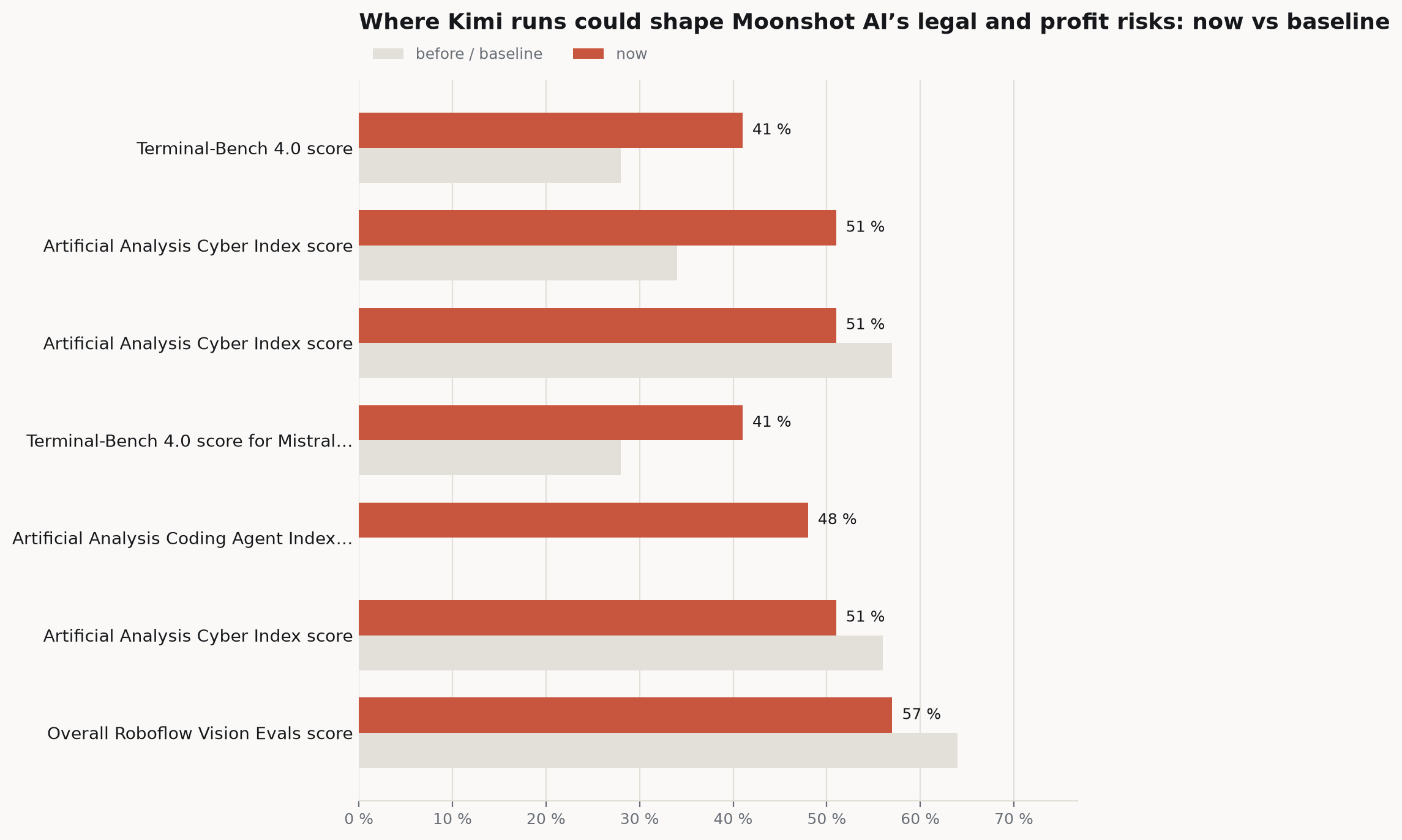
On Terminal-Bench, which uses realistic terminal tasks with strict task-specific tests, K3.1 Pro scored about 66%. GPT-6 Astra scored 58% under the cited comparison, while Claude Opus landed at roughly the same level as Kimi. Moonshot ran its model at maximum reasoning effort with specified sampling settings, so the score describes that setup rather than every deployment. A different agent harness, tool configuration or timeout can move the result. Benchmarks are useful receipts, but I still check what restaurant printed them.
The factual-accuracy result deserves attention too. On Moonshot’s difficult internal hallucination test with tools, K3.1 Pro had an 8% claim-level error rate, down from 23% for K3. Moonshot explicitly warns that this stress test does not describe everyday error rates. Fair enough. A large improvement on a deliberately hostile test still tells me the post-training work changed something meaningful, even if it cannot predict how often a customer-support bot invents a refund policy at 2 a.m.
Plotly supplies the necessary cold shower: Moonshot’s headline results are “Moonshot’s numbers on Moonshot’s harness.” Plotly ran its own data-analysis evaluation instead of treating the launch chart as scripture. I agree with the criticism. Practical performance depends on the surrounding agent, tools and task design, so a model can look heroic in one harness and spend the next workflow wandering through directories like my father looking for WhatsApp settings.
K3.1 Pro’s million-token context window adds range, though it proves nothing about demand. It lets a request include a huge amount of text and image material, which can help an agent keep documentation or a codebase in view. Longer context also creates more material to process. “It fits” and “it pays” belong in separate spreadsheet columns.
Singapore is a route to customers, not proof of an IPO
Moonshot’s commercial sequence is easy to follow. First, the company improved K3 through heavier post-training and released K3.1 Pro across its web product, Work, Code and API. Those products give individuals and developers ways to use the model without running the weights themselves. Moonshot then advertised for a Singapore sales leader who could turn early wins into scalable revenue and partnerships. Reporting also says the company has a Singapore entity. Together, these moves create an overseas route to market: products exist, customers can pay and a local commercial hire can chase accounts. They still tell us almost nothing about how much money is arriving.
A sales office can sign customers while the model remains hosted elsewhere. It can also support regional partnerships without owning Kimi’s intellectual property or operating the infrastructure behind each request. This distinction gets lost because corporate maps look wonderfully official once Singapore appears on them. I have incorporated companies before. Paperwork can make two people and a laptop look like the East India Company.
The location of the weights matters more than the address on an invoice. Open weights let a customer download the learned parameters and run the model on infrastructure they control, subject to the licence. Hosted access keeps the model with Moonshot while the customer sends requests and receives outputs. The first route gives customers more operational independence. The second gives Moonshot more control over access and a cleaner way to meter usage.
Marjorie Janiewicz explained her preference:
I don’t want to get disconnected. I want to own my model.
Nobody outside the relevant companies and regulators can currently answer whether Chinese export-control proposals or U.S. outbound-investment rules would restrict an overseas listing, foreign investment or deployment of Moonshot’s model weights. We also do not know whether the Singapore presence will affect revenue or any future IPO structure. Pretending otherwise would turn regulatory fan fiction into investment research.

The Singapore job still matters because it shows commercial intent. Moonshot wants somebody there to build market presence and partnerships, which is a stronger signal than vague language about “global ambition.” Yet one sales role cannot establish regional revenue, customer concentration or where inference happens. Until Moonshot publishes those details, Singapore is a bridge with an unknown amount of traffic.
Kimi’s API economics depend on completed work
Moonshot has created several routes to revenue. Customers can use Kimi through membership products, while developers can pay for API usage. Standard K3.1 Pro input costs $2 per million tokens, down from $3 for K3 under the listed pricing. That is a meaningful cut at the input layer. It does not reveal the cost of completing a useful job because an agent may make repeated requests, call tools and retry after failures. Every extra loop consumes more tokens. A cheaper input rate helps only when the model reaches the finish line without eating the discount on the way.
That is why the Terminal-Bench result is commercially relevant. Agentic AI coding tools must operate inside development environments, inspect files and execute commands until tests pass. A model that succeeds more often can save the customer time even if each successful run uses substantial compute. A model that fails cheaply is still selling failure, which has never been my favorite subscription tier. Moonshot has not disclosed enough usage or cost data to calculate the gross margin behind Kimi Code.
Speed claims need similar caution. Moonshot says K3.1 Pro Highspeed runs two to three times faster than the standard product, but it provides no standardized latency workload or hardware configuration for that comparison. Ultralytics measured a median request time of 22 seconds during its auto-annotation testing, versus 24 seconds for K3 under the same conditions. That independent result shows a modest improvement in that workload. It does not verify the broader Highspeed claim.
People searching for the best AI for image generation should also keep their categories straight. The evidence supplied for K3.1 Pro covers image input, coding agents and auto-annotation. It does not establish leadership in image generation. I would evaluate a dedicated generator on visual quality and editing control before handing Kimi that crown. Every AI product now wants to be a Swiss Army knife; several are mostly corkscrews wearing tactical trousers.
Moonshot’s business case will depend on completed-task economics. Management would need to show how often Kimi finishes useful work, how much inference each job consumes and whether paid customers stay. None of those operating figures are public. The API price tells me what Moonshot charges for one ingredient. Investors eventually need the cost of the meal.
Public-market questions require public-market numbers
The Moonshot AI IPO evidence currently ends at “maybe someday.” There is no verified confidential or public filing in the supplied record. The exchange, offering size and valuation are unknown, as are the banks that would underwrite it. Moonshot has not disclosed revenue growth, profitability or customer concentration. Without those figures, valuing the company means guessing how much of Kimi’s technical progress turns into durable paid usage.
This is where public-stock search habits become dangerous. The phrase Nvidia price to earnings ratio produces a usable metric because Nvidia has a market price and reported earnings. Asking is Nvidia expected to beat earnings also has a structure behind it: a scheduled report and analyst expectations that can be compared with the eventual result. Moonshot has no public share price or disclosed earnings base. A price-to-earnings ratio cannot exist when both halves of the fraction are missing.
Even a future filing would need to explain the operating map. Investors should look for the entity that owns the Kimi weights, the location of inference infrastructure and the company signing overseas customers. They should also demand clarity on how memberships compare with API revenue. If Singapore is mainly a sales layer while the technical stack stays elsewhere, that arrangement may work perfectly well. It simply creates different legal and margin risks from an offshore model operator with local infrastructure.
I understand why people want to front-run this one. K3.1 Pro is materially better than K3 on the disclosed tests, and Moonshot is building actual products around it. The company also has a plausible international sales route. Those facts make an eventual listing believable. They cannot tell me what the shares are worth.
My bet for 2027 is that Moonshot will push overseas API access harder than overseas weight deployment, with Singapore focused on selling hosted Kimi products. If an IPO filing appears, I expect its most important page to be a map of where the model lives. If that map is missing, the border is doing more work than the bankers want us to see.
Frequently asked questions
Has Moonshot AI filed for an IPO?
No verified public or confidential Moonshot AI IPO filing appears in the available record. The listing venue, timetable, offering size, valuation, underwriting banks and use of proceeds remain unknown. Moonshot also has not disclosed the revenue, profitability, cash burn or customer concentration needed to value a potential public offering.
Does Moonshot’s Singapore presence mean an IPO is coming?
Moonshot’s Singapore presence indicates an overseas route to customers, not proof of an IPO. A local sales hire can build revenue, partnerships and market presence while the model weights, intellectual property and inference infrastructure remain elsewhere. The company has not disclosed how Singapore affects revenue or any future listing structure.
How does Moonshot make money from Kimi?
Moonshot can charge for Kimi through membership products and usage-based API access. Standard K3.1 Pro input is listed at $2 per million tokens, but that price does not reveal completed-task economics. Retries, tool calls and repeated requests add consumption, while usage, retention, inference costs and gross margins remain undisclosed.
Sources
- BofA No Longer in Talks to Arrange IPO of China’s Moonshot AI
- Moonshot Debuts First AI Upgrade Since Its Own DeepSeek Moment
- Moonshot curbs hacking ability in new Kimi model as fears grow over AI-powered cyberattacks
- China’s Moonshot AI to operate in Singapore, jobs post shows
- Introducing Kimi K3.1 Pro
- Kimi K3.1 Pro Pricing Explained: Membership Plans and API Costs