
AI can be a good deal for customers and a poor one for investors
Cheaper AI can be a great deal for customers while leaving builders with bills, leases and uncertain returns.

The short version
- AI chip sales establish supplier revenue, but do not establish whether infrastructure buyers will earn adequate returns.
- Customer prepayments can fund AI capacity before service delivery, reducing financing needs while leaving providers with work owed.
- AI customers can benefit from lower prices while investors must assess sustained revenue, project costs and long-term payment obligations.
A cheaper AI subscription is a win for me, even if it ruins somebody’s infrastructure spreadsheet. As a customer, I’m not obliged to protect my supplier’s margins.
Big tech’s AI spending leaves me with an awkward split: the value I get from a service can be much larger than the profit its provider gets to keep. When I’m buying, lovely. When I’m investing, who’s paying for the gap?
I follow the money past the chip sale
NVIDIA reported about $108 billion in quarterly Data Center revenue, up 110% from a year earlier. Its fiscal quarter ended in October. That is an extraordinary amount of equipment sold, and I understand why investors treat it as evidence of AI demand.
But the equipment has to earn its keep after delivery.
A cloud operator buys equipment because it expects customers to pay for access. A model developer buys that access because it expects its own customers to pay for useful work. Each business can record genuine revenue while the next buyer in the chain is still figuring out its economics. Investment funding can keep those buyers spending during that discovery period. Eventually, operating receipts have to carry more of the load if the businesses are going to support themselves. A chip sale tells me the supplier found a buyer. It leaves open whether the buyer will earn an adequate return.
Kanishka Narayan described Britain’s challenge in capturing the economic benefits of its scientific ideas:
For too long, Britain has produced some of the world’s best scientific ideas, only to see too much of the technology, industry and wealth they create built elsewhere.
That distinction gets harder to track when suppliers also invest in businesses that buy their products. The Federal Reserve speech and European Central Bank review identify circular financing as a concern. Neither quantifies independently funded end-user demand in the available extracts, so I can’t put a defensible percentage on how much of this ecosystem already supports itself.
That missing number isn’t permission for either a fraud allegation or a victory lap.
IDC estimated global AI infrastructure spending at $121 billion in the second quarter of this year, up 53% year over year. Its tracker extends beyond Big Tech. Calling the entire amount “Amazon and friends’ AI bill” would give the number a meaning it doesn’t have.
My question for a model company is painfully ordinary: how much are customers paying you from budgets they can sustain? A funded startup buying compute is a legitimate customer. A customer whose own product generates enough cash to keep renewing gives me different evidence about the durability of that revenue.
Both businesses can succeed. I’d just rather not count the same wave of investor enthusiasm as proof at every stop along the way.
I love a discount more than a supplier’s margins
When I’m choosing AI tools for productivity, I care whether they finish work I would otherwise have to do. My affection for the company’s capital expenditure plan is limited.
If several providers can do the same job well, I can ask for a lower price or switch. The savings reach my business immediately. The provider still has to cover the cost of delivering the service, then pay its other expenses. A scarce input can absorb more of the customer’s payment before it reaches the provider’s bottom line. More usage helps only when the additional business contributes enough to cover those commitments. I can therefore love a product, use more of it, and remain a thoroughly disappointing source of profit. My Italian family would call that getting a good deal and ask why I was making it complicated.
Nebius offers evidence against the gloomiest version of this argument. Its shareholder letter says higher contracted prices shortened expected payback on comparable agreements. That’s an improvement in deal economics, and I take it seriously.
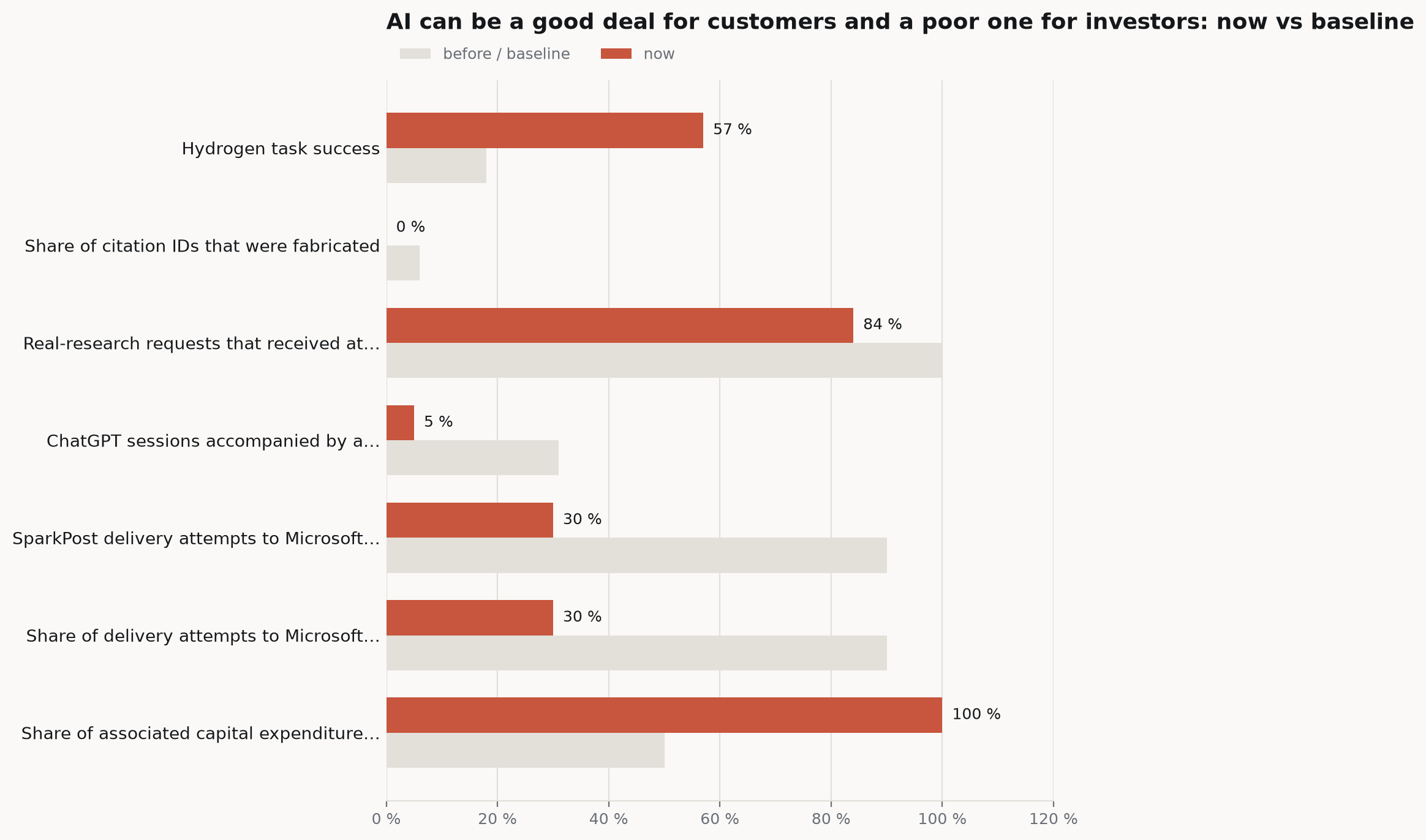
The company also says customer prepayments covered more than the associated capital expenditure on its third-quarter agreements lasting at least a year, compared with roughly half in the previous quarter. That expenditure includes GPUs, construction and leasehold improvements. Customers were helping fund capacity before the provider had finished earning the corresponding service revenue.
That arrangement reduces the capital a provider has to find elsewhere. It also leaves services to deliver. Cash in the account is not automatically profit available to spend.
Fermi announced a $200 million customer prepayment agreement to advance power development at Project Matador before a final long-term lease had been signed. The proposed development covers 600 MW beginning in 2027. Fermi says the undisclosed investment-grade hyperscaler wanted power development and site preparation to move on its schedule.
That is a serious commitment from a prospective customer. The missing final lease still matters.
Kat Jones highlighted the power requirements of AI datacentres:
Hyperscale AI datacentres simply cannot run on renewable power alone, they absolutely need a highly reliable source of grid power.
The optimistic investment case deserves a fair hearing, too. Morgan Stanley estimates that AI investment offers an attractive return on invested capital. Nebius’s improved contracted pricing gives that optimism something concrete to stand on: some customers are committing on terms the supplier says improve payback.
Lazard Asset Management argues that component and service shortages have raised costs and weakened customers’ prospective profitability. It doesn’t directly disprove Morgan Stanley’s estimate. To choose between those views for a particular investment, I’d need realized customer revenue alongside project-level costs. Better deals are evidence. They aren’t a guarantee that every new facility gets one.

I read Amazon’s lease as closely as the sale
Blackstone’s proposed Amazon transaction makes the financing unusually visible. Here, I can follow who contributes the buildings and who promises to keep paying for them.
Amazon affiliates would contribute data-center campuses to joint ventures. In exchange, they would receive minority stakes and a cash distribution. Blackstone’s trust expects to contribute IPO proceeds for controlling stakes. Property-secured, non-recourse mortgages would supply the remaining funding. Amazon would lease the campuses back under long-term triple-net leases, taking responsibility for specified property expenses alongside rent. Its parent company would guarantee payment. Blackstone would manage the ventures, subject to Amazon affiliates’ approval rights over major decisions. The transaction still has closing conditions and may not happen as planned.
The filing anticipates about $1.9 billion from Blackstone’s trust alongside about $2.5 billion in new mortgage loans. IPO investors supply equity for ownership; mortgage lenders supply debt secured against property. Different money, different claims.
Under the proposal, that funding helps provide cash to Amazon affiliates today. Amazon’s guaranteed lease creates a payment obligation over time. The company retains access to the campuses, while ownership and financing exposure are shared across the ventures’ participants.
The appeal makes sense to me on both sides. Amazon releases capital tied up in property while retaining its use. Blackstone’s trust acquires controlling stakes in ventures with a large tenant committed to paying rent. Lenders have property security. Each participant gets something specific and has to decide whether the terms compensate for what it is taking on.
“Non-recourse” deserves care here. It describes the property-secured borrowing arrangement. It doesn’t mean every participant has escaped every obligation, especially when the same transaction includes an Amazon parent guarantee of tenant payments.
This is why I won’t treat debt, equity and prepayments as interchangeable money. Investment means giving up ownership. Borrowing means owing repayment. A customer prepayment means owing work. A sale-leaseback releases cash from property while committing the seller to future rent.
Those differences matter when receipts arrive later than expected. Cash already distributed has done its job for the recipient. The lease still has to be paid according to its terms.
Whether this particular deal closes with its proposed funding and ownership arrangements unchanged remains unknown. The filing leaves that open. So do I.
I want to know who can wait for the payoff
Stockrow’s compilation of company filings and earnings information puts Alphabet, Amazon, Meta and Microsoft’s combined free cash flow at negative $25 billion in the latest reported quarter. A year earlier, the combined figure was positive $63 billion.
That gets my attention on the timing of cash receipts and spending. It cannot tell me whether every AI project those companies are building will produce a good return.
CoreWeave reported a quarterly net loss of about $700 million, compared with about $100 million a year earlier. That is its GAAP result for the quarter ended in September. A growing loss deserves scrutiny, but a company-wide accounting result isn’t a verdict on every facility it operates.
The wider commitments are harder to evaluate. Governor Michael Barr cited a Federal Reserve estimate of more than $3 trillion in potential maximum nominal off-balance-sheet obligations at large AI firms. The estimate includes contracts, leases and residual-value guarantees. It is neither debt currently outstanding nor a forecast of losses. The supplied material doesn’t establish how much would become an actual loss in a downturn.
Those obligations matter to me because payments can persist after expectations change. If investors lower their estimates of future AI earnings, firms may cut planned investment. Lower asset values can also reduce spending through wealth effects. A company with debt has payments to meet while it adjusts. Long-term contractual commitments can limit how quickly it can reduce cash outflows. Barr warns that financing structures could amplify a repricing through these channels. These are potential effects, not an outcome that has already happened.
Barr puts the risk this way:
In the case of a significant repricing of AI investments, stress from these three aspects of AI financing could amplify the repricing of AI investments.
I can’t make the easy bearish punchline survive contact with the contracts. Prepayments and guaranteed leases can give builders substantial contractual support. Nebius has customers funding associated capital expenditure. The proposed Blackstone ventures would have Amazon’s parent guarantee behind tenant payments. Calling those arrangements empty hype would mean ignoring the contracts because I preferred the joke.
Whether AI revenue and productivity gains ultimately justify the scale and timing of the buildout is still unknown. Neither NVIDIA’s sales nor the size of a future commitment answers that by itself.
For my own micro SaaS decisions, I can test whether a feature earns its keep before committing much money. These builders have considerably more concrete involved.
Here’s my bet: by the end of 2027, at least one major AI cloud provider will explicitly discuss customer price concessions in its earnings commentary. I’ll check the transcripts.
And if its service gets cheaper without getting worse, I’ll renew. Its investors and I don’t need the same ending.
Frequently asked questions
Does Big Tech’s AI spending prove that AI infrastructure is profitable?
AI infrastructure spending demonstrates demand for equipment and capacity, not an adequate return for every buyer. Chip suppliers, cloud operators and model developers have different economics. Assessing investment returns requires customer revenue alongside project-level costs, rather than treating supplier sales or future commitments as proof of profitability.
How do customer prepayments help fund AI data centers?
Customer prepayments provide cash before a provider finishes delivering the associated services, reducing capital it must obtain elsewhere. Nebius says prepayments exceeded associated capital expenditure on its third-quarter agreements lasting at least a year. That improves funding, but the provider still owes services, and cash received is not automatically profit.
How would Amazon’s proposed data-center deal with Blackstone work?
Amazon affiliates would contribute data-center campuses to joint ventures in exchange for minority stakes and cash. Blackstone’s trust would supply equity for controlling stakes, with property-secured mortgages providing additional funding. Amazon would lease the properties back, with parent-guaranteed payments. The proposed transaction remains subject to closing conditions.
Sources
- Blackstone Digital Infrastructure Trust Form 8-K
- Investing in Wyoming’s infrastructure, energy and workforce
- NVIDIA Announces Financial Results for Third Quarter Fiscal 2027
- Gartner Forecasts AI Infrastructure Spending to Represent 59% of Total Global AI Spending in 2027
- Financial Stability Report
- Financial Stability Review, November 2026