
Agentic AI coding tools: which 5 are worth buying?
Five coding agents ranked by workflow fit, cost control, security and specialist leverage, plus the safeguards every serious pilot needs.

The short version
- GitHub Copilot ranks first among five coding agents because it integrates code, issues, approvals and Slack context.
- Disposable sandboxes, constrained networks, separate secret controls and human merge reviews limit each agent’s production blast radius.
- Teams should judge pilots by accepted pull-request cost, review time, retries and unnecessary code changes, not benchmark scores.
Buying a coding agent by benchmark score gets you a genius intern holding production credentials and your credit card. In 2026, I’d buy GitHub Copilot first, then Warp Factories, Google Antigravity, Microsoft’s AL agent tools and SAP’s ABAP MCP stack.
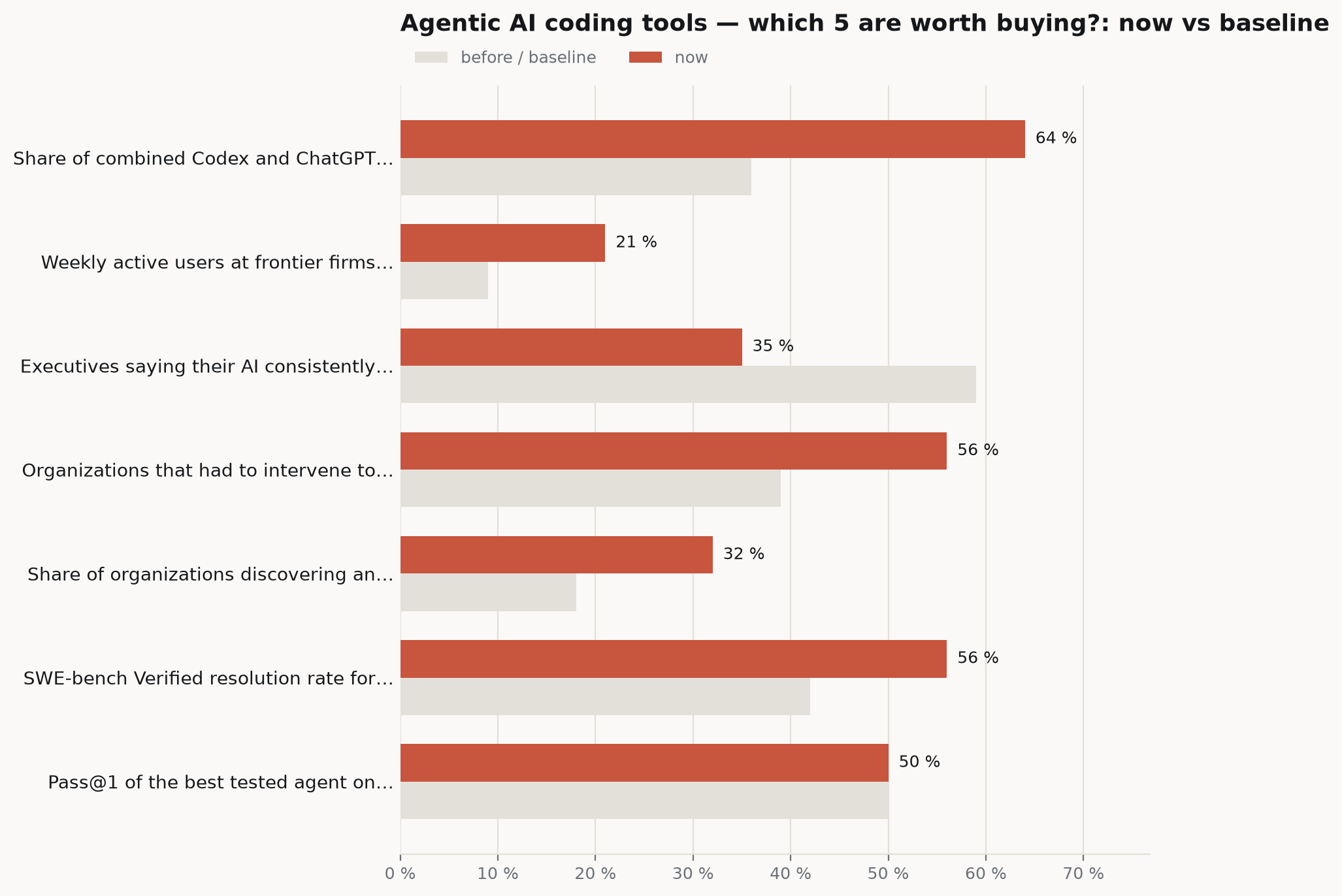
The usage data is loud. Among OpenAI enterprise customers in June 2026, Codex generated 64% of the combined output tokens from Codex and ChatGPT, versus ChatGPT’s 36%. OpenAI counts Codex usage as agentic AI use but warns that tokens imperfectly represent business value. Fair: a long, expensive debugging spiral produces plenty of tokens. So does my uncle after his second grappa.
I rank these tools by workflow fit, blast-radius control, cost and specialist leverage. The model determines raw capability; the harness controls what it sees, what tools it can touch and what happens when the first attempt goes sideways.
Scott Spencer, General Manager of Finance & Credit at Dun & Bradstreet, describes the next competitive advantage:
Banks have spent decades building digital infrastructure. The next competitive advantage is building an intelligence infrastructure for AI.
GitHub Copilot fits where work already happens
GitHub Copilot
GitHub Copilot wins because its agent works where most teams already store code, discuss issues and approve changes. Its Slack integration receives a conversation and whatever GitHub context the user may share. Copilot can investigate, create or update an issue and produce a pull request attributed to the Copilot app identity. Existing GitHub permissions apply, and administrators can require extra approval before merge.
The mechanism beats the demo. A bug begins in Slack with symptoms, screenshots and a message from somebody whose evening is ruined. Copilot receives the thread and permitted repository context, plans and finds the relevant code. Development tools let it search symbols, compile, retrieve structured diagnostics and debug failures. Errors reveal where the patch broke and may suggest the next action, letting it revise and validate again before publishing. The patch becomes a pull request tied to the original conversation. A human inspects the diff and can require another approval before merge. Intent, code and intervention remain in one shared record, not somebody’s private chat history.
The harness carries more of this workflow than demos admit. The Same Model, Different Harness study held the model and task constant but changed context management and stalled-work handling; coding performance changed with the harness. Be suspicious of demos built around one immaculate prompt and a repository groomed like a poodle before a dog show.
I’d still put Copilot under a procurement microscope. Before rollout, I’d check chat retention, enabled models, repository scope and cloud-agent budgets, then confirm who pays when bots review bot-authored pull requests. Convenience acquires hotel-minibar economics fast.
Warp and Google sell the operating layer
Warp Factories
Warp Factories is my second choice for smaller teams wanting repeatable agent workflows without building orchestration themselves. TechCrunch reports that Factories structures work around triage, specification, implementation, review and verification. Teams can use Codex or Claude Code, connect systems including Linear and Jira, compare configurations and track token spend.
That pipeline changes failure handling. Triage checks whether a ticket is actionable and gathers missing context. Specification turns the request into acceptance criteria before an agent freelances across the repository. Implementation runs in the chosen harness; review inspects the patch; verification runs relevant checks. Each attempt records its cost and outcome. Failed runs become evaluation data, not a Slack thread with seventeen skull emojis. Teams can then compare models using accepted work from their own repositories. I’ll take that over emotional attachment to whichever model won Tuesday’s leaderboard.
Warp’s CEO told TechCrunch that the company automates roughly 30% to 35% of weekly tasks, leaving about two-thirds to other workflows. I like the direction, but this is vendor-reported internal usage, not a customer-wide result. I’d choose Warp when orchestration is missing and model flexibility matters.
Google Antigravity
Google Antigravity ranks third because Google Cloud treats agents as variable compute workloads. More vendors should. One developer runs a long debugging session with repeated tests; another asks three questions and gets espresso. A flat seat price hides the difference until finance receives the bill and communicates only through calendar invitations. Gemini Enterprise can pool daily quotas across a project, estimate runtime costs and enforce hard monthly caps. Google also says eligible deferred agent workloads will receive discounts of up to half the standard inference cost by running during off-peak capacity windows. That option is still coming soon, so I’d exclude those savings from every spreadsheet until launch. I’d buy Antigravity for companies already deep in Google Cloud, especially when background work can await cheaper capacity. Everyone else inherits another control plane as a very expensive budget alert.

The model gets the billboard. The harness gets the pager.
Specialist agents need specialist tools
Microsoft’s AL agent tools
Microsoft’s AL tooling ranks fourth because it gives coding agents concrete Business Central development operations. Compatible agents can search symbols, build extensions, compile projects, retrieve diagnostics and publish through supported interfaces. Interactive debugging remains specific to VS Code; compilation and authentication are available through the AL MCP server. I can see exactly what the agent executes.
The loop works because every operation returns structured output. The agent finds relevant AL symbols, edits the extension and invokes the compiler against the real project instead of guessing from documentation and good vibes. If compilation fails, machine-readable diagnostics identify the file and error. The agent edits, recompiles and follows the suggested next action. Once the project builds, it can package and publish through the supported tool. A chatbot can sound extremely confident about AL; the compiler has fewer social graces.
Compilation cannot tell you whether an invoice behaves correctly. Accounting eventually will, usually during the worst possible week. Microsoft takes fourth because its executable depth is excellent for Business Central teams and irrelevant to almost everyone else.
SAP’s ABAP MCP stack
SAP has this list’s nastiest problem and possibly its biggest upside. Its ABAP MCP server lets compatible agents interact with ABAP code through a structured capability interface, including an ecosystem involving GitHub Copilot and Amazon Q. Support varies by environment and object type, so I’d pilot against the company’s exact SAP estate before trusting a slide deck.
Old ABAP systems hold decades of business rules, scarce expertise and code nobody touches before lunch. SAP’s announced migration strategy uses multiple agent families from planning through execution. The model inspects the environment’s available capabilities, calls ABAP tools and validates its work against the platform. That last step carries the proposition: plausible migration code can quietly lose business logic while looking respectable in a pull request. SWE-bench Science warns that, on repository-level scientific software tasks, the best tested agent remained below a 50% first-attempt pass rate, with the halfway mark as the comparison. Specialist guidance sometimes helped and sometimes anchored the agent wrongly. Even a brilliant Italian chef must know which knob controls the ancient oven.
Production trust starts inside a disposable box
Shibani Ahuja, SVP, Data & AI Strategy at Salesforce, explains what deliberate adoption requires:
Every boardroom is asking whether it’s moving fast enough. Two years into the agentic shift, the answer from the data is that the advantage was never in starting first; it’s in starting deliberately. The organizations getting real returns got specific about a shortlist of things before conditions were perfect: the data they made trustworthy for the job, the point where a person stays in the loop, and the guardrails they built before they needed them.
No coding agent gets production access by default. I let it work inside disposable isolation, keeping secrets and external network access behind separate boundaries. Repository writes need their own controls. Merges require review.
Docker describes the awkward reality beautifully:
They install tools, run arbitrary shell commands, execute project code, start databases, and occasionally discover surprising new meanings for the word “cleanup.”
Docker’s GitHub Actions architecture contains that energy. A Markdown task specification compiles into an Actions workflow that starts the agent inside a disposable Sandbox microVM. There, the agent gets shell access and a private Docker daemon, letting it install tools and run project code locally. Network destinations remain constrained outside the microVM. Secrets and writable repository paths have separate controls. A managed step exports the patch and can create a draft pull request, where an administrator may require approval before merge. Afterward, the microVM disappears instead of giving the host machine a mysterious new definition of cleanup.
Enterprise governance teams offer the strongest counterargument: reusable permissions and standing controls should make autonomous execution reliable. I get it. Nobody wants to approve every shell command until retirement. Yet an HFS Research and TCS survey of 101 US and Canadian leaders found that 59% trusted AI in critical workflows, while only 35% said it consistently delivered intended outcomes under enterprise control, a 24-percentage-point gap between belief and proof. Permissions can perfectly govern an action while bad data or a broken integration drives the wrong outcome.
Approval prompts alone are weak protection. Docker’s analysis of a Cursor vulnerability found that shell built-ins could alter environment variables without approval, changing what a later approved command executed. The command looked benign; its environment was already poisoned.
Agents also lack restraint. FixedBench tested stale issues whose reported bugs were already fixed, yet agents proposed undesirable code changes on 35% to 65% of tasks instead of correctly leaving the code alone. Asking them to reproduce the issue first helped only partially. Apparently “do nothing” remains an advanced computer science problem.
Normal human tickets worsen things. RealSWE preserved the coding tasks but rewrote requests as everyday user reports, and average resolution fell by about 6 percentage points versus the original structured benchmark inputs. Desired behavior, motivation and missing context all affected results.
Nobody knows whether gains from reinforcement learning, memory or harness changes will transfer reliably into your repositories and permissions. We also lack dependable real-world error rates for agent-authored pull-request reviews and do not know whether today’s sandboxing can withstand adaptive attacks during long production sessions.
My pilot would use representative tickets, including stale bugs and ambiguous requests. I’d measure accepted pull-request cost, review time, retries and unnecessary changes. Retries need a hard ceiling: the SkillBloat evaluation found that malicious skill injection could raise token consumption to roughly five to ten times normal task execution.
Then I’d ask every vendor one question: What did one accepted, production-worthy pull request cost on a repository like mine?
By 2027, most model names in this ranking will have shuffled. I’d bet the winners control repository context, capability interfaces, sandbox design and evidence from code humans accepted. The rest will sell prettier menus while somebody else owns the kitchen.
Frequently asked questions
What are the best agentic AI coding tools in 2026?
The five ranked options are GitHub Copilot, Warp Factories, Google Antigravity, Microsoft’s AL agent tools and SAP’s ABAP MCP stack. Copilot ranks first for broad team use, while Warp and Antigravity suit orchestration or cloud cost control, and Microsoft and SAP provide deeper specialist workflows.
How can companies use coding agents safely in production?
Coding agents should run inside disposable isolation with constrained network access, separate controls for secrets and writable repository paths, and mandatory human review before merge. Representative pilots should include stale bugs and ambiguous requests, while retries need hard ceilings to prevent runaway token consumption.
How should companies measure the cost of AI coding agents?
Teams should measure the cost of one accepted, production-worthy pull request rather than seat price or token volume alone. The evaluation should include review time, retries, unnecessary changes and whether the agent completed representative repository work under the company’s actual permissions and controls.
Sources
- FinOps for the AI era: New flexible billing and cost controls for agents
- The new GitHub Copilot experience in Slack
- Use AI agent tools for AL development
- With Agentic AI, ABAP Takes Evolution to Next Level
- Agentrys Raises $24.5 Million to Build Agentic Design Automation for Chipmakers
- Warp’s new system is an out-of-the-box software factory for AI development