
Downloading Mistral Large 4 prevents remote withdrawal, and remote rescue
European control depends on portable checkpoints, workable licenses, trusted infrastructure and contracts…

The short version
- European AI models deliver sovereignty only when checkpoints, licenses, infrastructure and contractual exit rights remain under European control.
- Mistral Large 4’s downloadable checkpoint is 606 GB and targets four GB300 datacenter GPUs for deployment.
- Buyers should test real workloads, full operating costs and provider migration before treating open weights as independence.
Mistral trained a one-trillion-parameter model in Europe, then tuned a leaner checkpoint for NVIDIA Blackwell hardware. Calling that digital sovereignty without reading the license or checking the cloud operator is slapping an EU flag on an American engine and charging for the sticker.
Mistral Large 4, nicknamed Le Chonk, is still a serious European win. Downloadable European AI models give hospitals, manufacturers and public institutions something APIs cannot: a checkpoint they keep when a supplier changes prices or politics. But that control requires a license permitting the intended use and the ability to move the model onto trusted infrastructure.
A Paris headquarters proves little. I follow the checkpoint from Mistral’s training environment into a repository, through the license gate and onto production hardware. That is where sovereignty speeches meet procurement lawyers and GPU invoices. Molto meno sexy, much more important.
A model does not get an EU passport
Mistral Large 4 has one valuable European credential: a European company controlled its training and released the weights. Its model card lists one trillion total parameters, the full model, not the smaller portion used per token. Its mixture-of-experts decoder contains several expert networks, with a router sending each token through a selected subset instead of activating everything for every word. A Pixtral vision encoder processes images before text generation, making Large 4 natively multimodal rather than a text model with a camera taped on. These choices shape the compute bill more directly than corporate nationality.
The attention design has an interesting history. Mistral says its first memory-saving approach passed conventional evaluations but hurt long-context agentic tasks requiring details from much earlier work. The team removed sliding-window limits and cross-layer attention sharing in affected layers, restoring broader context access but raising serving costs. It then added a sparse-attention indexer that selects relevant earlier positions instead of processing every previous token each time. Essentially, attention performs trained retrieval: preserve long-range access, then spend compute where useful information is expected. I trust that story more than an arrow-covered slide because it begins with something breaking.
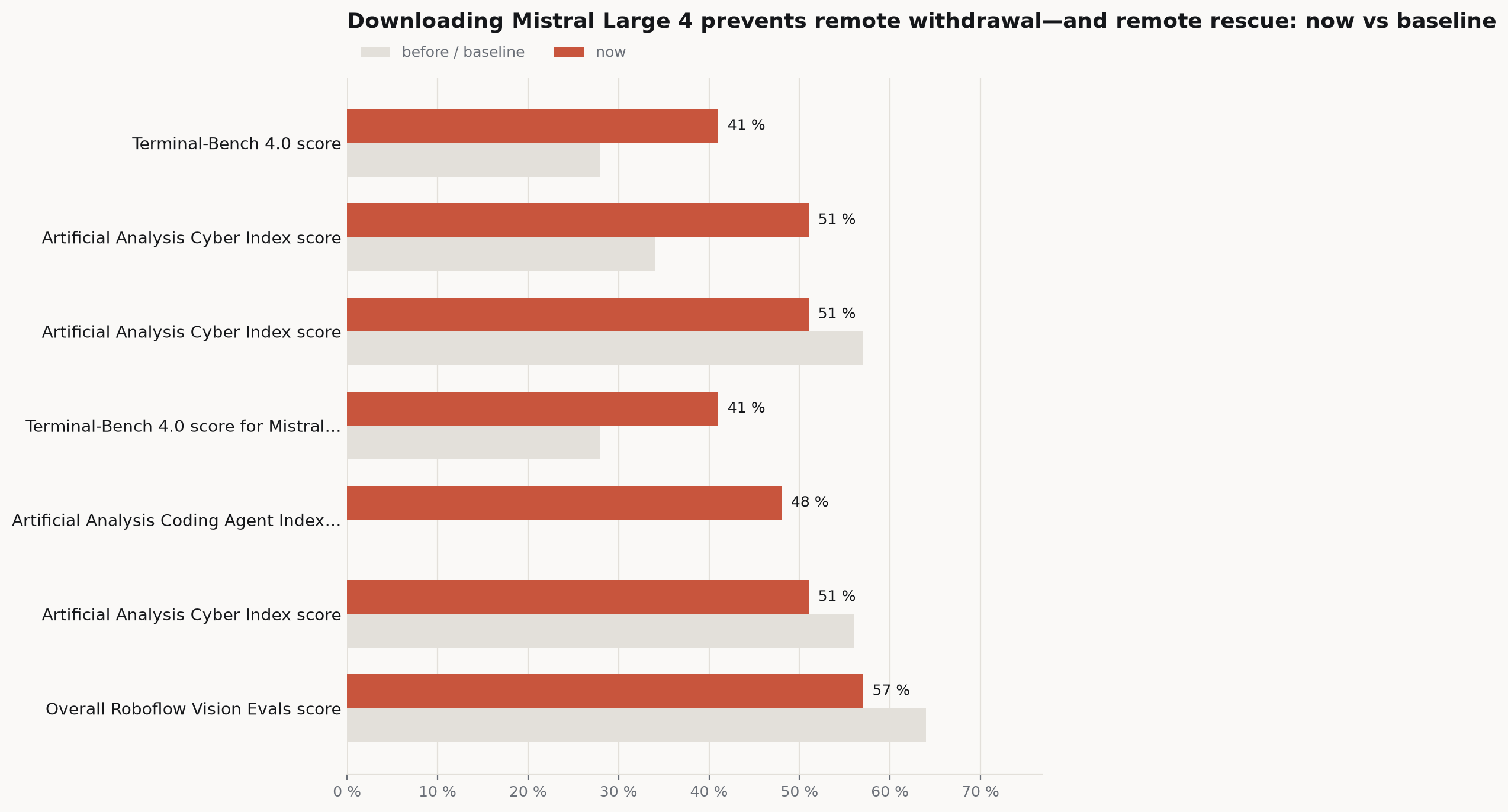
Additional reinforcement learning changed the released model after its public preview. On Mistral’s Terminal-Bench comparison, its score rose from 28% to 41%, 13 percentage points, while output token use fell by 30%. The benchmark uses sandboxed terminal tasks averaged across three complete runs. These are vendor-reported results, but the comparison shows the training’s goal: complete more tasks with less wandering.
My European federalism becomes basic accounting here. Twenty-seven miniature national AI stacks would duplicate expensive work while competing for the same accelerators. Shared EU compute and common multilingual evaluations would give European builders a meaningful home market. Europe can buy global hardware while retaining European control over the model, its deployment and the institutions governing its use.
Open weights create possession, with strings attached
Once a checkpoint reaches customer storage, Mistral cannot technically withdraw it. Under the Mistral Ecosystem Open-Weight License, the organization can run, modify and continue training it. A supplier dispute may end support or future releases, but cannot disable downloaded weights. That permanence gives ministries and manufacturers leverage in hosting negotiations. Moving still takes engineering and probably one cursed, cold-pizza weekend, but the customer already owns the asset. API customers start by asking permission.
Marjorie Janiewicz described why model ownership matters:
I don’t want to get disconnected. I want to own my model.
Pierre Stock, Mistral’s vice president of science, explained the principle in a Reuters interview published on October 29, 2026:
I’m not comfortable living in a world in which open weights do not exist.
Neither am I. Possession brings an awkward security bill. Mistral can update safeguards in its managed API and future releases; an old downloaded checkpoint stays as its operator left it. Access controls, monitoring and updates become the owner’s problem. Open weights prevent vendor remote control, and remote rescue. Freedom has always had terrible customer support.
The license matters as much as the download. It broadly permits use, modification, internal deployment, further training and distribution under its terms. A company offering commercial Model-as-a-Service may need a separate agreement, subject to exceptions for internal use and access through Mistral products. The process is simple: identify who controls the model, whether third parties receive access, and have counsel map the service to the license. Crossing the service-provider boundary means owning the files does not erase Mistral’s commercial rights. “Some Italian blogger said it looked fine” remains a weak litigation strategy.

Arthur Mensch has said AI should “be a tool for empowerment, not dominance.” Releasing weights supports that goal by giving users a real exit. Europe should defend it while acknowledging the boundary: open-weight is a licensing category, not the unrestricted commercial-hosting promise this license does not make.
Arthur Mensch described AI’s proper role:
be a tool for empowerment, not dominance.
Downloadable European AI models still need a home
The NVFP4 checkpoint is 606 GB, versus Mistral’s FP8 reference, which it says performs similarly in its evaluations. Mistral targets four GB300 GPUs for deployment. Those are datacenter accelerators, though my founder brain saw “four GPUs” and imagined a tasteful workstation beside the coffee machine. I held a small private funeral for that plan.
Serving works because different techniques cut different costs. Quantization stores model values with fewer bits, reducing the memory needed to load the checkpoint. Sparse attention reduces how much old context gets revisited. The embedded DSpark draft head proposes tokens for batch verification by the main model, called speculative decoding. In vLLM’s eight-GPU test, it delivered about twice the output throughput of serving without speculative decoding. Low, medium and high reasoning modes let operators trade token use against performance per request. Large 4 is not small; it is merely less absurd to operate.
For perspective, my fully resident 120-billion-parameter model generates about 51 tokens per second on an M3 Max with 128 GB of memory. I measured that locally in August. Large 4’s compressed checkpoint is several times larger than that machine’s entire memory before adding the serving environment. Local experimentation and serious Large 4 deployment live on different planets.
European cloud providers therefore matter. An organization can legally control the checkpoint while depending on an overseas cloud operator for hardware and system access. A European provider can keep the operating contract under EU jurisdiction and offer a credible migration path, if it supports the necessary accelerators and serving stack. The Model-as-a-Service restriction must also be handled explicitly. Sales-page data residency cannot rescue a contract that traps the checkpoint or makes migration economically impossible.
Nobody has published convincing independent evidence that self-hosting Large 4 pays once energy, hardware, staffing and monitoring hit the invoice. Coding-token savings may cut inference costs, but retries and human review can consume them. European buyers should demand a complete operating model before celebrating the download. A six-hundred-gigabyte checkpoint gathering dust in object storage has excellent sovereignty and roughly my gym membership’s productivity.
Europe should procure an exit, then test the work
Mistral reports 48% on the Artificial Analysis Coding Agent Index, effectively tied with GLM-5.3 while using 47% fewer tokens per task. Enterprises must test whether that efficiency survives real repositories, internal tools and human review. For cyber work, Large 4 scored 51% in Mistral’s displayed comparison, below the 57% chart leader. Mistral also measured a 97% refusal rate for malicious cybersecurity requests, its highest reported rate among open models. Downloaded checkpoints face operator data and motivated attackers, conditions no vendor benchmark fully reproduces.
Averlon’s separate assessment clarifies the cyber case. The model works best when evidence is supplied or searchable, making it useful for grounded defensive investigation. It is weaker at Terraform generation and misconfiguration triage, and may mishandle benign security requests. Detection outputs should be treated as leads and tested for false positives before deployment. The limits dictate the workflow: provide evidence, isolate tools, restrict credentials and require human approval for production changes. Calling it a capable defender is fair. Treating it as an autonomous security team is hiring a benchmark score and giving it root.
Vision deserves equal scrutiny. Roboflow’s October snapshot scored Large 4 at 57% across five vision tasks, below the 64% field median, with poor OCR performance. A European agency handling scanned forms should care more about that than a coding leaderboard. European origin cannot decipher a blurry permit application.
I would freeze the exact checkpoint and reasoning mode, then test the organization’s own work on its intended hardware. The evaluation should record successful tasks, serving costs and the effort needed to change providers. Every shortlisted European cloud provider should prove migration through an exit test, not a PDF promise. If a buyer cannot export the checkpoint, serving configuration and operational records, it has rented a flag-themed cage.
By 2028, I expect serious EU procurement frameworks to require checkpoint portability and documented exit tests alongside data-residency clauses. Europe will still use American chips and code written across continents. Fine. Parmigiano does not become less Italian because the truck has German parts.
The decisive question comes when a supplier changes prices, permissions or politics: can the institution move its model and keep working Monday morning? If Brussels cannot put that test into a contract, someone else still holds the veto.
Frequently asked questions
What makes a European AI model digitally sovereign?
European AI models support digital sovereignty when buyers can retain the checkpoint, use it under the applicable license, deploy it on trusted infrastructure and migrate it between providers. A European headquarters alone does not provide operational control if commercial rights, hardware access or cloud contracts still give another supplier an effective veto.
What does the Mistral Ecosystem Open-Weight License allow?
The Mistral Ecosystem Open-Weight License broadly permits use, modification, internal deployment, further training and distribution under its terms. Commercial Model-as-a-Service offerings may require a separate agreement, subject to exceptions for internal use and access through Mistral products. Owning downloaded weights does not eliminate Mistral’s commercial licensing rights.
Why do European cloud providers matter for AI sovereignty?
European cloud providers can place operating contracts under EU jurisdiction and offer a credible migration path, but only if they support the required accelerators and serving stack. Buyers must also verify checkpoint export, configuration portability, operational-record access and Model-as-a-Service licensing rather than relying on data-residency claims.
Sources
- Mistral Large 4 (Le Chonk) is now open weight
- Mistral Large 4 - Le Chonk
- Mistral Large 4
- Mistral Ecosystem Open-Weight License
- Welcome Le Chonk: Mistral Large 4 on Hugging Face
- Mistral Advances AI for Engineering with NVIDIA