Mistral’s later safeguards will not reach an old Large 4 download
Mistral’s one-trillion-parameter release gives European operators more control while transferring…

The short version
- Mistral Large 4’s downloadable weights give operators lasting control, customization, and deployment independence from its managed API.
- Its roughly 606 GB NVFP4 checkpoint has a validated four-GB300-GPU baseline, while production resilience demands additional capacity.
- Self-hosting enables authorized cyber work but transfers licensing, safeguard updates, credential security, evaluation, and incident responsibility to operators.
Mistral Large 4 fits on one black SSD. Running it takes four GB300 GPUs, a serving stack, security engineers and a plan for when an agent touches production code.
Owning the recipe does not give me the restaurant or the fire inspection.
Mistral gives European organizations a frontier model they can operate and modify without a permanent API connection, but the infrastructure bill and eventual incident report land on their desks. I support that trade. Europe needs AI capability it controls, especially in cybersecurity, but “sovereign AI” is marketing fog if we skip the expensive parts.
The download button transfers control
With Mistral’s managed API, the company controls pricing, availability and safeguard updates. A downloaded checkpoint stays with me through provider outages and connects to tools under my policy. During a cyber incident, an unavailable endpoint or provider refusal can otherwise block an authorized investigation at the worst moment.
Mistral CEO Arthur Mensch summarized the philosophy in “Mistral releases weights for its trillion-parameter AI model, targeting cybersecurity,” published on October 29, 2026:
be a tool for empowerment, not dominance.
Agreed. I still read the license before ordering the empowerment rack.
The Mistral Ecosystem Open-Weight License permits internal deployment, continued training, commercial use and derivative works. A qualifying model-as-a-service business serving third parties needs a separate commercial agreement, subject to the license’s exceptions. “Open weight” means parameter access and broad permission to use it; the contract still follows those parameters. Any founder who sends legal the Hugging Face link with “looks open lol” deserves the resulting calendar invitation.
Weights are the numerical parameters learned during training. Mistral’s API keeps them inside Mistral-operated infrastructure; downloading puts the checkpoint on mine, where my serving layer loads it, applies my access policy and exposes permitted tools. I can retain that checkpoint after Mistral changes its hosted service. Mistral vice president of science Pierre Stock told CSO that later safeguards reach the managed API and future releases; downloads keep the protections they shipped with. Technical possession gives me execution authority. The license and unresolved provenance questions join the ride.
The checkpoint offers three reasoning-effort settings per request: low for simpler work, medium for everyday tasks and high, the default, for complex jobs. Keeping them inside one model rather than separate products gives operators control over cost and latency. Someone must still test every mode on the organization’s workflows. A dropdown is a terrible evaluation program.
One trillion parameters needs a serious machine
Mistral Large 4 has about one trillion parameters, with roughly 49 billion active per token. Mixture-of-experts routing explains the gap: the model contains many specialist components, but each token visits only a selected subset plus a shared expert. Think of a restaurant where a pasta order wakes the pasta station, not every cook. The restaurant remains enormous, caro mio. NVIDIA will remember the electricity bill.
The mechanism has several parts. Images pass through a Pixtral vision encoder, becoming representations the language model can process. In the decoder, multi-head latent attention stores a compressed key-value state for context. A DeepSeek Sparse Attention indexer selects relevant earlier positions instead of sweeping the full context for every token. The mixture-of-experts router sends each token to a few specialists plus the shared expert, activating only part of the model. Users adjust reasoning effort per request, changing how much work precedes an answer. An embedded DSpark draft head guesses upcoming tokens, and the larger model checks them in batches. On an eight-GPU setup, vLLM measured about twice the output throughput with speculative decoding, though other machines or workloads may differ.
Quantization cuts the hardware entry price. Mistral says its calibrated NVFP4 checkpoint is about 606 GB and performed close to the FP8 reference in its evaluations. The validated deployment uses four GB300 GPUs because NVFP4 targets Blackwell hardware, though production capacity must handle failures and traffic spikes beyond that baseline. Idle frontier GPUs have the financial charm of a Ferrari reserved for buying parsley.
My M3 Max has 128 GB of unified memory. In my August measurements, it ran a fully resident 120-billion-parameter model at about 51 generated tokens per second, with roughly six seconds to the first token. I love that machine. Le Chonk still lives several racks beyond my expensive desk toy, a humbling result after Apple spent years telling me I owned a portable supercomputer.
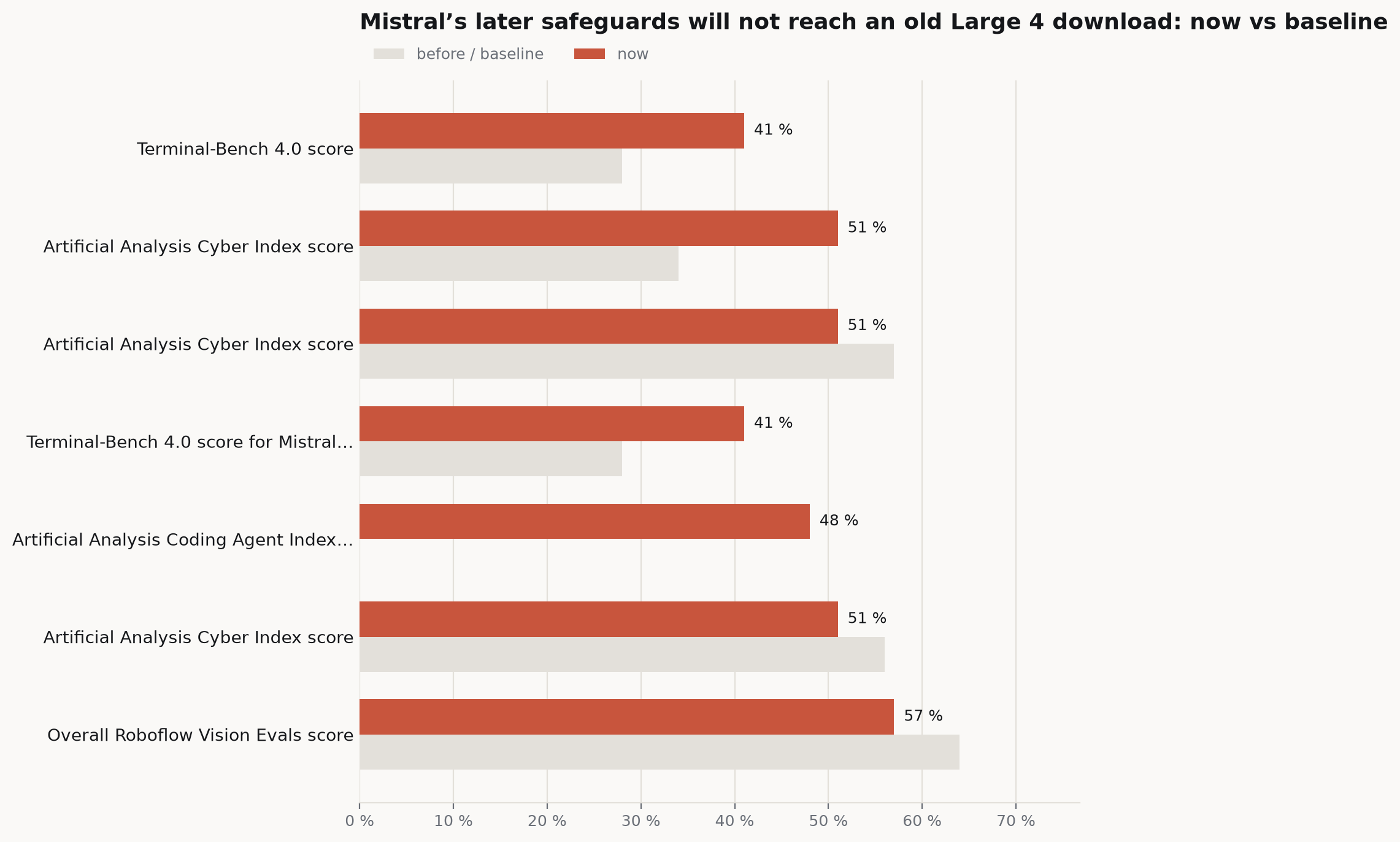
The strongest benchmark case is coding efficiency. Mistral reports 48% on the Artificial Analysis Coding Agent Index, effectively tied with GLM-5.3 while using 47% fewer tokens per task. At scale, fewer tokens can cut inference costs. Nobody has shown whether that advantage survives human code review and real engineering’s repeated corrections.
Three additional weeks of reinforcement learning raised Terminal-Bench from 28% in preview to 41% in the release, a 13-percentage-point gain, while cutting output token use by 30%. The benchmark uses sandboxed terminal tasks and averages three complete runs. The direction convinces me. Independent reproduction details and full evaluation scaffolding remain unavailable, so the champagne stays corked.

Suggested image: Managed API versus operator-hosted Mistral Large 4. Compare provider-controlled updates and lower infrastructure burden with checkpoint continuity, local policy and operator-owned security responsibility. Show the roughly 606 GB NVFP4 checkpoint on the validated four-GPU configuration.
Cyber capability comes with an irreversible downside
Security creates an awkward filtering problem: a defender reproducing a vulnerability may enter the same commands as an attacker, while authorization depends on ownership and context a model cannot reliably infer from one prompt. A managed API may therefore refuse legitimate exploit reproduction during an incident. A self-hosted checkpoint lets security teams set policy for machines they may test. It also lets a stolen credential reach the model without Mistral’s filter. Once weights spread through private infrastructure, later safety updates reach Mistral’s API and new checkpoints, not old downloads sitting wherever operators left them.
The argument against releasing capable weights deserves more than a shrug about innovation.
Mistral reports 51% on the Artificial Analysis Cyber Index, which tests vulnerability discovery and patching without breaking existing functionality. Its chart puts MiMo-V2.6-Pro at 56% and DeepSeek V4.1 Flash at 57%. Le Chonk is capable, but Mistral’s own comparison places two models above it on the aggregate index.
An independent Averlon assessment adds useful friction. The model performed best when evidence was supplied or searchable, and worse on Terraform generation and misconfiguration triage. Averlon warns that some findings are leads and generated detection rules require false-positive testing. Less sexy than “AI cyber defender,” yes. That is exactly why it belongs in the deployment plan.
Mistral says the model refused about 97% of malicious cybersecurity requests across three evaluation sets, its highest measured rate among open models. Gartner analyst Niyati Daftary told CSO that this describes Mistral’s test scenario, not performance with an operator’s data or against motivated production attackers. She is right. A press release cannot turn a benchmark refusal average into a production guarantee.
I still support the release because defenders need durable access to capable tools. My preferred setup is unglamorous: run the model in an isolated environment with separate, short-lived credentials, and require human approval before any patch reaches production. Every generated vulnerability is a lead until reproduced. Every generated patch is hostile code until review proves otherwise. At 3 a.m. when the pager becomes a tiny electronic dictator, those gates matter more than the demo.
Europe should pool the expensive part
Europe now has a serious open-weight model from a European company. Safe operators will mostly be large banks, defense ministries, major industrial groups and a few well-funded labs. Regional hospitals and midsized manufacturers will struggle to justify a dedicated frontier-model cluster and the specialists securing it.
Twenty-seven national GPU islands would be peak Europe in the worst way: duplicated spending, scarce engineers spread thin and every member state learning the same painful lesson alone. I want an EU-level secure compute program for open-weight models, with shared technical teams and isolated environments for each institution.
The model is practical. An EU facility could maintain shared hardware while giving each organization a segregated deployment and its own access policy. ENISA and national cybersecurity agencies could publish common evaluations, then rerun them against every checkpoint and serving configuration. Hospitals and manufacturers could bring authorized data into their partitions without sending it to a foreign API provider. A common incident process would let others patch a weakness after one deployment fails, before repeating it. Joint procurement would keep expensive accelerators busier, cut each institution’s costs and build operational knowledge across borders instead of buying the same mistake in every capital.
Canada has shown how direct sovereign-AI industrial policy can be. Its government announced a planned investment of up to CAD $1.6 billion in Cohere, tied to staged reporting and commitments inside Canada. Cohere committed at least CAD $1.7 billion to additional Canadian computing infrastructure by 2030. Europe has a larger market and deeper research base. We can coordinate at Union level.
Canadian Prime Minister Mark Carney made the political case in the government announcement published on October 29, 2026:
We’re not waiting for the future of AI to be decided somewhere else by those we don’t know or those we don’t trust. We are building it right here, the right way.
Brussels should borrow the sentence and improve the scale.
By the end of 2027, I expect at least one serious proposal for shared EU infrastructure dedicated to secure open-weight deployment. I will judge it by whether a hospital in Bologna and a manufacturer in Brno can use the same evaluated model without separate GPU fortresses.
Europe already has the 606 GB file. Sovereignty begins when institutions outside Paris can open it safely.
Frequently asked questions
What does releasing the weights of Mistral Large 4 allow organizations to do?
Releasing Mistral Large 4’s weights gives operators access to its learned numerical parameters, allowing internal deployment, continued training, commercial use, and derivative works under the license. It does not eliminate license conditions, infrastructure costs, security duties, provenance questions, or the need for a separate agreement for some third-party model services.
What hardware is required to run Mistral Large 4?
Mistral says the calibrated NVFP4 checkpoint is about 606 GB and validates deployment on four GB300 GPUs because NVFP4 targets Blackwell hardware. That is an entry configuration, not a complete production plan: operators still need serving infrastructure, security expertise, evaluation, and spare capacity for failures and traffic spikes.
What are the cybersecurity risks of self-hosting Mistral Large 4?
Self-hosting lets authorized security teams apply local policies and continue using the checkpoint when a provider is unavailable or refuses a request. It also leaves old downloads without later API safeguards, so stolen credentials, generated vulnerabilities, and patches must be controlled through isolation, short-lived credentials, testing, human review, and approval gates.
Sources
- Mistral Large 4 (Le Chonk) is now open weight
- Welcome Le Chonk: Mistral Large 4 on Hugging Face
- mistralai/Mistral-Large-4-1T-A52B
- Mistral Large 4 NVFP4
- Mistral Ecosystem Open-Weight License
- Mistral Large 4