
AI judges passed human-replacement tests in about half the setups studied
Before paying for an AI career course, test your existing judgment, check who reviews it, and track what the…

The short version
- Existing professional skills provide a starting point for investigating AI training jobs, but assessments require accurate, reviewable decisions.
- Advertised median midpoints were $26 for annotation and $60 across tracked AI training work, not measured take-home pay.
- Actual receipts, unpaid application time and dispute procedures provide a stronger basis for evaluating opportunities than advertised rates alone.
An AI career course can wait. Before paying someone to reinvent me, I’d like to know whether I can stand the work.
AI Training Pay’s November 22 listing snapshot gives me reason to investigate: the median advertised midpoint was $26 an hour for data annotation roles versus $60 across all tracked AI training work. The annotation calculation included stated ranges but excluded “up to” rates. These are advertised rates, not measured take-home pay.
I’d start with skills someone already pays me for. Can I catch a faulty assumption in a model’s answer? Write a correction another reviewer can check? An assignment would tell me more than a course checkout page.
But buyers are also experimenting with automating judgment. Before applying, I’d want to know how mine gets evaluated, and whether another model is learning that job.
I’d prepare a correction before polishing my résumé
Give me an error from work I understand, stripped of confidential details, and I can test my fit. An inspectable correction seems more useful than another afternoon rearranging my résumé’s skills section.
Enabled Intelligence gives me a reason to prepare this way. CEO Peter Kant describes applications starting with a sample labeling or data-analysis exercise, screening for the accuracy and analytical skills the company says its work requires. Not every platform necessarily follows that approach.
Kant describes the concentration involved in a Federal News Network interview:
And you need a lot of data to train these AI tools, so you need hyper-focus and a somewhat repetitive task.
For practice, I’d slow down enough to show my reasoning: understand the written criteria, identify evidence, and locate mistakes precisely enough for a reviewer to reproduce my check. I’d flag consequential ambiguities rather than invent rules. That lets reviewers distinguish subject-matter disagreements from misunderstood instructions. My experience helps a shared dataset only when someone else can interpret my decisions.
The RECUR clinical project makes this tangible. Medical students annotated de-identified radiology documents under a detailed schema. Experts adjudicated their work to establish a reference dataset for model development and evaluation. That extra checking turned students’ decisions into a standard researchers could assess models against.
Having opinions does not grant me diplomatic immunity from the rubric. Tragic, but fair.
For a consultant, I’d start with subjects clients already pay them to understand. With a video-production background, I’d check assignments assessing that craft and their requirements. Before any substantial assessment: is it paid, and what does passing make me eligible for?
I’d follow my judgment past the submit button
My annotation might become a reference example or feedback affecting training. I’d want to know which.
Kanishka Narayan described the stakes of where ideas create value:
For too long, Britain has produced some of the world’s best scientific ideas, only to see too much of the technology, industry and wealth they create built elsewhere.
Those uses aren’t interchangeable versions of “training AI.” Workers mark images, transcribe audio or judge answers against written guidelines. Models can learn from those labels; evaluators can use them to check performance. A reference dataset supplies a comparison standard. Human feedback can also combine with model-judge predictions to rank models. PP-Rank does this because human evaluation is expensive; its semi-synthetic experiments improved ranking precision over human-only baselines. That supports the tested method, not predictions about next month’s platform hiring.
Things get more uncomfortable when verdicts become training signals. In Blind Spots Travel, Knowledge Stays Home, researchers changed only a judge’s verdicts on a small set of training answers. The trained model then behaved differently on new questions in the same category.
For questions about capitals of former states, refusals rose from 5% to 90%. This was a category-specific reinforcement-learning experiment, not a demonstrated workforce outcome. What catches my attention: a verdict can teach a habit that travels beyond the original examples.
If I supply those verdicts, who catches my mistakes? If another model supplies them, same question.
The evidence isn’t all cautionary. In Calibrated Decision Rewards, a reference-free model judge helped raise MATH500 accuracy from 72% to 77% in the tested training setup.
Researchers calibrated the judge with about a hundred labels. On a harder training distribution, its probabilities became overconfident and its reward trailed the answer key. Confidence learned on familiar material can become a liability when work changes.
Before accepting, I’d ask who resolves disagreements and what happens when material differs from the examples establishing the rules. Better still, show me an ambiguous case someone resolved. I learn more there than from polished onboarding instructions.
I’d take automated judging seriously
A permanent human-only parking space for specialist judgment would be lovely. I wouldn’t assume one exists. Human evaluation costs money; a model judge performing adequately on a task gives buyers a legitimate alternative.
Kat Jones described AI infrastructure’s power requirements:
Hyperscale AI datacentres simply cannot run on renewable power alone, they absolutely need a highly reliable source of grid power.
PP-Rank makes me take hybrid evaluation seriously. If combining human feedback with model predictions improves precision within budget, I see why buyers would use it. Caring about workers doesn’t require pretending the result is useless.
AltRA-Test asks something narrower than the usual replacement debate: can a model annotator substitute for a human on the evaluated task? I appreciate a research question that hasn’t dressed for a TED Talk.
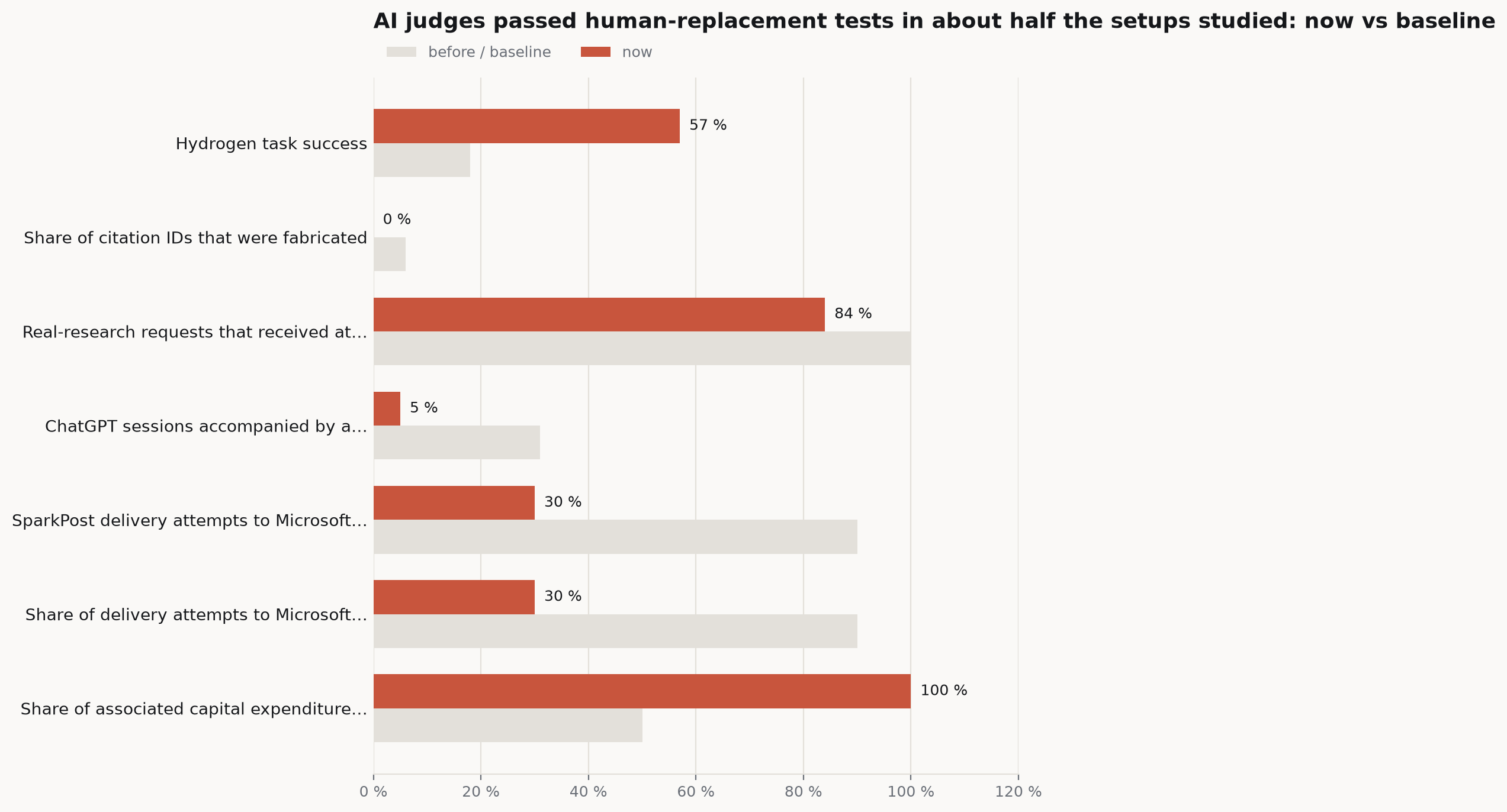
Here’s how I understand its mechanism. Researchers resample items, replace a human annotation with a model annotation, then compare agreement in that mixed panel with all-human panels. Substitution is assessed against humans’ existing disagreements. About half the real-world model-judge setups tested passed. Experiments covered text, images, audio and video; results depended mainly on the task. Passing supports replacement for that task under those conditions, not an assumption that the judge will pass in another language or production workload.
I’d still feel safer selling specialist judgment than general annotation. That guides where I investigate; these results don’t establish a protective moat around my résumé. Specialist tasks still need testing.
Nor can I tell applicants how often these laboratory results mean fewer assignments or changed working conditions. The research doesn’t establish that link. We don’t yet know how replacement-test results generalize across languages, over long periods or in production.
Building my own AI agents, I’d bring the same skepticism to automated evaluators. Before letting a score settle an important disagreement, I’d test decisions on the actual task and keep examples of disagreements with qualified reviewers.
As a worker, I’d ask who reviews challenges to the judge, and whether contesting its decisions is paid.
I’d keep an application ledger beside the pay rate
That gap between advertised medians gets my attention. Calling it a career ladder gets ahead of the evidence.
The medians describe different listing groups. They don’t establish that a course or persistence with the refresh button lets me move between them. I’d check actual requirements, then whether passing an assessment leads to paid work.
My calculation starts with money received. For hourly work, I’d record hours approved for payment; for task-based work, accepted submissions and their receipts. Application hours and time chasing payment belong in the ledger too. Receipts divided by all work-related hours gives me an effective rate to compare with other opportunities. Assignment-free weeks stay in the record: rent has never respected my pipeline forecast. Taxes and expenses need separate treatment for my circumstances.
Unpaid work deserves more than spreadsheet attention. The people doing the work behind AI reports that 53% of surveyed platform workers completed tasks without payment during the preceding year. The survey covered 226 data workers overall; that percentage applies to its platform-worker subset, not a representative global rate.
Before starting, I’d save the terms, check how to dispute rejected work and ask whether revisions are paid. Easier before I’ve sunk an evening into something I desperately want approved.
Even employment labels need dates. An earlier guide described Mercor as offering no W-2 positions; AI Training Pay’s later snapshot identified Mercor employee roles through an employer of record. Changed offerings or scope differences may explain these different snapshots. I wouldn’t make a tax decision from an old platform summary. I’d inspect the current offer.
The market-wide figures I want remain missing: actual earnings and paid hours, alongside unpaid application time. Listing snapshots can’t supply them. Until receipts establish a pattern, I’d treat this as income I’m testing, and limit speculative application hours.
Beside that ledger, I’d keep a private folder of non-confidential examples: errors I caught, evidence supporting corrections, and enough context for another reviewer to check. That folder stays on my laptop when a platform’s queue goes quiet or an account disappears.
The next application can ask me to prove my judgment. I’d rather already have the file open.
Frequently asked questions
Do I need an AI course before applying for AI training jobs?
Existing professional skills can provide a starting point for investigating AI training jobs before paying for a course. Preparing a non-confidential correction with clear evidence can help test fit. Some employers use sample labeling or data-analysis exercises, so applicants should check assessment requirements, payment and eligibility for subsequent work.
How much do AI training jobs actually pay?
AI Training Pay’s November 22 listing snapshot reported median advertised midpoints of $26 an hour for data annotation and $60 across all tracked AI training work. These figures are not measured take-home earnings. An effective rate requires dividing actual receipts by all work-related hours, including unpaid application and payment-chasing time.
Can AI replace human data annotators?
Model annotators can substitute for humans on some evaluated tasks, but results depend on the task and testing conditions. About half the real-world model-judge setups tested in AltRA-Test passed its substitution assessment. The research does not establish how often such results lead to fewer assignments or changed working conditions.
Sources
- AI training jobs: November 2026
- Building better artificial intelligence requires people willing to do meticulous work at scale
- YYForce's Humanoid Robotics and VLA Training Workflow Featured on Mediacorp's Meeting AI
- Skilling in the age of artificial intelligence
- Imperial College London launches new division to address UK AI skills gap
- Training Workers for a World Increasingly Influenced by AI