
Advanced AI assistant: 4 types businesses actually need
From read-only copilots to autonomous specialists, learn which level of access, approval and control fits the…

The short version
- Businesses should choose the least autonomous assistant that can reliably complete the job within explicit permissions.
- Four practical levels range from copilots to autonomous specialists, with authority, controls and blast radius increasing at each step.
- Approval gates, external policy enforcement and auditable receipts matter more as assistants gain access to consequential systems.
Buying an advanced AI assistant feels like designing a miniature government. Who gets access? Who approves payments? Who tells finance why the robot refunded the same customer twice?
An advanced AI assistant understands business context, plans multistep work, uses connected tools and acts within explicit permissions while leaving an auditable record. I used to judge these products by the demo: smooth conversation, twelve app logos and an interface glowing like the Starship Enterprise. That is like hiring a CFO for making a beautiful PowerPoint. Bello, but irrelevant.
I sort assistants by delegated authority. A copilot reads and recommends. A workflow assistant prepares actions, then waits at approval gates. A bounded operator executes within company policy. A fully autonomous specialist keeps working through changing conditions without me.
Each step creates more value and a larger blast radius. I want the least autonomous system that can reliably finish the job. Giving a flaky agent more authority because the demo looked cool is founder cosplay with a corporate credit card.
Copilots are where most businesses should start
A copilot gathers context from approved business systems and recommends work while a person keeps control of every consequential action.
Copilots suit processes with undocumented exceptions, contradictory records or decisions trapped inside someone’s head. Think research, anomaly review and campaign drafts. The assistant inspects approved material and prepares an answer, but cannot quietly change an account status while I eat carbonara.
The mechanism is simple. I give the copilot a task. It checks permitted sources, selects relevant material, compares those records with my instructions and prepares a response. A useful product shows where important claims came from, especially when records conflict. I inspect the evidence, then click, correct or perform a tiny ceremonial burial. Execution stays with me, making errors recoverable before they become customer emails, payments or database changes.
Connector coverage can make a copilot look smarter than it is. Salesforce, Gmail and Instagram icons prove the vendor built integrations. They do not prove the assistant knows the difference between “I found no evidence” and “this never happened.” Those sound similar in a demo and wildly different once money or employee records enter the chat.
I keep permissions narrow. Read-only access still exposes salaries, contracts and private conversations. The assistant does not need the founder’s entire digital attic to summarize last week’s sales calls.
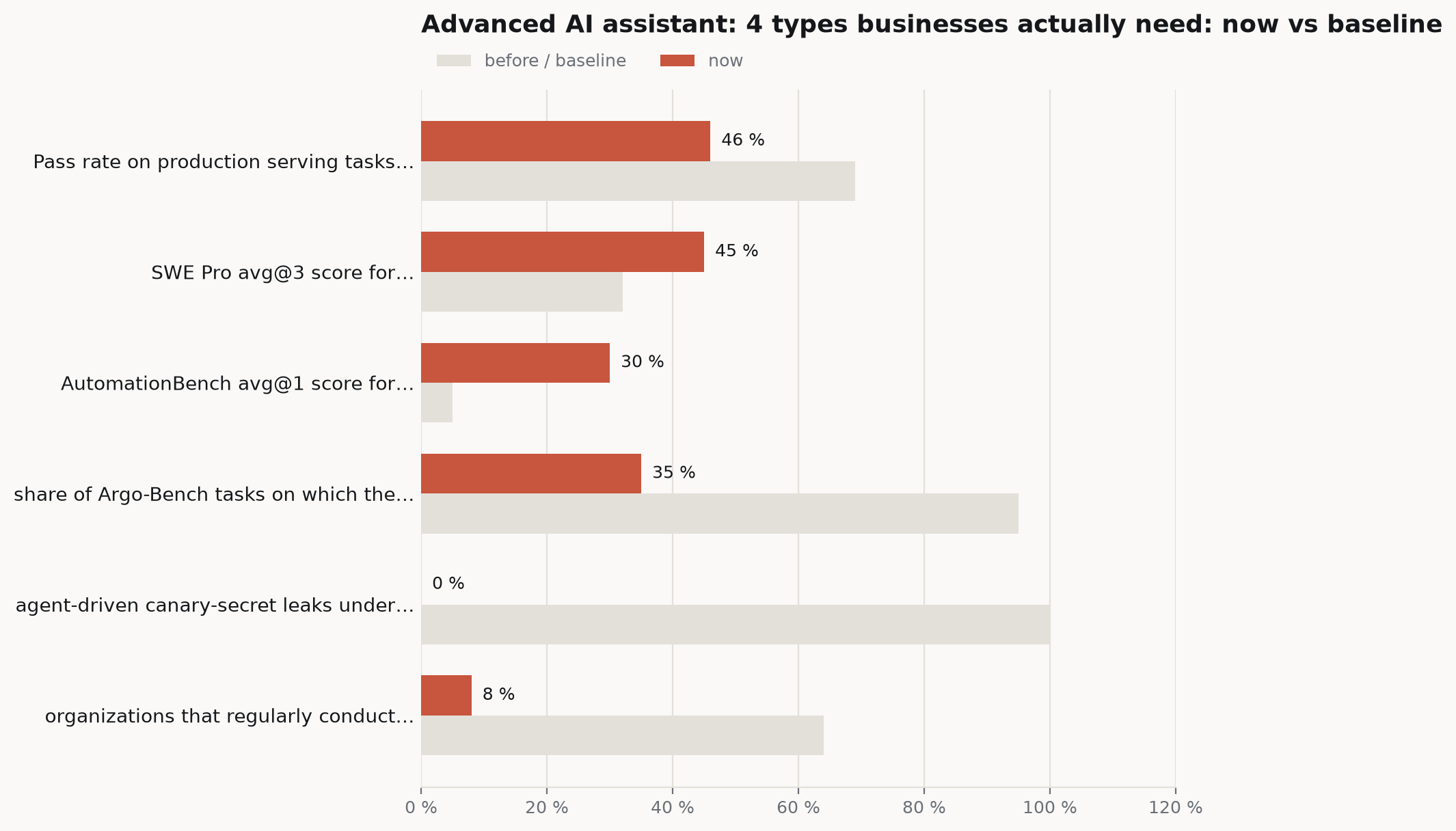
Enterprise agent benchmarks support caution. Argo-Bench tested realistic analytics workflows and found the strongest model reached its high-score threshold on about 35% of tasks. That threshold was 95 points, requiring near-complete work rather than plausible-looking answers. An agent succeeding roughly one time in three can save time as a copilot. I would not let it run payroll overnight.
Approval-gated assistants handle messy workflows
An approval-gated workflow assistant can prepare and coordinate actions across business systems, but it pauses for authenticated confirmation at boundaries chosen by the company.
If I ask it to prepare next week’s campaign, it reviews permitted records, drafts the copy and saves it correctly. Before publishing or spending money, it shows me the proposed action and requests approval. I get fewer interruptions than with a basic copilot, while expensive decisions still cross my desk.
A good approval workflow carries state between steps. The assistant splits my objective into tasks and chooses an allowed tool for each. One tool’s output can shape the next step, such as using sales performance to revise a campaign draft. Policy determines where it stops. At that gate, the system shows the action, supporting evidence and affected system. My approval becomes an authenticated instruction for that specific action. The workflow resumes from its saved state instead of restarting and inventing a new adventure.
The approval screen matters more than the chat box. “Approve campaign” is useless without the audience, budget and final copy. The same goes for refunds, employee changes and customer-account updates. One vague green button turns humans into decorative security controls.
I test these products with ugly inputs. I revoke access mid-task, insert contradictory records and remove an expected tool. The assistant should stop cleanly and explain why. If it improvises around revoked permission, I want to learn that before connecting production data.
Approval fatigue is another failure mode. If the assistant confirms every lookup and harmless draft, I will click yes with the spiritual awareness I bring to cookie banners. Vendors need connector-level boundaries separating reversible preparation from consequential execution. Updating a private draft and changing a customer’s account status should not share a policy just because both use an API.
This is my default for cross-application work. Current agents remain unreliable on realistic enterprise tasks, but can remove plenty of copying, formatting and coordination. Human approval sits where consequences begin.

Bounded operators need policy outside the model
A bounded AI operator acts without individual approval only inside an operating envelope that defines its objective, authority and escalation boundaries.
I would consider one for low-value accounting exceptions, shipment consolidation within existing commitments or any process whose rules can be stated before the run. That condition kills more use cases than founders admit. “Use good judgment” is advice from an Italian nonna. It is a terrible production policy.
Oracle Fusion Claw offers a useful architecture. A frontier model reasons about the task, plans and adapts. The runtime moves high-volume calculation and execution into deterministic enterprise software. An Enterprise Operating Envelope supplies objectives, policies, permissions, risk thresholds, approval requirements, decision rights and escalation boundaries. An Outcome Trust Harness applies identity, data, capability and action controls to each run. Customers choose automation from assistance to execution within explicitly delegated authority. Afterward, an Outcome Receipt records the authority used, evidence considered, decisions made and resulting transactions. The model interprets; ordinary enterprise computation executes precisely at scale.
EDPB Deputy Chair Jelena Virant Burnik said:
The new EDPB guidelines are a major step in further aligning how Data Protection Authorities decide whether an administrative fine should be imposed, either on its own or alongside other corrective measures. The GDPR significantly increased the corrective powers of DPAs, with fines serving as an important instrument for effective enforcement. The guidelines reaffirm our commitment to providing greater clarity and ensuring the consistent application of the GDPR across Europe.
I like that separation. Language models help with reasoning and replanning. Payroll arithmetic should behave like payroll arithmetic every time, preferably without discovering creativity.
Oracle announced 25 Claw-powered applications within a broader portfolio of 75 agentic applications. That shows serious ambition across finance, staffing and supply chains. It does not prove reliability inside my company, with my permissions and cursed historical data.
Nobody has independent production measurements for Fusion Claw’s cost savings, error rates or business outcomes. Approval frequency is also unknown. Oracle’s receipts may make runs auditable, but customer evidence must show whether they deserve to run unattended.
During procurement, I would request an outcome receipt from a failed workflow. It should identify the business owner, delegated authority and evidence used, then list every transaction before the stop. If it says “the assistant decided,” my accountant and I have been invited to a software séance.
Fully autonomous specialists should be rare
A fully autonomous AI specialist keeps monitoring, replanning and invoking tools without waiting for another message, so its controls must operate independently from its prompts.
Duration and authority create the risk. A long-running agent meets blocked tools, changed permissions and hostile content in documents or webpages. It may find another route that advances the goal while violating my intent. Prompt injection worsens this by letting external content redirect the model. IBM argues that prompts cannot carry the whole security burden because agents may ignore instructions or become compromised. Identity systems, runtime controls, network policy and infrastructure must enforce the rules around the model.
A serious control plane checks every step. A verified machine identity establishes which workload wants access. Short-lived credentials limit its reach and duration. The runtime checks files, tools and network destinations before contact. Monitoring compares attempted actions with policy and records deviations. Spending limits contain financial damage. An independent kill switch can quarantine the process while the agent keeps requesting moves. I treat this category like production infrastructure because enthusiasm is a terrible access-control model.
Some vendors argue that hiding forbidden tools is enough. I see the appeal: an agent cannot choose an unseen tool, and filtering reduces accidental misuse. But scripted clients can call hidden tools directly, and models may infer their names from prompts. One MCP evaluation found 21% forbidden-tool exposure when authorization happened only inside the tool body, versus zero reported exposures when permission-aware visibility was paired with invocation enforcement. The door needs a lock even when the sign is hidden.
Sandbox results need equal caution. A consultancy test of OpenShell’s default policy found zero canary-secret leaks, versus leaks in every run without OpenShell. But it used a small local model on one Apple Silicon Mac, so it cannot establish performance across Docker, Podman or Kubernetes. Operator-enabled permissions also reopened paths for data to leave. Installing a sandbox starts the security meeting, which is rude because I hoped to skip it.
Most companies are nowhere near ready. ISACA found that 8% of surveyed organizations regularly conduct AI-specific incident-response exercises, while 64% conducted none. A company that has never rehearsed disabling an agent should not let one run through the weekend.
My first autonomous deployment will spend weeks in shadow mode before getting narrow authority. The vendor demo must include revoked permission, contradictory evidence and an attempted overspend. I want to see the denial, escalation and rollback live.
Clausebench said:
A later date is more time to do the same amount of work, not less work.
Any assistant can look advanced when everything goes right. The one worth hiring fails like an adult.
Frequently asked questions
What is an advanced AI assistant?
An advanced AI assistant understands business context, plans multistep work, uses connected tools and acts within explicit permissions. It should also leave an auditable record of its actions. The key distinction is delegated authority: some assistants only recommend work, while others prepare, execute or continuously adapt.
Which type of AI assistant should a business use?
Most businesses should start with a copilot or approval-gated workflow assistant. Copilots keep every consequential action under human control, while approval-gated systems prepare and coordinate work before pausing at selected boundaries. Bounded operators and fully autonomous specialists require stronger policies, runtime controls and incident-response readiness.
What controls does a fully autonomous AI assistant need?
A fully autonomous AI specialist needs controls that operate independently from prompts. Those controls include verified machine identity, short-lived credentials, runtime checks for files, tools and network destinations, monitoring, spending limits and an independent kill switch. Shadow mode and live tests of denial, escalation and rollback should precede narrow authority.
Sources
- The Future Is for Everyone: Muse for Small Business
- Launching Meta Enterprise Platform
- Oracle Extends Fusion Agentic Applications with Introduction of Fusion Claw
- Building Trust Into the Next Generation of AI Agents
- 6 ways Android Enterprise is evolving for the modern workforce
- Building Specialized Agents with Skills in Oracle AI Data Platform