
Mistral AI vs Claude: What should Europe buy today?
Claude wins on difficult hosted work, while Mistral offers the infrastructure control that critical European…
The short version
- Claude is the stronger choice for most European businesses today because its difficult hosted-work evidence is substantially better.
- Mistral cost about one-fifth as much per benchmark task and can shorten the processor chain through customer-controlled infrastructure.
- Critical workloads need a tested exit from foreign APIs when provider policy changes could stop operations.
Most European companies should buy Claude today. But if losing a foreign provider could stop your business at three in the morning, buy Mistral.
Every European cell in my body wants Paris to win. Yet Claude has stronger evidence for difficult hosted work. Mistral offers something else: control of the infrastructure itself, priceless when access is part of the threat model.
I won’t pay for a tricolore sticker when a workflow needs better reasoning. Nor will I treat an American API as permanent infrastructure because the sales rep brought nice slides. Mi dispiace, procurement is not Eurovision.
Claude has earned the benchmark advantage
Artificial Analysis gave Claude Opus 5.5 an Intelligence Index score of 58, versus 38 for Mistral Large 4 Preview. The index combines ten evaluations, making it more useful than a cherry-picked benchmark screenshot doing laps on X. Mistral was still a preview release, but preview software gets no imaginary production points. For difficult reasoning today, Claude has a serious advantage. European patriotism cannot close a twenty-point gap.
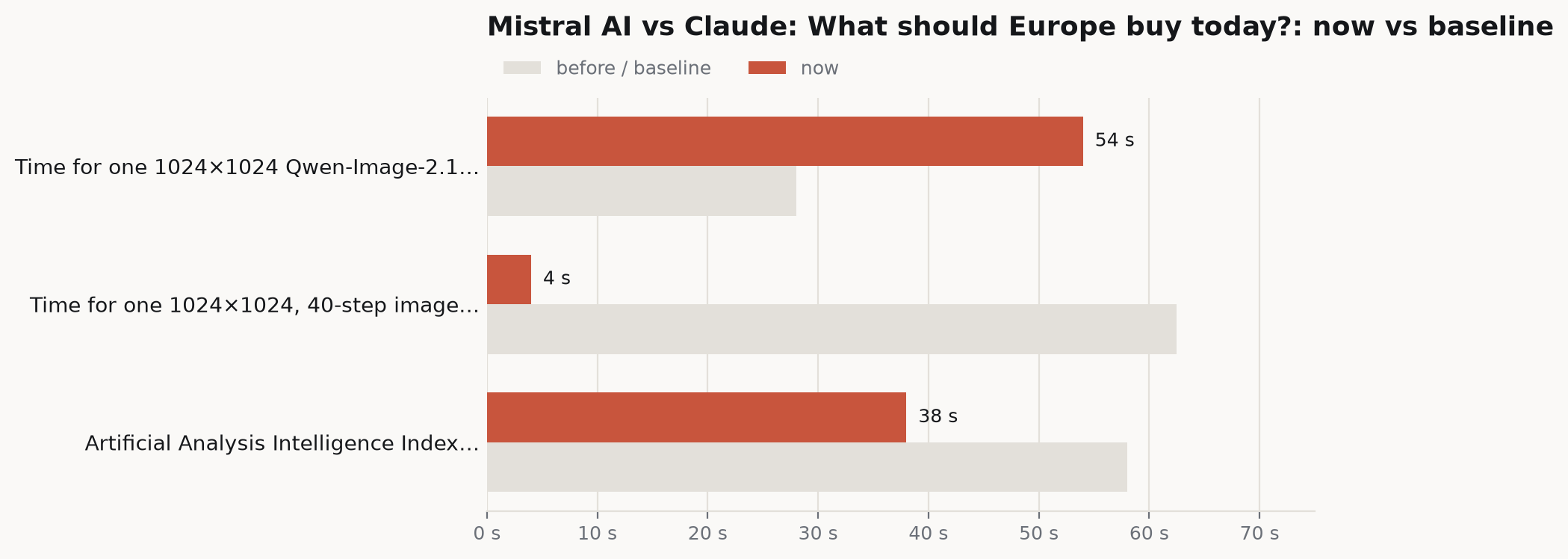
Price complicates that verdict. Artificial Analysis put the weighted benchmark cost at about $1 per task for Mistral and roughly $6 for Claude, including input, caching, reasoning and answer tokens. Mistral cost around one-fifth as much under that harness. But cheap calls become expensive when employees spend twenty minutes repairing them. I measure retries and human review across the workflow. Token pricing alone is procurement cosplay.
Coding is harder to dismiss. On Terminal-Bench 4.0, which measures agentic coding and terminal use, Claude reached 60% while Mistral scored 27%. Claude used maximum reasoning with default fallback; Mistral remained a preview model. Vals AI later reported a lower Mistral result using its own provider setup, documented generation settings and high reasoning effort. The disagreement proves the harness can move scores, not that the original gap vanished.
Nobody has published the comparison I want: final Mistral Large 4 weights against Claude with matched prompts, tool access, effort settings, safety policies and deployment hardware. Until then, anyone declaring an eternal winner sells confidence by the kilogram.
The models expose intelligence differently. Mistral Large 4 accepts text and images, routes inference through a granular mixture-of-experts architecture and returns text. Claude Haiku 5.5 also accepts text and images, while adaptive thinking controls reasoning depth through an effort setting. Routine work stays cheap; harder jobs get more thinking time. Anthropic says Haiku 5.5 costs about 75% less to run on average than Haiku 4.5, though context length and task mix affect the bill. Mistral’s accessible-weight strategy changes another variable: who operates the model and sets its policies. I decide which control matters before comparing prices.
PotionUI summarized the principle:
Forms, not wiring, each model exposes only the controls it actually understands.
Yes, I caught myself excusing Mistral’s weaker score because I want a European champion. That is why the numbers belong here. Forcing a weaker model through the wrong workload efficiently teaches employees to resent European industrial policy.
GDPR-compliant AI starts with the plumbing
A vendor cannot make a system GDPR-compliant by sprinkling legal parmesan over the API contract. I need to know where prompts travel, who can retain them and whether my analytics capture personal data before the model sees it.
Accessible weights give Mistral the clearest route to infrastructure control. The company says customers can run its models on their own systems, train them on company data and operate them under internal policies. Local inference can remove an external model endpoint from the processor chain. Responsibility then falls on the customer: lawful basis, deletion, access control, the whole glamorous menu. Those controls must also cover the surrounding application. Downloading weights does not magically confer GDPR compliance, however satisfying the button feels.
Follow one request. A user submits information through my application, where analytics may record part of the prompt. My infrastructure authenticates it before a cloud platform creates operational records. The model processes the input; the output may be stored beside the user’s account. Every organization touching either side creates a contractual question. Customer-controlled Mistral infrastructure shortens this chain; hosted Claude leaves more governed by vendor and cloud agreements. Draw the diagram and everyone sees who may access personal data, and how far a deletion request must travel.
Claude can still support a serious European deployment. A regional cloud configuration may constrain where supported workloads are processed, but the contract must identify the exact services. I would verify the endpoint and retention settings in writing, then ask which support staff can access the data. Another gateway changes the processor chain regardless of the model company’s passport. Corporate nationality is context. The arrows decide whether I sign.
My vendor questionnaire asks every location where prompts and logs can be processed. Then: How long does each record survive? Who can change model behavior after deployment? What happens if the regional endpoint disappears? Customer-specific terms must make those answers enforceable. A tasteful European-blue gradient will not configure deletion inside my product.
EU AI Act enforcement reaches the whole product
Under the EU AI Act, intended use and each organization’s role determine whether an AI system is high-risk. A hiring workflow keeps its legal character when the underlying model changes. A gorgeous benchmark score says nothing about human oversight.
I start with the deployed workflow because its intended use determines whether Article 6 and Annex III apply. Then I establish whether my company is a provider or deployer, since the roles carry different duties. Model features can support logging and generated-content marking, but the finished system still needs classification. I must test the application, downstream software and exact intervention point. A model swap may reduce one technical risk without changing the product’s legal duties. Enforcement examines what employees and customers actually use, usually far messier than the board’s architecture slide.
Claude has a useful, and surprisingly European, advantage. Anthropic says it signed the Article 50(2) Code of Practice on Transparency of AI-Generated Content. For supported Claude models, generated text receives an embedded watermark; supported files can receive C2PA Content Credentials.
The text watermark matters because its origin signal can survive copying and some editing. Anthropic acknowledges that translation or heavy rewriting can destroy it. Screenshots can also flatten sophisticated provenance into dumb pixels, because every futuristic compliance system must eventually fight the screenshot button. Detection indicates possible Claude processing; it does not prove authorship. We still lack independent evidence of how well the watermark survives extensive reformatting or adversarial alteration. I would put that uncertainty into the compliance plan before legal discovers it after launch.
Available Mistral material does not establish equivalent generated-content marking or participation in that code. Claude therefore gives compliance teams a more concrete provenance mechanism. Mistral instead offers customer-operated infrastructure where internal policy requires it. These controls solve different problems; an EU AI Act assessment must map each onto the actual workflow.
European political support for Mistral still matters. In Mistral’s undated “Hallo, Deutschland!” announcement for its Munich hub, Bavarian State Minister Dr. Florian Herrmann put it plainly:
Technological sovereignty is political sovereignty. That is why we need strong European AI champions that take a leading role in international competition. Mistral’s decision to choose Munich sends a strong signal for our position as a high-tech location. Bienvenue à Munich, bienvenue en Bavière!
He’s right. Europe needs EU-level compute, coordinated procurement and institutions strong enough to act continentally. Scattered national projects will struggle against American hyperscalers and China’s industrial capacity. Federalism gets practical when the infrastructure bill arrives.
Digital sovereignty needs weights I can download
Digital sovereignty is Mistral’s strongest argument, with one awkward preview-stage caveat: its launch changelog labelled Large 4 “open weight” while saying the weights were coming soon.
That undercuts much of my enthusiasm. Procurement teams cannot deploy a future download, and the final license remains unknown. Nor do we know the delivered weight formats or practical self-hosting requirements. Public sources disagree about the preview context limit without explaining whether the final release will differ. I like Mistral’s direction, but its roadmap is not yet infrastructure. European loyalty should raise my standards, not lower them.
The Mesmer Tools benchmark author cautioned:
I wouldn’t call it lossless.
Once accessible weights arrive, the operational chain changes. I can move inference from Mistral’s endpoint to infrastructure controlled by my company or a European institution. I can pin the version and apply internal policies without provider approval for every use case. A refusal can no longer halt the workflow. That matters in cybersecurity, where legitimate vulnerability research may resemble offensive activity to a safety system. Mistral explicitly positions self-deployment as useful when refusals interrupt incident response. During an active breach, “the chatbot felt uncomfortable” is a difficult sentence for the board report.
Claude gives me controls within a vendor-operated system. Haiku’s effort setting balances reasoning depth against cost, while Anthropic’s watermark adds an origin signal that may survive copying. Both help. Neither keeps Claude running if access terms change or the provider withdraws a capability.
So yes: I would approve Claude for most businesses today, then properly negotiate the European data architecture. For critical infrastructure, defence or legitimate security research, I would fund Mistral when provider policy could halt operations: assuming the final weights and license fulfil the preview’s promise.
By 2029, major European tenders should require a tested exit from foreign model APIs for critical workloads. Smart companies will write that clause before an outage, sanctions dispute or policy change writes it for them.
Frequently asked questions
Is Mistral AI or Claude better for European companies?
Claude is the stronger choice for most European companies today because benchmark evidence favors it for difficult reasoning and agentic coding. Mistral is preferable when customer-operated infrastructure, accessible weights, lower benchmark costs, or protection against provider withdrawal and policy refusals are essential to the workload.
Can Mistral AI or Claude provide GDPR-compliant AI?
Neither model is automatically GDPR-compliant. Compliance depends on where prompts and logs travel, retention settings, access controls, contracts, lawful basis, and deletion processes. Customer-controlled Mistral infrastructure can shorten the processor chain, while hosted Claude requires careful governance of vendor, cloud, endpoint, support-access, and regional-processing arrangements.
Does switching from Claude to Mistral change EU AI Act duties?
Changing from Claude to Mistral does not change a system’s EU AI Act classification by itself. Intended use and the organization’s role determine whether duties apply. Claude offers generated-content provenance mechanisms for supported outputs, while Mistral’s customer-operated infrastructure addresses control rather than eliminating product-level classification, testing, logging, or oversight obligations.
Sources
- Introducing Mistral Large 4
- Mistral Large 4
- Hallo, Deutschland! Mistral Opens German Hub in Munich to Advance Industrial AI in Europe’s Largest Economy
- Introducing Claude Haiku 5.5
- How Claude marks AI-generated content
- Mistral AI unveils new AI model aimed at ‘narrowing the gap’ with top Chinese competitors