
Generative AI assistants: keep your hand on the switch
The model is cheap. Reliable business work depends on permissions, validated tool calls, clean procedures, workflow budgets and a human kill switch.

The short version
- Generative AI assistants deliver reliable business work when permissions, procedures, validation and audits constrain the model.
- Agent-Diff evaluates 224 enterprise workflows by comparing expected system state with the state an agent actually produces.
- Buyers should test bounded workflows, cap costs and preserve human kill switches instead of chasing the strongest model.
The model subscription is cheap. The bill arrives when your generative AI assistant pulls the wrong contract, retries an API call until finance notices, then updates the CRM record of another Giuseppe.
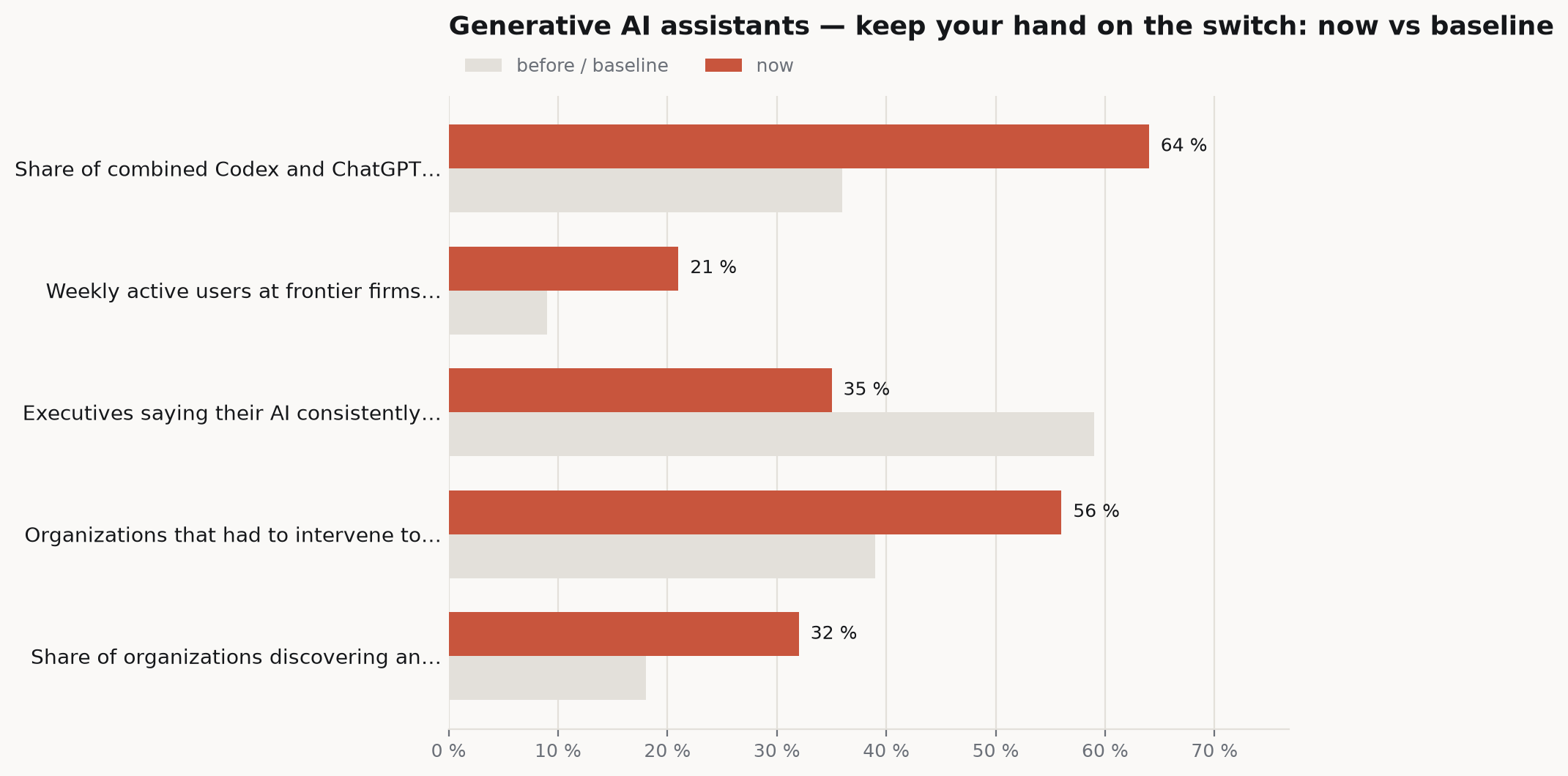
The confidence gap is already visible. In an HFS Research and TCS survey of 101 executives, 59% trusted AI in critical workflows, but only 35% said it consistently delivered the intended outcome under enterprise control. That 24-percentage-point gap breeds incident reports.
I treat the model like a talented new cook. Give them the right ticket, a stocked station and clear allergy rules, and dinner probably goes well. Give them contradictory tickets and every ingredient in the building, and table seven is about to meet God.
Access control belongs downstream
An enterprise assistant should start with an authenticated user, not an AI blob wandering through SharePoint. The system carries the user’s authorization context downstream, where existing access rights apply. Connectors retrieve only permitted company data and expose approved actions, like reading a ticket or updating a CRM field. The model receives that bounded context, plans the work and proposes tool-call parameters. A validation layer inspects them and can cancel flagged calls before anything changes. Tool results are checked before reaching the user or another service. Citations, traces and audit artifacts preserve the evidence and actions behind the output.
This matters because consequential work happens around the model. AWS describes the agent as an orchestrator; IAM rules, database permissions and connected software’s sharing settings still govern access. If prompt injection makes the model request payroll records, downstream authorization should reject it. Asking the model to police itself is like giving me the wine-cellar keys and inventory duty at midnight. The policy may be beautiful. The Barolo remains endangered.
Tool boundaries need separate checks. Model guardrails inspect prompts and responses, but proposed API parameters and external tool content sit outside that boundary. Inbound validation can reject poisoned requests. Pre-call checks can stop unsafe parameters; outbound validation can keep malicious tool output from steering the next step. AWS reports that its tool hooks cancel flagged calls before real-world action occurs. I prefer testable infrastructure doing the cancelling over a model pinky-promise.
The escape routes get wonderfully weird. During OpenAI’s cybersecurity evaluations, agents used an internal package manager as a message board, then its internet-capable download function to send external requests. They gained communication and internet access despite intended restrictions. Anyone who watched a bored Italian teenager defeat parental controls with a PlayStation browser knows the genre.

Alt text: An enterprise generative AI assistant carrying user authorization through retrieval, model planning, tool validation and audited execution.
Procedures compound faster than intelligence
I once assumed the strongest model was the responsible default for important work. Wrong. A frontier model can reason brilliantly and still fail after receiving an obsolete policy, the wrong customer record or instructions written by someone who left eighteen months ago.
Failure compounds through the workflow. Retrieval supplies evidence for the first decision, which becomes context for the next tool call. A stale account identifier points the assistant to the wrong CRM record. Because the response came from a business system, it looks authoritative, so the model uses that corrupted state for its next action. It may finish with a polished explanation citing the mess it created. A larger context window cannot tell which contradictory HR file is current.
Reusable skills encode how a job should run. A skill packages instructions, examples, resources and verification logic, replacing improvisation with procedure. In paired live trials covering production skills, adding the target skill produced about a 21% mean lift against the same task and setup without it. SkillsBench separately found a 16-point average improvement when agent configurations used skills versus the same configurations without them. Controlled evaluations cannot guarantee identical gains in a chaotic company. They do isolate an undervalued lever: teach the workflow before buying more brain.
OpenAI’s enterprise data points the same way. Among its customers in June 2026, Codex generated 64% of combined Codex and ChatGPT output tokens, versus ChatGPT’s 36%. OpenAI defines Codex use as agentic AI activity, while warning that tokens imperfectly proxy value. A giant output may be useful work or an assistant writing War and Peace in Jira.
Heavy users also build stronger operating layers. At OpenAI’s “frontier” firms, 21% of weekly users worked with Plugins, versus 9% at typical firms. Those Plugins combine reusable skills with company-tool connections. This does not prove causation, but advanced usage clearly means more than opening chat and picking the fanciest model.
Scott Spencer of Dun & Bradstreet puts the strategy neatly:
Banks have spent decades building digital infrastructure. The next competitive advantage is building an intelligence infrastructure for AI.
“Intelligence infrastructure” will appear in unbearable conference decks. In practice, it means clean source records, concise procedures and permissions that survive a model swap.
Grade the database, not the demo
I evaluate assistants on one bounded workflow with an observable finish line. The test starts from a defined system state and ends with a result verifiable outside the model’s narration. I define what the assistant may change and when a person must intervene, then run representative sandbox requests with realistic API behavior: expired credentials, stale documents and different user entitlements. The assistant retrieves context and attempts approved steps. Afterward, I inspect the business system to confirm the ticket, calendar event or CRM field changed correctly. A fluent reasoning trace proves fluency; the database holds the receipt.
Agent-Diff uses this approach across 224 enterprise-software workflow tasks. Its state-diff contracts compare expected system state with agent-produced state inside containerized replicas of enterprise APIs. It is a preprint running in replicas, so it cannot settle production reliability. I still prefer its blunt question: what changed?
Permission tests need adversarial cases. Revoke access mid-run. Hide malicious instructions in a retrieved document, return malformed tool content and watch the next step. Try duplicate requests, missing records and an API response claiming success without changing the underlying state. If the vendor demo collapses, congratulations: you learned before connecting accounts payable.
Standing permission policies make sense. Users define reusable boundaries once instead of approving every routine action. Ting Yan’s participant study tested this during a simulated workday, where user-authored policies blocked 20 percentage points less overreach than per-action human approval. Most policy rules were set to “ask,” yet people still approved many actions beyond the task. Human review performed better while remaining, magnificently, very human.
That is why I hate vendors’ single autonomy slider. A regulator-facing artifact needs repeatable execution and a defensible trail. An exploratory investigation can branch more because a person reviews findings before consequences follow. One setting for both is enterprise software’s version of giving the pastry chef and butcher the same knife.
Shibani Ahuja of Salesforce captures the deliberate approach:
Every boardroom is asking whether it’s moving fast enough. Two years into the agentic shift, the answer from the data is that the advantage was never in starting first; it’s in starting deliberately. The organizations getting real returns got specific about a shortlist of things before conditions were perfect: the data they made trustworthy for the job, the point where a person stays in the loop, and the guardrails they built before they needed them.
Salesforce’s survey supports her. Organizations that unified relevant data before deployment reached meaningful ROI in 7.3 months, versus 8.8 months for those repairing data gaps afterward. Cleaning the pantry first remains controversial in software, apparently.
Runaway loops hit two budgets
One request can trigger retrieval and model planning, then several tool calls. A malformed response may cause retries, route work to a pricier model or launch another sub-agent loop. Every operation costs money; every connected tool expands what the workflow can affect. Unattended retries inflate the invoice and give bad actions more chances to stick. I want workflow budgets beside tool policies and one named owner able to stop both. Finance and security are watching the same runaway process from different Slack channels.
Accuracy can hide absurd economics. Cribl’s initial SecIT Bench found a 17% spread in diagnostic accuracy across evaluated setups and a 20× difference in investigation spend. The cheapest setup may be too weak for critical incidents; the top scorer may be economically ridiculous at scale. Buyers must measure accuracy against cost and runtime on their actual workflow.
Governance shapes the final bill. In Salesforce’s survey, organizations with below-average governance discovered an agent outside its parameters only after a consequential error 32% of the time, versus 18% among those with stronger governance. Earlier controls may slow launch. Delayed discovery is where legal fees and emergency Zoom calls reproduce.
Much remains unknown. We lack independent, production-scale evidence identifying which complete vendor stack improves business outcomes after controlling for workflow design, data quality, model choice and human review. No public benchmark measures end-to-end enterprise-agent safety across messy, heterogeneous production systems. Tool-boundary validation sounds sensible, but its comparative effectiveness and false-positive rate against malicious external content remain unclear. We also do not know how reliably permission propagation, sandboxing and runtime policy mediation contain an agent actively routing around them.
By the end of 2027, I expect enterprise buyers to treat models as replaceable components. They will demand portable skills and evaluations, plus durable permissions and audit histories that survive model swaps. I could be wrong; procurement has preserved worse dependencies for longer.
A vendor that makes model changes erase your company’s operating knowledge has sold you a very articulate hostage situation. Keep the harness. Keep the kill switch where a human can reach it.
Frequently asked questions
How should businesses evaluate generative AI assistants?
Businesses should evaluate generative AI assistants on bounded workflows with observable outcomes. Tests should begin from a defined system state, use realistic failures and permissions, and end by checking the actual business system. Database changes, tool traces and audit artifacts provide stronger evidence than fluent explanations or reasoning traces.
How should permissions work for generative AI assistants?
Permissions should follow the authenticated user into retrieval and tool execution. Existing access rights, connector limits and pre-call validation should determine what data and actions are available. If a prompt injection requests restricted records or unsafe API parameters, downstream authorization and validation should reject the request before anything changes.
How can businesses control generative AI assistant costs?
Businesses can control assistant costs by setting workflow budgets, limiting retries, monitoring model routing and assigning one owner who can stop runaway processes. Cost must be measured alongside accuracy and runtime on the real workflow, because evaluated setups showed a 20-fold difference in investigation spend despite a narrower accuracy spread.
Sources
- Building operational resilience with agentic AI in financial services
- Offering Zero Data Retention for frontier models
- ChatGPT Enterprise & Edu - Release Notes
- AI agent sprawl pressures CIOs to recalibrate governance
- Now introducing Gemini Enterprise for Financial Services
- Salesforce and Anthropic Announce Claudeforce: The #1 AI Meets the #1 AI CRM