
Mistral AI stock: Why €21 billion buys you nothing
Mistral is worth more than €21 billion on paper, but retail investors still cannot buy shares or treat its…
The short version
- Mistral AI remains private, so ordinary investors cannot buy its shares through a public stock exchange.
- Its valuation above €21 billion came from a €3 billion financing round with selected private investors.
- Investors should treat the valuation as one negotiated reference, not an executable market price or retail opportunity.
Search your brokerage app for Mistral AI stock. You’ll find zero shares, zero tickers, and no secret buy button for people wearing Patagonia vests.
Mistral is private. Its reported valuation above €21 billion came from a €3 billion financing round: selected investors negotiated a private price for part of the company. Ordinary investors got no executable share price.
When the news hit my phone, my brain saw “European AI champion” and mistook the valuation for a public market signal. Before coffee, but still. Brutta figura.
That confusion exposes an awkward European problem. EU institutions can support strategic companies, public agencies can buy their products, and taxpayers can fund the ecosystem, yet ordinary savers can barely own the resulting growth. Digital sovereignty feels incomplete when citizens finance the foundations while private funds own the building.
A funding round cannot create a public ticker
Mistral reportedly raised €3 billion on September 8, 2026, for a post-money valuation above €21 billion. Samsung led the Series D, with the EQT-managed Scaleup Europe Fund and PSG Equity as co-leads, according to reporting on Mistral’s acquisition of Pimento. The smaller figure is capital entering the deal; the larger is the company’s implied value afterward. Retail investors remained outside the cap table.
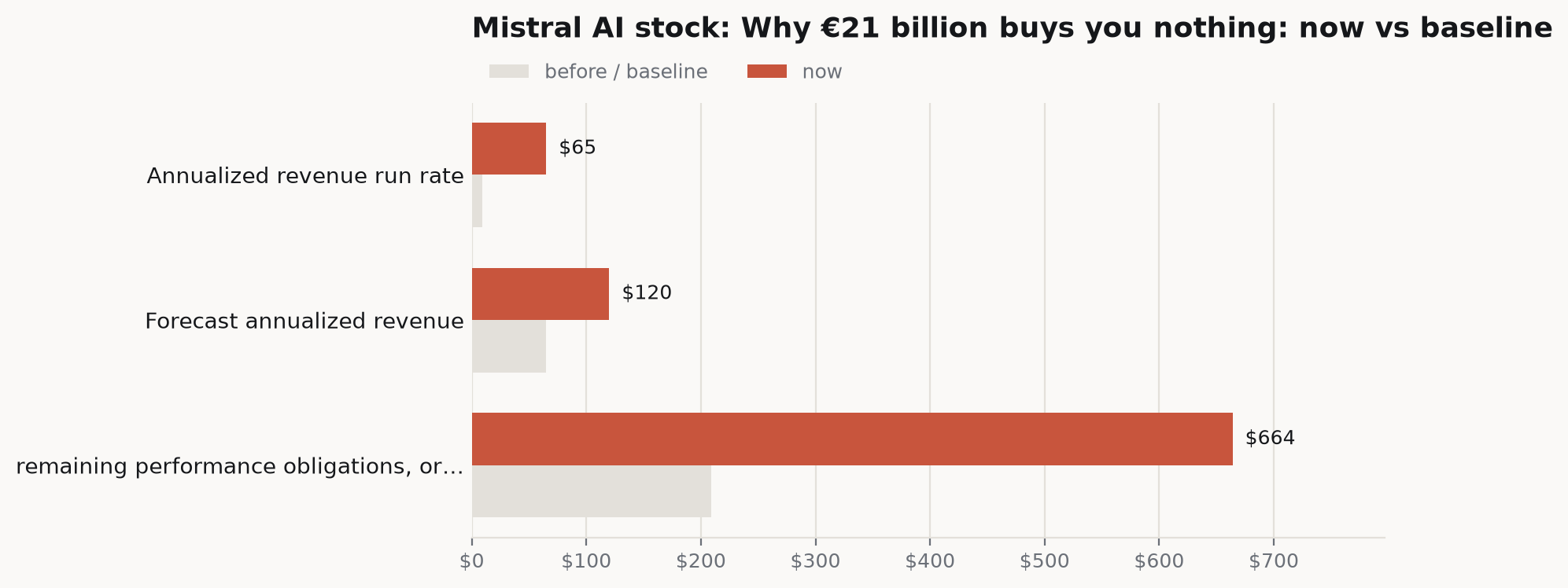
Mechanically, Mistral issued shares to selected investors on privately negotiated terms. The investment and share price produced the reported post-money valuation. Those shares never reached a public exchange, so no live order book shows bids or accepts market orders. Transfers may need company approval and involve a different share class from the latest round. Investor protections can also alter the economics hidden by the headline valuation. Until another credible transaction sets a newer price, this valuation remains a reference from one financing event.
Copying it into Robinhood will not summon a stock.
Private shares are weird little creatures. A secondary seller might offer direct shares or an interest in a special-purpose vehicle wrapped in enough paperwork to stun a horse, leaving buyers several legal steps from owning Mistral itself. Fees reduce returns, transfer restrictions may block sales, and buyers could get weaker rights than the latest investors. Nobody has disclosed the price or terms of any Mistral private secondary transaction.
If someone offers “pre-IPO access,” ask who legally owns the underlying shares and which share class you’ll receive. Ask who must approve the transfer, when you can sell, and what each layer charges. Rocket emojis beside a countdown timer mean close the tab.
Mistral has announced no listing date or confirmed public offering process. Nobody knows whether it will list, when, or on which exchange. Anyone confidently selling a future Mistral ticker today has crossed from analysis into fan fiction.
The valuation is missing its denominator
A private valuation captures expectations under one negotiated deal. Judging whether more than €21 billion is attractive requires Mistral’s revenue, cash burn, customer retention and gross margin. None appears in the supplied public reporting, making a conventional valuation model mostly theatre.
Anthropic shows a better-informed comparison. The Irish Times reported second-quarter revenue of $11.5 billion, around 14 times the previous year’s level. Investors can connect that growth to operating performance and debate a sensible multiple. With Mistral, outsiders have a financing price and polished announcements but no reliable revenue denominator. My Italian relatives have started family feuds with less information, though I wouldn’t invest based on those either.
Mistral’s valuation rests on a long causal chain. Its models must win enterprise workloads, then customers must renew and expand usage. That revenue must fund more model development and enough compute to stay competitive. Firefox Smart Window could expand distribution, while industrial experiments must become recurring contracts. Weak distribution limits adoption; weak adoption constrains revenue; weak revenue makes infrastructure investment harder. Financing-round investors presumably assessed this chain using private information and contractual protections outsiders lack. Turning their negotiated price into a retail thesis skips most of the work.
There are concrete reasons for optimism. Mistral says it plans to build one gigawatt of European compute capacity by 2030, though supplied sources disclose no current installed baseline. Its acquisition of Emmi AI added more than 30 physicists, researchers and engineers, with no disclosed pre-acquisition Physics AI team size for comparison. They work on computational fluid dynamics, structural mechanics and multiphysics simulations, where manufacturers care deeply about confidential engineering data.
Physics AI also offers a path beyond general-purpose chatbot access. Applied engineers can work with industrial customers, convert simulation problems into model workflows, and improve systems using domain data. If those tools shorten engineering cycles, they become part of operations rather than another forgotten browser tab. That could create stickier relationships, assuming reliable models and support at scale. The mechanism is credible. The revenue remains undisclosed.
Nobody knows whether Mistral will hit its compute target. We also don’t know what happens to Pimento’s advertising product or existing customer relationships. The Next Web reported conflicting acquisition prices from other outlets, while Mistral confirmed neither. Inventing precision would be very Silicon Valley, so I’ll resist.

Mistral AI vs Claude comes down to deployment
A useful Mistral AI vs Claude comparison starts with where the model runs. Claude suits buyers wanting Anthropic’s hosted product and frontier model experience. Mistral gets especially interesting when an organisation needs accessible weights, customer-controlled infrastructure or operation under European law.
Mistral offers several deployment paths. When authorised by an order form, customers can run models on infrastructure they control. Accessible weights let teams train with internal data and keep execution inside the organisation. Others can deploy through a partner or use Mistral infrastructure under applicable commercial terms. That choice determines where prompts travel, who administers servers, which contracts govern processing, and how the organisation maintains auditability. For a European aerospace company handling confidential engineering data, those details will outlive this month’s benchmark leaderboard.
Mistral’s work with the European Space Agency follows that logic. Their letter of intent creates a framework to evaluate Mistral’s models and infrastructure across ESA engineering, scientific work and operations, including potential Earth observation and space engineering uses. ESA provides serious domain problems; Mistral provides the models and technical infrastructure to test whether deployments hold up.
Firefox gives Mistral consumer distribution. Smart Window uses Mistral models for supported users, conversations aren’t saved on Mozilla servers by default, and Mistral agreed to zero data retention. Mozilla found a privacy arrangement suitable for its browser assistant, though one partnership cannot settle every Claude comparison on Earth.
In the announcement “Mistral and Mozilla are bringing open, private and multilingual AI to your web browser,” Mozilla Corporation CEO Anthony Enzor-DeMeo described the product philosophy:
A browser shouldn’t be a one-way funnel. It should preserve what made the internet powerful to begin with: the freedom to explore, discover different ideas and tech, and decide for ourselves where to go next.
I’d test both providers on production work. Use representative prompts, including the ugly edge cases your demo avoided. Call the tools your application needs and measure failed tasks at realistic context lengths. Include engineering time. A cheap model gets expensive when two developers spend a week nursing its serving stack like a temperamental Vespa.
GDPR-compliant AI starts in the order form
Mistral can support GDPR-compliant AI deployments. Compliance covers the whole processing operation, including the data and legal basis. A French logo on the invoice doesn’t sprinkle regulatory holy water over a broken implementation.
The control chain starts with deployment. Customer-controlled infrastructure can keep execution inside the organisation; hosted deployments rely on Mistral or an authorised partner under applicable terms. That choice determines where prompts travel and who accesses the machines. Connectors can open paths into external services, each requiring technical and contractual review. Customers still need a lawful basis for processing personal data, plus a deletion process that works outside PowerPoint. Access controls must reflect real employee roles, and someone must own requests from people exercising GDPR rights. Open weights enable local control but configure none of those safeguards.
Local deployment also deserves skepticism. Research into consumer local-LLM software found prompt remnants in allocator-managed memory and plaintext persistence at the wrapper layer. In controlled trials, an undocumented saved-state flaw let one tenant restore another’s conversation state every time. The finding covered specific serving software, not every local installation. It still demolishes the comforting assumption that owning the machine automatically protects prompts.
The AI Act creates separate duties. I understand why teams hope a GDPR data-protection impact assessment can cover everything: evidence overlaps, and nobody dreams of another compliance document. Regulation AI’s analysis says an AI Act fundamental-rights impact assessment complements a DPIA because each covers a different scope. Teams can reuse relevant evidence, then address the remaining obligations. Renaming the file won’t impress a regulator.
Europe must now turn regulatory seriousness into industrial power. Mistral’s Munich expansion puts engineers near German manufacturers, while its Physics AI work targets simulations those companies already use. Europe can build GDPR-compliant AI around its industrial strengths while keeping sensitive expertise under European legal jurisdiction.
In “Mistral Opens Munich Hub to Advance Industrial AI in Germany,” Bavarian State Minister Dr. Florian Herrmann gave the blunt version:
Mistral stands for powerful AI made in Europe. Technological sovereignty is political sovereignty.
I agree. Coordinated EU procurement could give Mistral a continental home market, while deeper European capital markets could eventually let citizens share the upside. Country-by-country procurement leaves buyers negotiating alone as American hyperscalers arrive with one balance sheet and a continent-wide contract template. Europe has the market size. Fragmented execution keeps wasting it.
By 2030, when Mistral aims to have built one gigawatt of European compute despite disclosing no current installed baseline, the EU should have a credible cross-border market capable of listing it. Otherwise, Europe’s next AI champion will seek deeper capital elsewhere. We’ll build the data centres, train the engineers and create the customers, then export the ownership. Even for Brussels, that would be an impressive own goal.
Frequently asked questions
Can you buy Mistral AI stock?
Mistral AI is privately held, so ordinary investors cannot buy its shares on a public exchange. The company has no public ticker, announced listing date, or confirmed offering process. Any private secondary access may involve restrictions, fees, special-purpose vehicles, and different share classes.
What does Mistral AI’s €21 billion valuation mean?
Mistral’s valuation above €21 billion is the implied post-money value from a €3 billion private financing round. Selected investors negotiated terms and received private shares. The figure is a reference from that transaction, not a live market price supported by public bids, orders, or continuous trading.
How does Mistral AI compare with Claude for European deployments?
Mistral becomes especially relevant when an organisation needs accessible model weights, customer-controlled infrastructure, or deployment under European law. Claude suits buyers seeking Anthropic’s hosted product and frontier model experience. The practical choice depends on prompt handling, server administration, contracts, auditability, tool use, failure rates, and engineering effort.
Sources
- Mistral Opens Munich Hub to Advance Industrial AI in Germany
- Mistral and Mozilla are bringing open, private and multilingual AI to your web browser
- ESA and Mistral strengthen cooperation on artificial intelligence
- Release notes
- v1.12.0: Agnostic validation mode
- Exclusive: Mistral acquires adtech startup Pimento in €12.7m cash-and-shares deal, filings show