
Anthropic revenue 2026: $120 billion on the speedometer
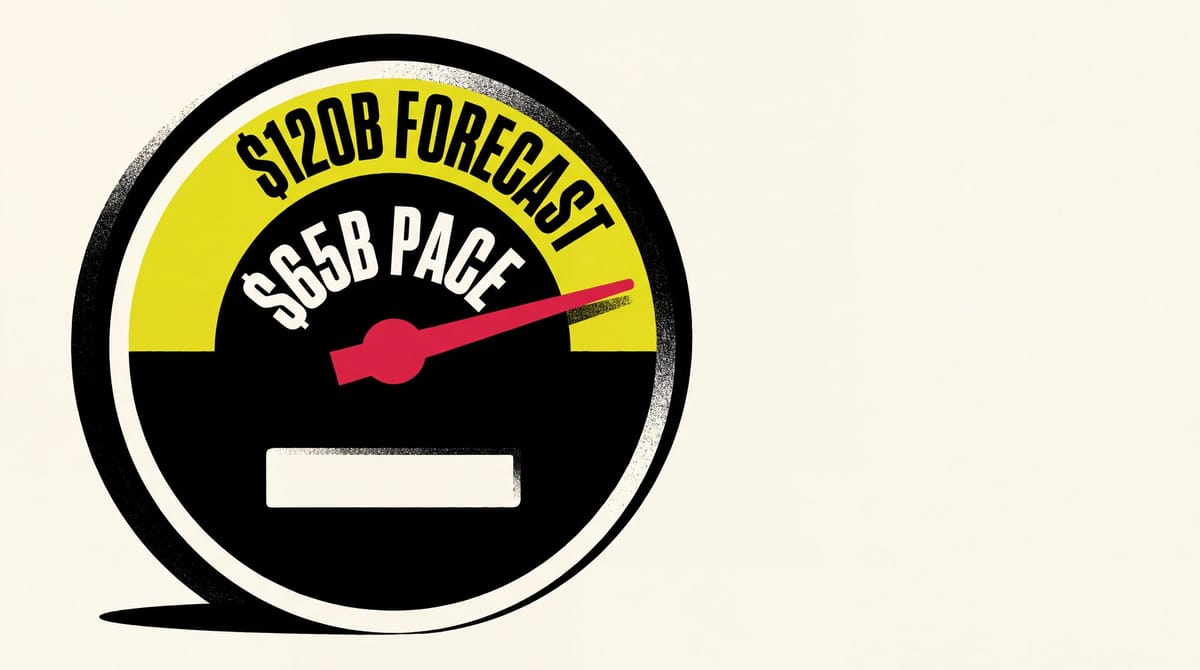
A $65 billion annualized pace and a $120 billion forecast look enormous, but Anthropic’s eventual IPO will be…
The short version
- Anthropic’s audited full-year 2026 revenue remains unknown, while reported figures mix quarterly revenue and annualized run rates.
- The annualized pace rose from $9 billion to $65 billion, while investors forecast $120 billion by year-end.
- An Anthropic IPO prospectus must clarify revenue recognition, partner payments, training costs and customer concentration before valuation claims hold.
Anthropic’s biggest revenue number comes from a year that has not happened. Investors reportedly expect a $120 billion annualized pace by the end of 2026, and the financial internet is already spending it like my uncle after selling one apartment in Milan.
The verified picture is still extraordinary. According to The Irish Times, Anthropic generated $11.5 billion in the second quarter, about 14 times the amount reported a year earlier. Its annualized revenue run rate reached $65 billion at the end of July, up from $9 billion at the end of the prior year. That is frankly rude growth.
But these numbers measure different things. Quarterly revenue covers a completed period. A run rate projects a recent month or quarter across a full year. The year-end number adds an investor forecast to that projection.
As a founder, I get the seduction. Take the hottest month, multiply it forward, order a nicer espresso machine. Public investors eventually ask for the receipt.
Anthropic revenue in 2026 depends on which clock you use
Anthropic’s audited full-year 2026 revenue remains unknown, as do its GAAP operating income and net income. Primary reporting provides preliminary quarterly revenue and an annualized pace, but Anthropic has released no public prospectus explaining the accounting policies needed to reconcile them.
Run-rate math is useful here. When a company grows this quickly, last year’s total looks prehistoric, so investors use the latest period to estimate current scale. But the calculation assumes demand holds near that pace for the next 12 months. Customer churn, contract timing and price changes can wreck that assumption. Revenue recognition adds complexity because signed enterprise contracts, consumed API capacity and marketplace cash may hit the accounts differently. Anthropic’s public materials do not explain those policies. Until they do, annualizing July gives us a speed reading, not a completed financial record.
The $120 billion forecast needs that label too. It compares an expected year-end annualized pace with the $65 billion pace reported at the end of July. Anthropic would need to nearly double its pace within months, staggering even by frontier AI standards. Maybe it does. I avoid betting against a market where companies can accidentally burn through my hometown’s electricity budget before lunch.
I will not convert that forecast into full-year revenue. Anthropic could reach the expected pace on December’s final day yet earn far less over the year because earlier months ran lower. The reverse applies if demand cools. Exit velocity reveals little about the journey.

This distinction vanishes whenever Anthropic IPO chatter heats up. A private funding round can emphasize momentum and selected operating metrics. A public filing must show periodic revenue under consistent policies, plus the expenses making the income statement much less sexy. Accountants ruin bottle service.
How Anthropic turns Claude usage into revenue
Anthropic monetizes Claude through direct API access, Claude.ai plans and AWS-connected enterprise offerings. API customers pay separately for input, output and cached tokens, while enterprise administrators control consumption and inspect usage reports. Anthropic earns more as customers move from occasional chats to repetitive production work. A coding agent may reuse a long cached context, call the model repeatedly and generate substantial output for one task. Lower serving costs let Anthropic cut prices; cheaper usage makes more jobs economical; those jobs consume more tokens. Revenue rises when usage grows faster than unit prices fall.
Anthropic has tied Claude Opus 5.5 pricing to its lower serving-compute requirements. This is the business’s cleanest causal chain. Less compute per task lets Anthropic charge less without surrendering the full economic benefit. Customers can run previously unaffordable workloads, especially agentic jobs requiring many model calls. More work enters production, consumption rises, and Anthropic collects on the volume.
The catch is obvious to anyone who has discounted a product and then nervously stared at Stripe. Customers may use roughly the same amount while paying less. Public information does not show cohort retention, consumption growth after price cuts or net revenue after distribution payments. I understand the strategy; I cannot grade the result.
AWS removes another friction point. Claude Platform on AWS uses AWS Marketplace billing and AWS identity authentication, while Anthropic operates the inference stack and processes inference inputs and outputs. Existing AWS customers can add Claude through their current procurement relationship instead of creating another vendor path, negotiating separate payment machinery and giving finance another dashboard to hate. Anthropic gets enterprise demand; AWS provides the commercial doorway. We do not know how much revenue Anthropic shares for it.
Usage also grows when Claude handles a whole workflow instead of producing one clever paragraph. A Governance-as-Code paper reported that an automated compliance pipeline reproduced a manual expert audit’s findings while cutting audit labor by about 75%. Such deployments can generate repeated model calls across documents and validation steps. They also give buyers a concrete labor baseline instead of vague “AI transformation” promises, a phrase responsible for many expensive conference lanyards.
A fair objection: generative AI does not fit neatly into every compliance framework designed for predictive systems. Rudrendu Kumar Paul and Sourav Nandy identify gaps in provenance, human oversight and emergent risk when applying EU AI Act requirements to generative models. Ronald Schnitzer and his co-authors also found that most high-risk requirements concern organizational processes and documentation; only a minority directly address AI-specific risk sources. Enterprise adoption can create enormous usage, but making those systems acceptable still costs money.
The IPO math is missing its most expensive lines
The reported profit numbers look excellent until I inspect the exclusions. The Irish Times says Anthropic expected a second consecutive quarter of positive adjusted operating income. That metric excludes costs including stock-based compensation, which has an annoying habit of becoming real once a company trades publicly.
Reported gross margin above 80% needs even more caution. It comes before revenue shared with distribution partners such as Amazon and before model-training costs, with no prior-period margin disclosed for comparison. Both exclusions are central to Anthropic’s model. Distribution opens AWS demand; constant model development keeps Claude competitive. I cannot calculate a fully loaded margin without knowing those costs and where they appear in the accounts.
The IPO valuation rumor makes those blanks impossible to ignore. Anthropic could reportedly seek a valuation of $2 trillion or more, but the company declined to comment on its valuation and listing plans. No public prospectus confirms an Anthropic IPO date, offering terms or even the accounting denominator investors would buy. Dividing a hypothetical valuation by a forecast run rate creates a tidy multiple and fake precision. I need recognized revenue, partner payments and customer concentration before calling that analysis rather than calculator cosplay.
Training costs deserve suspicion. The reported margin excludes them, and outsiders do not know Anthropic’s full training bill. Nor do we know how much revenue comes from direct API consumption, Claude.ai subscriptions, enterprise contracts, Amazon Bedrock or AWS Marketplace offerings. A direct-subscription dollar can have very different economics from one routed through a distribution partner.
The bullish case still has teeth. Revenue reportedly grew about 14 times from the prior-year quarter, adjusted operating income has been positive for consecutive quarters, and annualized pace rose from $9 billion at the end of the prior year to $65 billion in July. I expected frontier model labs to remain bottomless capital furnaces much longer, so Anthropic’s reported operating progress proved me too pessimistic. I will happily eat that prediction with olive oil and salt.
Still, audited 2026 revenue could differ sharply from the final month’s implied number. The investor forecast could miss either way. Nobody outside Anthropic and its selected recipients currently knows.
AI IPOs in 2026 will be judged by the footnotes
Anthropic is the cleanest test for AI IPOs in 2026 because its private-market narrative outruns its public financial disclosure. A prospectus would define recognized revenue, explain major distribution relationships and show standardized expenses. Auditors would test those policies across reporting periods. Investors could add stock compensation back into their calculations rather than accept an adjusted figure. Customer concentration would show whether growth comes from a broad market or several giant contracts. Risk factors would reveal how Anthropic describes training costs and regulation with lawyers in the room. That filing would benchmark every AI company behind it.
Regulation will complicate that benchmark. EU AI Act transparency rules became applicable on August 2, 2026, with the Commission supporting implementation through guidelines and a Code of Practice. Obligations for stand-alone high-risk systems under Annex III now apply from December 2, 2027, later than the previously scheduled August deadline. Vendors get more implementation time, not less work.
EDPB Deputy Chair Jelena Virant Burnik said:
The new EDPB guidelines are a major step in further aligning how Data Protection Authorities decide whether an administrative fine should be imposed, either on its own or alongside other corrective measures. The GDPR significantly increased the corrective powers of DPAs, with fines serving as an important instrument for effective enforcement. The guidelines reaffirm our commitment to providing greater clarity and ensuring the consistent application of the GDPR across Europe.
Clausebench put it perfectly:
A later date is more time to do the same amount of work, not less work.
Anthropic may benefit if its controls help customers meet those obligations, since compliance workflows can sustain API consumption. But Anthropic must also fund the product work, documentation and oversight enterprise buyers expect. Its prospectus should show whether trust is a paid product advantage or an expensive requirement attached to every sale.
And when is the OpenAI IPO?
The material available for this analysis contains no confirmed OpenAI IPO date or public filing. I will not invent one for search traffic. Anyone promising precision without a prospectus has added a calendar widget to financial fan fiction.
The same goes for Anthropic. The company is preparing for a potential public listing, but that does not confirm a date. A filing matters more than more valuation gossip because it should reveal revenue-recognition policies and major cost composition.
My Anthropic IPO prediction is dated and simple: during its first week of public scrutiny, the revenue-recognition footnote will move the valuation conversation more than any Claude benchmark released that month. The first model investors must interrogate lives inside the spreadsheet.
Frequently asked questions
What is Anthropic’s revenue in 2026?
Anthropic’s audited full-year 2026 revenue is not publicly known. Reporting cited in the article gives $11.5 billion for the second quarter and a $65 billion annualized run rate at the end of July, while investors reportedly forecast a $120 billion annualized pace by year-end.
Is Anthropic planning an IPO?
Anthropic is preparing for a potential public listing, but no public prospectus confirms an IPO date, valuation, or offering terms. A filing would need to explain recognized revenue, distribution relationships, standardized expenses, stock-based compensation, customer concentration, training costs, and regulatory risks.
When is the OpenAI IPO?
No confirmed OpenAI IPO date or public filing appears in the material analyzed. Without a prospectus, claims that assign a precise listing date are unsupported. A public filing, rather than a rumored calendar date, would provide the reliable evidence needed to assess timing and offering details.
Sources
- Anthropic Moves Ahead With I.P.O. Plans Amid A.I. Safety Debate
- Anthropic tops $100 billion revenue pace, report says
- Anthropic’s $2 Trillion IPO Could Reprice the Entire AI Market
- AI doomerism isn't on investors' list of worries
- Introducing Claude Opus 5.5
- Partnering with Accenture on embedded evaluation