
KTM Opened Seven Sealed MotoGP Engines: With Every Rival's Consent
Seven sealed RC16 engines were repaired under FIM supervision, preserving KTM’s allocation while raising the line between a fix and development.
The short version
- KTM opened seven sealed RC16 engines for same-spec repairs after unanimous rival approval and under FIM supervision.
- The serviced engines retained their usage history and allocation status, restoring usable inventory rather than creating fresh units.
- Repairing suspect parts may let KTM relax protective limits, but durability matters more than one fast Aragon result.
Seven sealed KTM MotoGP engines went onto the operating table, and every rival manufacturer signed the consent form. In this paddock, that’s basically a minor diplomatic miracle.
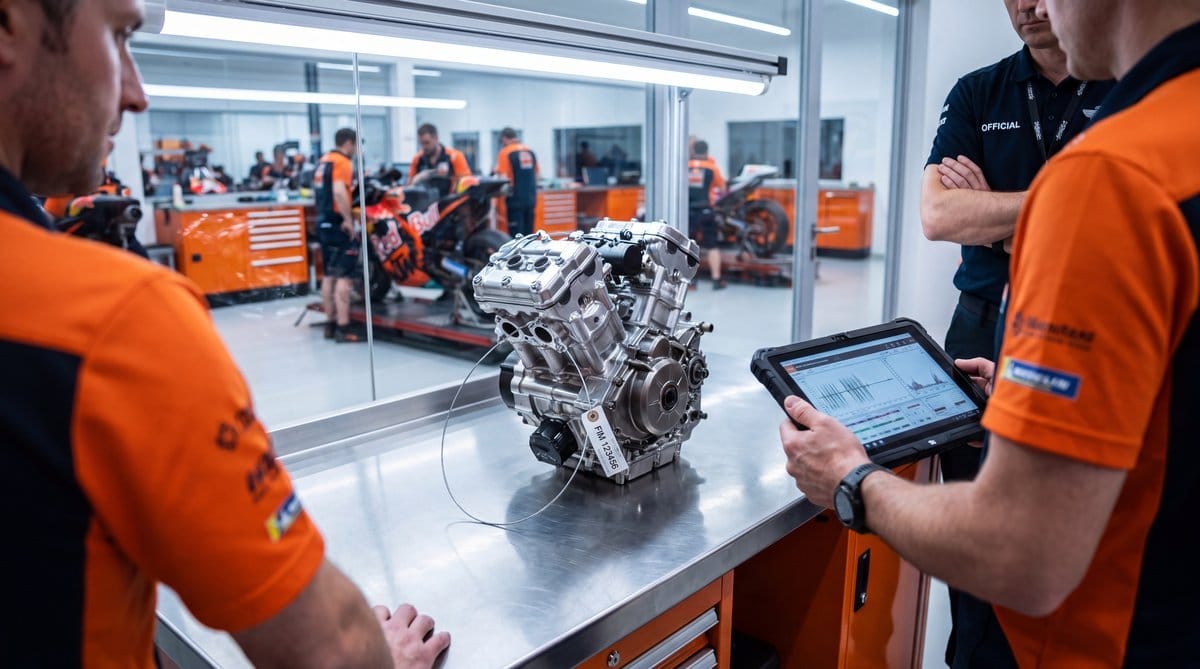
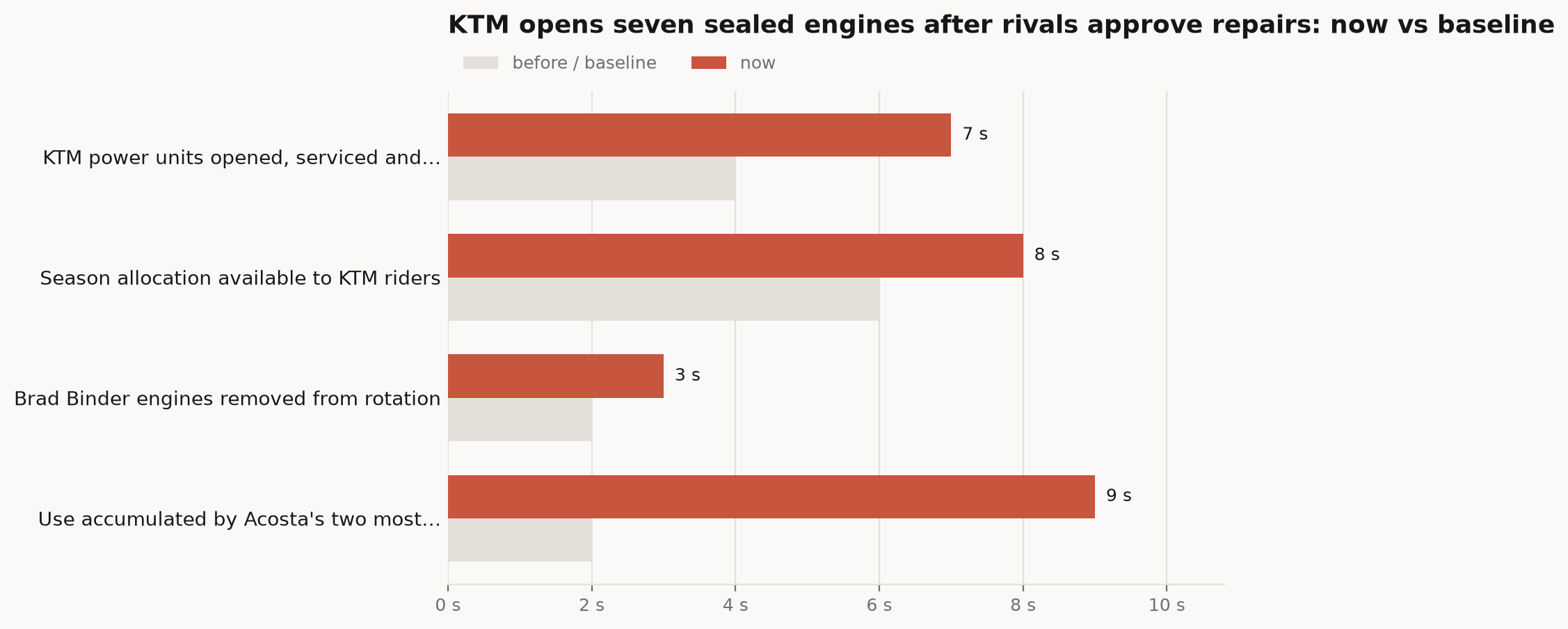
The work happened at KTM’s Munderfing facility under FIM supervision ahead of the 2026 Aragon Grand Prix. Four of the seven RC16 engines belonged to Pedro Acosta; the other three had served KTM’s remaining riders, though nobody has disclosed who got which unit. These were engines already counted within KTM’s season allocation. No bonus motors dropped from the MotoGP vending machine.
KTM said high-stress powertrain parts had failed to meet the required quality standard. Its proposed fix would restore the homologated specification, with officials watching as the engines were opened, serviced and resealed.
Any sneaky change in materials or dimensions would turn maintenance into development wearing a fake moustache.
How KTM got through the seals
I think of an engine seal as an audit log attached to an extremely expensive crankcase. My self-hosted Docker stack is also “locked down,” yet I can still enter production when something catches fire. The difference is permission, supervision and a record of what changed. Otherwise, security means staring respectfully at the outage while customers scream.
Here’s the chain that matters. Recurring reliability problems pushed KTM to restrict engine power or maximum revs at selected races, reducing stress on the suspected component. The engine freeze prevented engineers from casually replacing that part, while the seals made unauthorized access obvious. KTM therefore proposed a corrective intervention that would preserve the approved engine specification and asked every rival manufacturer to consent. Once approval arrived, technicians could open the affected units under FIM supervision, replace the accepted suspect parts plus consumables disturbed during disassembly, and present everything for inspection. Resealing returned the serviced engines to KTM’s legal rotation from Aragon. Without that process, KTM faced the lovely choice between running questionable engines and abandoning units that still counted against its allocation.
Grande Prêmio reported that Aprilia supported KTM’s request earlier, while Ducati, Honda and Yamaha needed more convincing. Fair enough. Unanimity is a terrible way to order dinner with an Italian family, but it works rather well when one factory wants access to frozen engines.
Autosport and Motorsport.com place the work at Munderfing under FIM supervision. Earlier reporting from AS expected an IRTA technical representative to verify the changed element, giving officials a chance to ensure that “corrective” had not become paddock dialect for “faster.”
The seven engines kept their previous use and remained inside KTM’s original allocation. Servicing made them available again. It did not wipe their history clean.
Why the other manufacturers said yes
Ducati, Honda and Yamaha had every reason to inspect KTM’s request with the warmth of an Italian nonna judging supermarket pesto. A legitimate repair establishes a useful precedent for future supplier defects. A hidden upgrade hands KTM free performance. The agreed scope had to be narrow enough for officials to verify.
There was also a practical reason to approve the work. KTM said supplier-related parts had failed to meet the specified quality requirement, so leaving the engines sealed would punish the factory for hardware that allegedly fell outside the approved standard. FIM supervision reduced the opportunity to introduce design changes while the cases were open. Any rival could encounter a similar supplier problem later, and blocking KTM outright could create a precedent that eventually bites everyone. Sudden failures can also endanger nearby riders, especially when a bike cuts out in traffic. Approval gave KTM a controlled repair route while preserving each manufacturer’s ability to challenge anything beyond the agreed scope. The initial suspicion was healthy because this entire exception depends on the inspection being credible.
Autosport cited an earlier Yamaha case involving supplier-produced M1 valves that were outside tolerance by hundredths of a millimetre. Rival manufacturers approved corrective work there as well. That precedent helps explain the procedure, though it offers zero proof about which KTM component failed.
Motorsport.com and Autosport describe the pneumatic valve system as the prime suspect. KTM has never publicly confirmed the exact component or documented failure mode, and we lack a complete list of parts installed during the supervised work. We also don’t know whether every opened engine received the same repair. Claims that all seven units got identical pneumatic-valve replacements are running several laps ahead of the evidence.
I got one part of the reliability story wrong at first. Acosta’s Barcelona cutout looked like an obvious symptom of the mechanical problem, but Racing365’s summary of Speedweek traced that incident to standard electronic engine management. Racing machinery remains extremely good at humiliating anyone who mistakes a tidy timeline for proof.
Tech3 boss Guenther Steiner described how personally KTM management treated the wider issue:
They did the utmost to fix it, and Pit Beirer always kept me well-informed about what they're doing. It was very personal to him. He really wanted to fix this, because obviously it was a big issue.
A repair can release power already inside the RC16
Several headlines have called the serviced engines “practically new.” My moka pot looks practically new after I replace the gasket, and yet Ducati has never asked to inspect it for illegal performance gains. Condition and specification answer separate questions.
A same-spec repair can still make the RC16 quicker through a simple causal chain. When a component looks vulnerable under heavy stress, KTM lowers revs or available power to reduce the chance of another failure. That protective setting prevents riders from using the engine’s full approved operating range. Engineers then install a conforming replacement and gain confidence that the assembly can handle its intended load. KTM may relax the temporary restrictions and recover output already present in the homologated package. Officials must verify the replacement because a redesigned component capable of tolerating higher loads could create a genuine performance gain. The line between repair and development lives inside that inspection.
Motorsport.com says ordinary consumables such as gaskets, washers and lubricants also needed replacing during the work. That proves very little about performance. Nobody reuses a disturbed gasket out of sporting purity; even parc fermé has limits, grazie a Dio.
The Aragon setup remains unknown. Autosport and Motorsport.com reported that KTM could retain some protective limits after the repairs, while several secondary articles expect full power immediately. KTM has published neither the size of its temporary reduction nor confirmation that every restriction will disappear. There is no public dyno comparison, top-speed study or controlled lap-time test showing what changed. A faster RC16 at Aragon would settle little on its own because track conditions, tyre behaviour and setup can move lap times before anyone reaches for the conspiracy corkboard. Durability is equally opaque: nobody outside KTM and the supervised process knows whether these engines will survive the rest of the season.
The repair rescued Acosta’s shrinking engine pool
Acosta had opened six engines from his allowance of eight before Aragon. Two had already been removed from rotation, so repairing the remaining four used units restored options while preserving his final pair of unopened engines. That matters more than the “practically new” label.
Engine allocation becomes vicious inventory math once failures start. Teams rotate power units according to accumulated use and the demands of each circuit. When one engine drops out, its planned sessions shift onto the survivors, which then age faster. Another failure squeezes the schedule again and pushes the team toward opening a fresh unit earlier than planned. Eventually the rider reaches the allocation boundary with too much season left and no pleasant choices. Returning a serviced engine interrupts that spiral because the unit can rejoin the rotation. Its completed work still counts, so KTM has recovered usable inventory rather than discovering youth in a bottle.
Acosta’s two busiest units had covered nine versus seven race weekends, according to Motorsport.com on August 24, 2026, with Silverstone usage still unconfirmed. Weekend count doesn’t reveal exact mileage or workload, but the older engine had already endured two more events than the other. That is meaningful wear in a championship where KTM had already been managing reliability through reduced stress.
Brad Binder was under even tighter pressure. He had removed three of his six opened engines from rotation, compared with Acosta losing two after opening the same number. The three repaired units assigned outside Acosta’s pool eased pressure elsewhere, although public reporting has not identified how KTM divided them among its other riders.
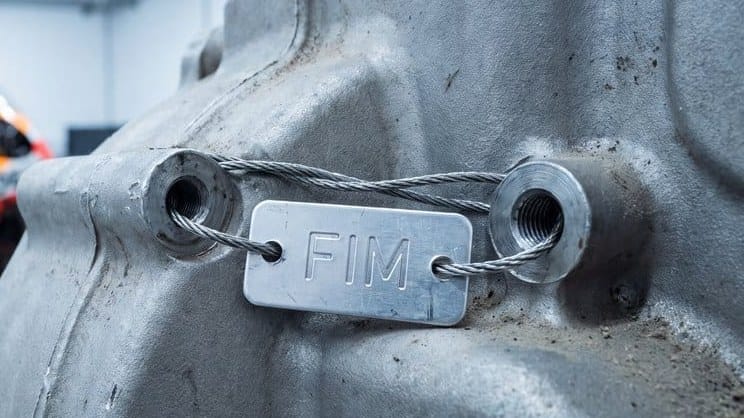
Now the stopwatch gets to cause trouble. If KTM arrives at Aragon with more speed, social media will diagnose an illegal upgrade before the first espresso cools. I’ll take the less glamorous bet: by the final race of 2026, the survival rate of these repaired engines will matter more than one fast Sunday. FIM seal wire can police an engineering process. It cannot bless a bad part into staying alive.
Frequently asked questions
Why was KTM allowed to open seven sealed MotoGP engines?
KTM opened seven sealed MotoGP engines because high-stress powertrain parts allegedly failed to meet required quality standards. Rival manufacturers unanimously approved a narrow, same-spec repair process under FIM supervision, allowing suspect parts and disturbed consumables to be replaced before the engines were inspected, resealed and returned to legal rotation.
Does opening KTM’s sealed engines give the team more power?
A same-spec repair does not create a new engine or erase prior use. It can restore performance indirectly if KTM relaxes temporary rev or power restrictions imposed to protect vulnerable components. Any redesigned part that tolerates higher loads could constitute development, which is why officials inspected the work.
How did the engine repairs affect Pedro Acosta’s allocation?
Pedro Acosta had opened six of eight allowed engines and removed two from rotation before Aragon. Repairing his four remaining used units restored rotation options while preserving two unopened engines. The serviced units kept their previous usage history and continued counting within KTM’s original seasonal allocation.
Sources
- Primary trending article
- KTM finally gets to 'revitalize' its MotoGP engines
- KTM takes advantage of MotoGP break to service engines after deal with rivals
- KTM opent MotoGP motorblokken na problemen: ingrijpende operatie voor Aragón
- Acosta presiona a KTM
- Pedro Acosta: "I asked KTM some tough questions"