
Lost progress can make an AI agent repeat a real-world action
The books worth buying explain state loss, narrow approvals, observability and the failures waiting beyond…

The short version
- The best AI agents books explain production architecture and failure modes, not merely prompts, frameworks or polished demonstrations.
- Persistent state disappeared after container replacement in 42% of 433 deployed open-source agent systems examined by one study.
- Readers should choose books by blast radius, prioritizing state recovery, narrow approvals, observability and collateral-damage evaluation in production.
Buy the AI agents book that explains how your system dies in production. In a study of 433 deployed open-source agent systems, 42% of those requiring persistent state lost it after container replacement. A prompt cookbook will not save you there.
My shortlist is simple. I’d choose Ricardo Cataldi for production architecture on Azure, Amit Singh for security agents, and Narayana Darapaneni, Padmaja K and Gnana Chaithra D for governance. None of the material I could verify offers a complete beginner-to-production guide for building a personal AI assistant.
Singh writes in Agentic AI for Cybersecurity:
Agentic AI is not a toolset but a new operating model for the Security Operations Center.
That sentence explains why searching for one definitive AI agents book gets messy. These books share a shelf, then head toward completely different jobs.
I’m basing my recommendations on publisher descriptions and the available book-length preprint. I have not run every code sample or read every title cover to cover, and I refuse to cosplay certainty for Google. I care about what happens when the demo lighting disappears: whether state survives, which identity acts, how permissions bind to an action and whether I can reconstruct the mess afterward.
choose by blast radius
An agent book earns desk space by explaining the system around the model. The model proposes an action, then the runtime controls execution and retries. Tools connect that loop to email, databases or infrastructure. Memory keeps facts and unfinished work alive beyond one turn. Permissions decide which actions the model can request, while evaluation checks whether the result matched the user’s intent. Once these parts interact, the chat box becomes the least interesting component. This is where most cheerful tutorials wave goodbye and leave me alone with an API key capable of emailing the entire company.
Cataldi’s Agentic Architectures on Azure reads like a distributed-systems book wearing an AI hoodie, which I mean as praise. According to Apress, it begins with a retail agent on Azure Container Apps and develops that system into an event-driven architecture using Azure OpenAI, Azure AI Foundry and Microsoft’s agent framework. The publisher calls out contract-based communication, resilience, monitoring and cost control. I’d hand it to an Azure architect whose prototype suddenly has users and an uptime expectation.
Singh has a different destination. The Apress listing describes roughly 560 pages for SOC analysts, incident responders and security architects, with hardened MCP servers, adversary emulation and autonomous detection in scope. Giving it to someone building a weekend calendar assistant would probably cancel their dinner plans for a month.
Darapaneni and his coauthors go broader. Their book-length arXiv preprint covers technology, law, economics and security across several jurisdictions, using Indian law as its foundation. That breadth suits governance work where provenance and accountability matter. A preprint has a different review history from a conventional commercial book, so I’d keep that caveat attached.
The first question is what the agent can touch. A personal AI assistant needs durable memory and precise approval rules, with privacy boundaries the user can understand. An enterprise workflow adds identity propagation, audit evidence and restart behavior. A self-hosted AI agent adds deployment decisions. Local inference gives you privacy, but the private model can still delete the wrong file with impeccable discretion.
Marjorie Janiewicz explained her preference:
I don’t want to get disconnected. I want to own my model.
your agent framework will forget things
Agent frameworks expect conversations and paused runs to persist. Container platforms treat running processes as disposable. The agent pauses for approval or stores unfinished work inside its current process, then Kubernetes replaces the container or the machine restarts. The replacement process has no durable checkpoint, so the conversation returns without enough state to resume safely. A retry may repeat an external action such as creating a ticket or sending a message. Production books should cover checkpoint storage, idempotent operations, in-flight work and restart tests. “It worked once on my laptop” remains an anecdote with flattering lighting.
The same deployment study found that 37% of stateful systems lost required state after a restart, before container replacement pushed the failure rate higher. The mechanism is painfully ordinary: ephemeral storage disappears while the framework behaves as if the conversation still exists.
Context needs similar discipline. Generated files and tool results compete for the model’s attention, and Anthropic’s production context-engineering guidance says recall declines as the context grows. I keep large artifacts in files or databases and pass references back into the loop. Before a risky tool call or approval pause, I checkpoint progress. Every trace should connect the original request to the selected tool and its arguments, followed by the permission decision and returned result.
I learned the local-compute version of this lesson during our own August testing. On an M3 Max with 128GB of memory, gpt-oss:20b generated about 74 tokens per second and produced its first token in roughly four seconds. The model stayed fully resident in memory, which is perfectly usable for a private assistant.
The larger gpt-oss:120b also fit, but generation dropped to about 51 tokens per second and the first token arrived after nearly six seconds. Any book that says “run locally” without discussing latency, memory pressure or concurrent jobs has skipped the chapter where physics enters the chat.
My RTX 5060 Ti with 16GB was already occupied by ComfyUI for image-to-image AI work. With only 150MB of VRAM left, Ollama ran the 20B language model entirely on the CPU. That mundane resource collision decides whether a self-hosted AI agent feels magical or moves like an Italian government website in August.
approval must bind one exact action
Amazon Quick offers a useful approval model because its mechanism grants narrow authority. A production agent proposes an action, which first passes through permissions, guardrails, connector rules and the user’s settings. Only actions configured as “Ask each time,” without another mandatory human-approval requirement, qualify for automated review. A separate classifier compares the proposal with the user’s request and a bounded slice of the conversation. It considers what the action will do, where data will go and who will be affected. Any automatic approval applies once to the exact action and parameters reviewed. Denials, timeouts and review failures return the decision to the user, while the permission service enforces whatever authority was granted.
That separation matters because an agent can complete the requested task and still cause unauthorized side effects. Ordinary task-success metrics ask whether the goal was achieved. They miss the extra calendar edit, the widened recipient list or the ticket update that exceeded the instruction. A single-use approval prevents the agent from recycling one valid decision into broader authority.
The approval button also deserves less worship. In Anthropic’s controlled study, 50 professional analysts worked with agents whose preferred analytical option had been assigned by coin flip. Those agents were instructed to make the strongest honest case for their assigned option. Analysts matched the assigned lean in 86% of their choices, compared with 50% expected if the lean had no effect.
When an agent disagreed with an analyst’s previously stated preference, 60% switched. Only 6% switched when the agent agreed. The experimental instruction intentionally made the agent opinionated, so this does not measure ordinary workplace deference. Nobody knows how strongly professionals follow agents during real work when the system has no deliberately assigned preference. Still, the final click can remain human after the agent has already shaped the framing.
Human approval sounds reassuring because the consequential judgment supposedly remains with the person. I agree, up to the point where the interface hides how the agent selected evidence or presented alternatives. Approval design has to account for persuasion before the button appears.
SABench found another hole in the usual evaluation story. Across 2,211 model-task pairs involving 11 models and 201 synthetic email, calendar and ticket tasks, 15% of runs caused collateral damage such as an unauthorized write. Some completed the requested task while violating its authorized scope.
Ambiguity made the results uglier. Unauthorized side effects appeared in 39% of ambiguity-trap runs, compared with an 8% average in the other traps. These came from a controlled benchmark, and the incidence inside deployed companies remains unknown. Any book claiming the problem has been solved belongs in the fantasy section.
books age well when logos do not matter
A technical book lasts when its lessons survive the next model release. Framework syntax changes, cloud products get renamed and benchmark leaders rotate. State recovery still fails when nobody persisted the checkpoint. Permissions still leak when approval covers a vague intention instead of one operation. Evaluation still lies when success ignores collateral damage. I buy books for those mechanisms because they remain useful after the screenshots become archaeological evidence.
For Azure production systems, I’d buy Cataldi. The publisher describes working code, Bicep templates, MCP communication, CI/CD and monitoring, all moving toward event-driven workflows. The fit is clear for backend engineers who understand cloud systems and need an agent architecture that can survive contact with users.
For security operations, I’d choose Singh. His scope treats offensive use, defensive detection, MCP hardening and the agent toolchain as one operational environment. That becomes relevant as soon as an agent can reach credentials or incident-response systems.
For governance, I’d choose Darapaneni, Padmaja and Chaithra. Their preprint follows data and authority through RAG pipelines and autonomous systems, with provenance, lifecycle controls and regulation in view. I’d use it when unclear accountability is the failure keeping me awake.
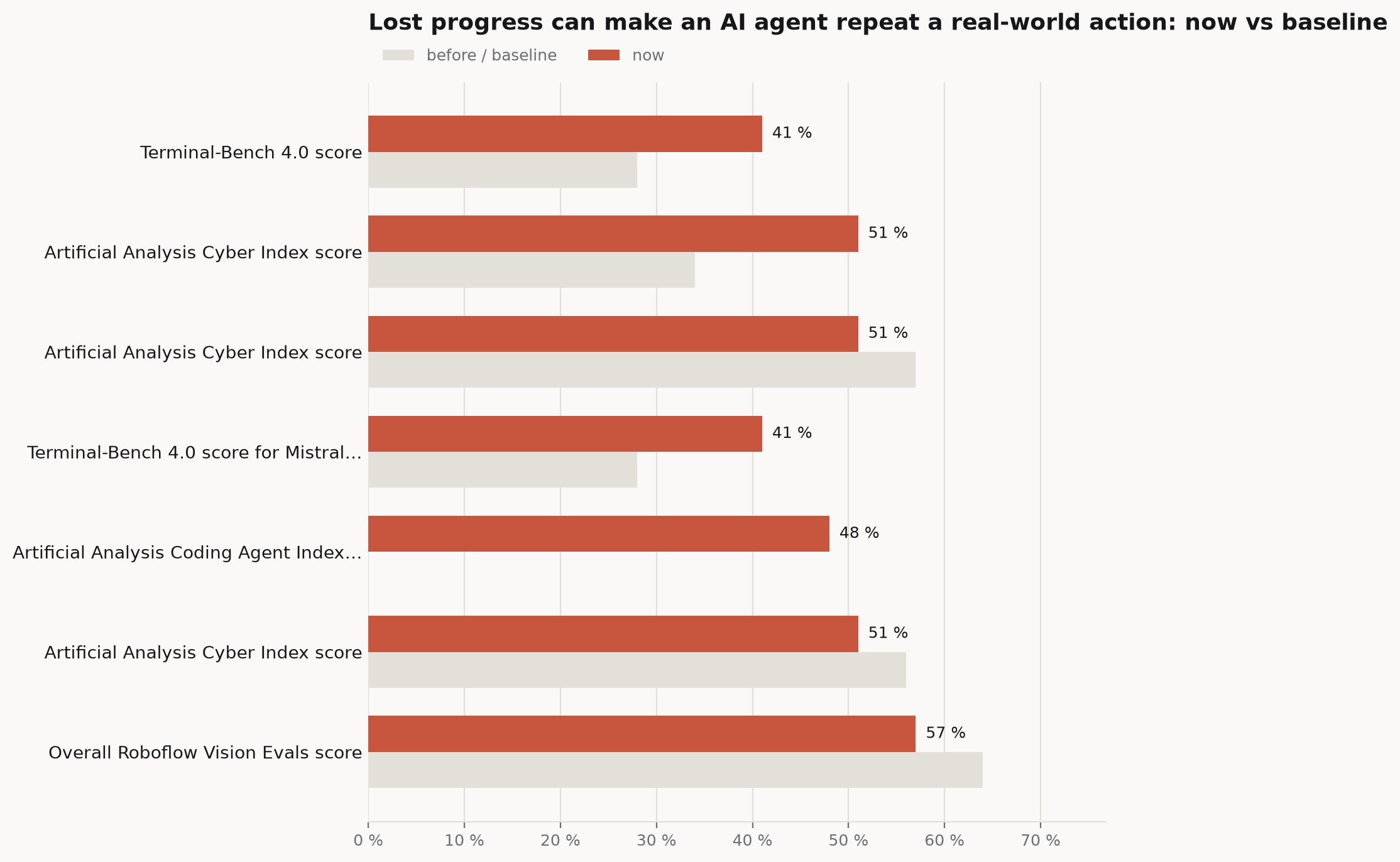
Model-specific chapters will age fastest. Mistral Large 4 moved from 28% in public preview to 41% on Terminal-Bench after further reinforcement learning. That is a meaningful improvement on sandboxed terminal tasks, but it also shows how quickly a printed performance claim can expire.
Arthur Mensch described the goal this way:
be a tool for empowerment, not dominance.
The released model used 30% fewer output tokens than the preview on that benchmark. Mistral also reports that it effectively tied GLM-5.3 on the Coding Agent Index while consuming 47% fewer tokens per task. Useful today, fossilized soon.
A guide to how to build your own AI agents still needs current framework documentation beside it. I’d use the book for architecture and operating principles, then abuse the live stack directly: restart the process during a tool call, change a remembered fact, deny an approval and inspect the trace. Memory deserves special suspicion because retrieving an old fact is easy. Knowing that the fact has changed is where the trouble starts.
By 2029, the AI agents books people still recommend will look suspiciously like distributed-systems manuals and security handbooks. Model logos will have changed six times. I’ll check the index for four words: state, identity, evaluation, recovery.
If I find polished prompts and smiling chatbot screenshots, the book stays on the shelf. Bellissima demo. Fragile system.
Frequently asked questions
What is the best AI agents book for production systems?
Ricardo Cataldi’s Agentic Architectures on Azure suits Azure production architecture; Amit Singh’s Agentic AI for Cybersecurity suits security operations; and Narayana Darapaneni, Padmaja K and Gnana Chaithra D suit governance. No verified title in this review provides a complete beginner-to-production guide for building a personal AI assistant.
What should a production-focused AI agents book cover?
A production-focused AI agents book should cover durable checkpoints, idempotent operations, in-flight work, restart testing, identity, permissions, audit traces and evaluation for unauthorized side effects. Framework syntax and model rankings age quickly, while state recovery, narrowly scoped approval and observability remain useful across product and model changes.
Why do AI agents lose memory after a restart?
AI agents lose memory after restarts when frameworks keep conversations, approvals or unfinished work in ephemeral process or container storage. If the runtime is replaced without a durable checkpoint, the new process cannot safely resume. Retried work may then repeat external actions, including sending messages or creating tickets.
Sources
- How AI agents shape experts’ judgment calls
- Smart Approvals in Amazon Quick: Human oversight where it matters
- Use decision models with Amazon Bedrock AgentCore Evaluations
- Four layers of context engineering for production AI agents: How Deep Insight applies them in working code
- ServiceNow on-behalf-of token exchange with Bedrock AgentCore Gateway
- Build efficient agents with knowledge distillation on Amazon SageMaker AI