
Anthropic IPO: Will the Electric Meter Set the Price?
Claude's growth looks extraordinary, but cloud-partner economics, compute contracts and Texas permits may determine what investors get.
The short version
- Anthropic has filed confidentially, but no official valuation, share count, price range or debut date exists.
- Revenue comparisons are distorted by run-rate assumptions, channel mix and different accounting treatment for cloud-partner sales.
- Investors should prioritize compute cost per revenue dollar, contractual obligations and infrastructure constraints over model leaderboard scores.
The Anthropic IPO will be sold from a chat window and priced from an electric meter. Claude feels weightless, but behind that tidy box Anthropic is writing enormous checks for chips, cloud capacity, electricity and buildings stuffed with cooling equipment.
I understand why investors love the revenue chart because I’m a founder who once spent an embarrassing afternoon tweaking chart colors while the ugly cost assumptions waited three tabs away like unpaid parking tickets. Software trains us to expect better margins as the product scales. Frontier AI has software’s growth rate and the appetite of an Italian family ordering Sunday lunch.
Anthropic’s growth deserves the hype. Its eventual IPO price still depends on how much money survives after cloud partners collect their share and Claude answers the next flood of prompts.
The paperwork still has giant holes
Anthropic has confidentially submitted a draft prospectus, but it has announced no official valuation, share count, price range or debut date. Those missing fields matter more than whatever month is circulating in banker group chats.
The available sources do not explain the mechanics of Anthropic’s IPO process in enough detail for me to fake certainty about its sequence or timing. A confidential draft shows that the company has entered the regulatory process, while preliminary investor meetings show that management is testing its pitch. Neither gives public investors official terms they can evaluate. Anthropic still controls when it publishes, and the filing could change before anyone outside the process sees it. Until the company releases documents with an actual price range and share count, every valuation headline comes from investor expectations. I enjoy gossip as much as the next terminally online founder, but it belongs beside the aperitivo, far away from the spreadsheet.
CNBC reported that the early meetings focused on Claude, enterprise adoption, management and Anthropic’s release pace. Its sources described high-level conversations with no specific valuation or detailed financial discussion, which tells me plenty about the sales pitch and very little about the stock.
OpenAI CFO Sarah Friar reportedly told employees that both companies had filed confidentially and suggested Anthropic could publish first. She also stressed that each company controls its own schedule. I’m treating every rumored autumn date as calendar fan fiction until Anthropic releases the paperwork.
Even then, the numbers will need close reading. Nobody outside the process currently knows Anthropic’s audited net income or cash flow. Its gross margin remains undisclosed, along with the adjustments behind its reported positive operating result. We also lack the split between direct sales and cloud-partner sales, which determines how much of the reported revenue Anthropic actually keeps.
My checklist starts with the public registration statement, exchange, ticker and final prospectus. Those are the load-bearing details when someone wants a gigantic check.
Revenue run rates come with accounting baggage
Fortune reported preliminary second-quarter 2026 revenue of about $12 billion, up from roughly $800 million in the corresponding quarter a year earlier. The documents were shown to prospective investors, and the figures remained subject to revision. Even with that caveat, the acceleration is bananas.
Axios reported that Anthropic reached a $65 billion annualized revenue pace at the end of July 2026, compared with OpenAI’s reported run rate above $40 billion. Both Axios and Fortune warned that the companies may calculate those figures differently.
Here is how a gorgeous comparison becomes financial cosplay. Completed-quarter revenue records sales recognized during a defined period, while a run rate takes a recent pace and stretches it across a year under the assumption that momentum continues. That assumption gets fragile when a model launch or token-price change can move usage overnight. Accounting adds another wrinkle. Separate reporting says Anthropic records the full value of some sales made through cloud partners, with partner economics appearing later in expenses, while OpenAI reportedly records only its share. Two companies can process similar customer spending and publish very different top lines. A valuation multiple built from those top lines may compare accounting presentation as much as customer demand.
Gross presentation can be completely legitimate if Anthropic controls the service being sold. It still changes the economics of every revenue dollar I see. A dollar booked gross through a cloud partner may leave less behind than a dollar sold directly, so channel mix can drag margins around even while the headline run rate looks magnificent.
The public filing needs to show how much revenue comes directly from customers, how much flows through partners and what Anthropic pays those partners. I also want the principal-versus-agent accounting policy in plain English. Nobody has disclosed those details yet, so any clean Anthropic-versus-OpenAI revenue table comes with a large asterisk wearing sunglasses indoors.
Investors have reportedly projected that Anthropic could seek about a $2 trillion valuation, double the roughly $1 trillion level attached to its late-May private funding round. Anthropic has announced neither figure as an IPO term, and CNBC says its early meetings avoided discussing a specific valuation.
The bullish case deserves a fair hearing. Anthropic has exceptional growth, and investor enthusiasm can outrun conventional valuation models when a company appears to own a new computing platform. I can accept that argument. I still need consistent revenue definitions before deciding what multiple anyone is paying.
Profit depends on who owns the factory
Fortune says Anthropic’s preliminary materials showed positive adjusted operating income for the second quarter of 2026. I expected the company to be farther away from that threshold, so this genuinely undercuts part of my skepticism. I was too pessimistic there.
Adjusted operating income leaves plenty of room for mischief, especially before an IPO. Gross margin shows what remains after delivering the service, while operating income then includes the cost of running the company, although an adjusted version can exclude selected expenses. Net income moves farther down the statement and includes financing costs plus taxes. Free cash flow follows the actual money moving through the business and subtracts spending needed to maintain or expand it. Anthropic can therefore post positive adjusted operating income while major contractual payments keep draining cash. A complete income statement would show where the exclusions sit, and a cash-flow statement would reveal whether the business funded itself during the period. Anthropic has published neither, so the early result is encouraging with too many gaps to call conclusive.
Fortune calculated that a company valued near $2 trillion would need roughly $60 billion to $80 billion in annual profit to trade around the average trailing and forward earnings multiples of the Nasdaq’s largest technology companies. Anthropic has disclosed no net-income figure against that benchmark, only the preliminary adjusted operating result.
That comparison is imperfect because a fast-growing AI company deserves different assumptions from a mature Nasdaq giant, and public investors regularly pay for growth years before it reaches the income statement. The calculation still shows the altitude involved. Anthropic must turn an early adjusted profit into earnings on the scale of America’s largest businesses.
Compute obligations will decide whether it gets there. Reporting based on a SpaceX filing puts Anthropic’s payment for access to SpaceXAI clusters at about $1.3 billion per month, with the agreement running through May 2029. Reduced initial-period fees were reported without a disclosed amount, so multiplying the headline rate across the full contract would overstate what we know.
Long contracts can secure scarce capacity and make supply more predictable. They can also become expensive furniture when demand misses the forecast or a competitor improves efficiency faster. Anthropic has not disclosed how much compute it owns, leases or accesses under short-term arrangements, which makes the unit economics impossible to reconstruct from outside.
Investor Evan Schlossman put the ownership question bluntly:
Do they own that?
He also wants to know whether Anthropic leases the capacity and how long those contracts run. The answer determines whether growth produces operating leverage or another invoice.
A Texas permit can hit the valuation
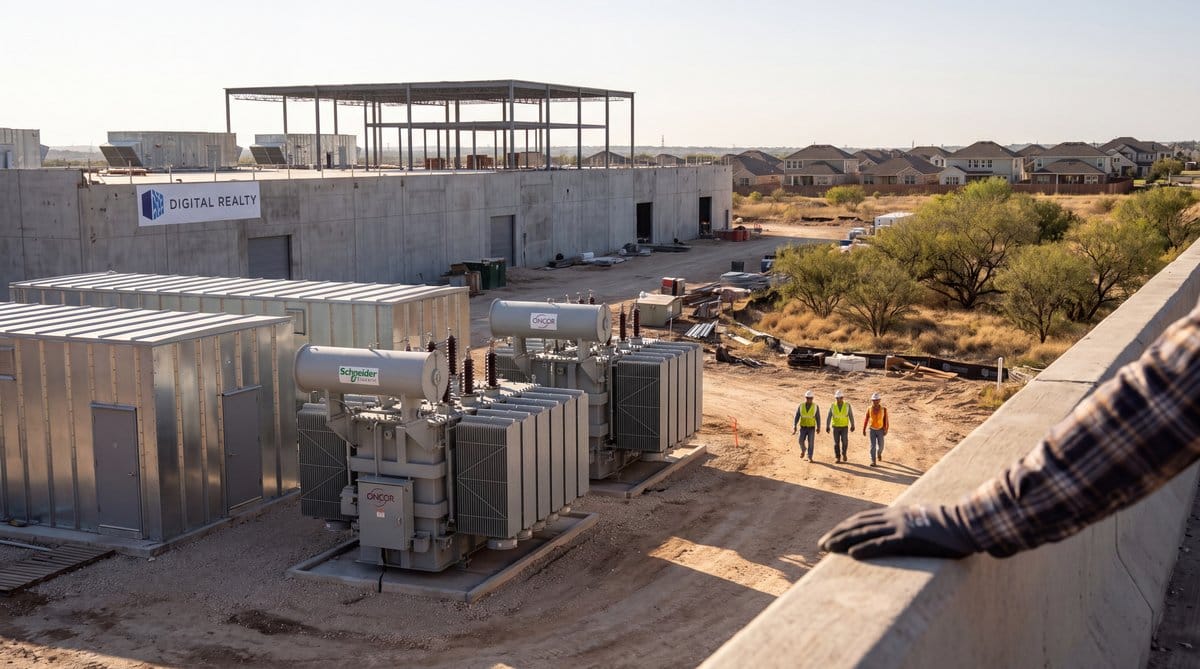
Customer demand only becomes revenue when Anthropic has enough machines available to serve it. That supply depends on infrastructure partners expanding compute capacity, and prospective investors have already questioned the company about what happens if data-center construction slows.
The path from a local permit to an IPO valuation is brutally direct. More Claude usage requires additional compute, which needs functioning data centers with grid connections and cooling. Developers need regulatory approval before those facilities can open. A delayed project leaves Anthropic with less capacity than its forecast assumed. Scarcity can raise serving costs or force the company to limit usage. Higher prices may push customers toward cheaper models, while usage caps reduce the revenue Anthropic can recognize. Either outcome damages the growth expectations built into the valuation. Public investors then lower the multiple.
Local resistance is becoming measurable. An Annenberg survey found 61% of U.S. adults opposed new data centers nearby, up from 49% in the preceding spring survey. That is a 12-point rise.
The nationally representative poll covered about 1,300 adult citizens from mid-June to mid-July 2026. Polling cannot cancel a construction project by itself, but it gives mayors and state regulators a strong incentive to demand tougher conditions.
Texas has already turned that pressure into operating requirements. Governor Greg Abbott’s office says Anthropic and its infrastructure partners agreed to preconstruction audits covering power demand and water plans, plus incentives and ownership. Regulators say they need complete information to make grid decisions, and state agencies can deny approval when developers fail to comply.
Abbott’s warning was unusually clear:
They must not pass costs on to Texas families or interfere with their quality of life.
Those protections are reasonable, and they add dependencies to Anthropic’s capacity schedule. Nobody has quantified how permitting delays or local opposition would affect its available compute, growth rate or valuation. The company has also yet to publish its company-wide greenhouse-gas emissions; Anthropic says it is still measuring the footprint.
Ioannis Ioannou described the scale of the concern:
We’re talking about the potential environmental impact of a scale that we haven’t seen before.
When Anthropic finally publishes its prospectus, I’ll search for minimum purchase commitments, termination rights and supplier concentration. I’ll also look for margin sensitivity tied to electricity and cloud-partner pricing. A benchmark win in San Francisco earns zero dollars when the required substation in Texas is waiting on an audit.
Here’s my dated bet: within Anthropic’s first year as a public company, investors will care more about compute cost per dollar of revenue than model leaderboard scores. Claude may sell the shares. The electric meter will grade them.
Frequently asked questions
When will Anthropic go public?
Anthropic has confidentially submitted a draft prospectus, but it has not announced an IPO date, valuation, share count or price range. The company controls when it publishes its registration documents, and rumored autumn dates remain unconfirmed until official terms appear in a public filing.
What will Anthropic’s IPO valuation be?
Anthropic has not announced an official IPO valuation. Investors have reportedly projected a valuation near $2 trillion, while its late-May private funding round was associated with roughly $1 trillion. Early investor meetings reportedly avoided a specific valuation, so both figures remain expectations rather than formal IPO terms.
Is Anthropic profitable?
Anthropic’s preliminary materials showed positive adjusted operating income for the second quarter of 2026, but the company has not disclosed audited net income, free cash flow or gross margin. Positive adjusted operating income can coexist with heavy contractual payments and cash outflows, so full financial statements are still necessary.
Sources
- Anthropic CFO Krishna Rao is leading early IPO meetings with investors and has not discussed valuation, sources say
- Anthropic IPO valuation hinges on $190-200 billion 2028 revenue forecast, sources say
- Anthropic Revenue Surges to Over $11.5 Billion in Second Quarter
- Anthropic’s Annualized Revenue Tops $65 Billion Before IPO
- Anthropic Pre-IPO Credit Facility Set to Climb Past $10 Billion
- Anthropic Set to Add Citigroup to Top IPO Banks on Mega-Listing