
How to Make Pasta from Scratch Recipe: 2 Ingredients
Egg dough, rolling, troubleshooting and a glossy Alfredo come together in a practical fresh-pasta guide built on touch, timing and two ingredients.
The eggs breached their flour wall and headed straight for my laptop. Apparently my first batch of fresh pasta had strong opinions about venture capital. This how to make pasta from scratch recipe is the rescue plan I wish I’d had that night: knead 300 grams of 00 flour with 165 grams of egg, rest the dough for 45–60 minutes, roll it thin, cut it and boil it for 2–4 minutes.
Two ingredients. Plenty of chaos.
I grew up in Ivrea and have cooked for years between Torino and Los Angeles. I’ve also made noodles with the structural integrity of wet charging cables. Measurements get me started; my hands decide when dinner is ready.
How do I make pasta from scratch?
I make pasta from scratch by combining 300 grams of 00 flour with 165 grams of beaten whole egg. I knead the dough until smooth, wrap it for 45–60 minutes, then roll, cut and boil it in salted water. This makes about four portions.
The ingredient list is aggressively short:
- 300 g Italian 00 flour
- 165 g whole egg, approximately 3 large eggs
- Semolina flour for dusting
- Optional: 2 g fine sea salt
That ratio comes from the Chef Italiano Channel’s pea and ricotta ravioli recipe. Natasha Kravchuk also keeps her basic dough to flour and eggs, which I appreciate because my kitchen already contains enough devices capable of firmware errors.
Kravchuk wrote on Natasha’s Kitchen:
After my trip to Italy, I’ve adopted the Italian method – a simple 2-ingredient* dough made with just flour and eggs that can be shaped into fettuccine, linguine, lasagna noodles, ravioli, and more.
I mound the flour on the counter, make a wide well and beat the eggs inside with a fork. Then I pull flour inward gradually. Once the mixture resembles shaggy scrambled eggs, I use a bench scraper to gather everything into a dough.
The well method looks gorgeous until the eggs escape. A bowl works perfectly well. My nonna would disown me for saying that, but she never had a MacBook sitting 40 centimeters from the crime scene.
I knead with the heel of my hand: push the dough away, fold it back, rotate and repeat. Kravchuk starts at about 5 minutes, while Claudia Lamascolo recommends 8–10. I watch the dough more closely than the clock. It should feel firm, elastic and smooth.
Lamascolo described the target in Yahoo Creators:
Knead it for about 8 to 10 minutes, or until the dough becomes smooth and elastic. If the dough feels too dry, add water a few drops at a time. If it feels sticky, lightly dust the work surface with flour. The finished dough should feel soft and pliable but not sticky.
I wrap the dough tightly and leave it alone for 45–60 minutes. Then I divide it into four pieces, keeping three covered while I flatten the first into a rough rectangle.
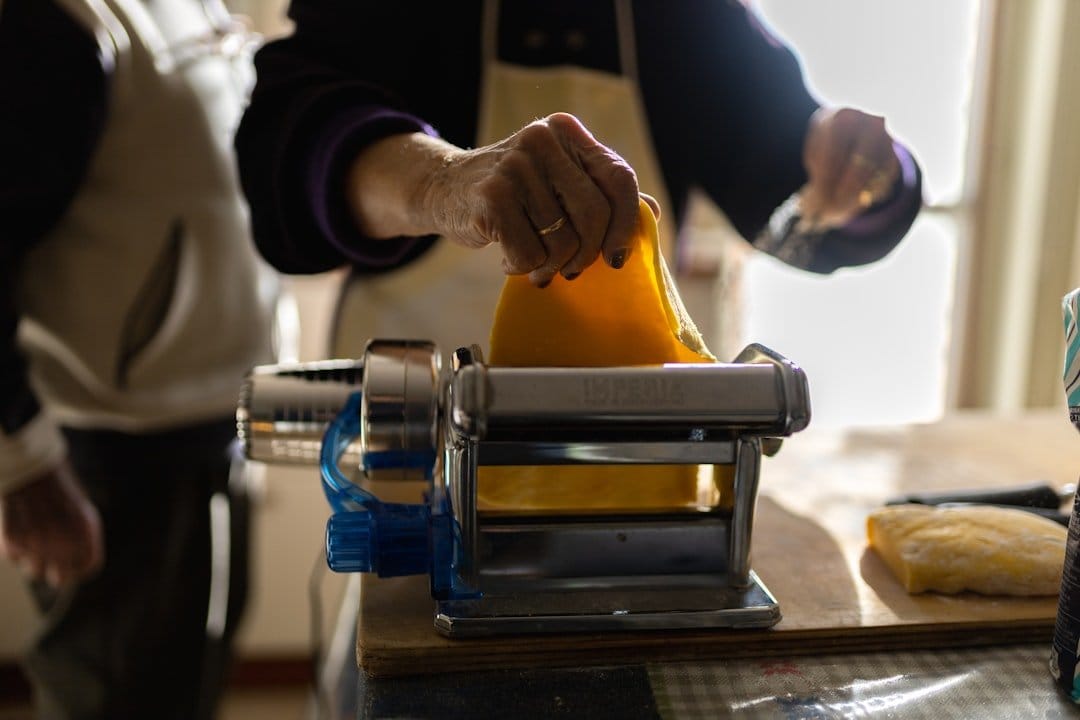
That piece goes through the widest pasta-machine setting. I fold it into thirds like a letter and run it through again, then work through the settings one at a time. SBS Food’s scarpinocc recipe says setting No. 6 produces a sheet around 2 mm thick. For fettuccine or pappardelle, I continue until my fingers are faintly visible through the dough.
I cut the sheet, dust the strands with semolina and form loose nests. Fresh noodles usually cook in 2–4 minutes, depending on thickness. I taste after 90 seconds because optimism has ruined enough pasta already.
Why fresh pasta dough misbehaves
My homemade pasta usually fails because the dough is too wet, too dry, poorly rested or exposed to air while I roll it. Egg size, humidity and flour absorption change each batch, so I adjust by touch.
I hold back a little flour during mixing. Forcing every gram into a batch made with small eggs creates a crumbly brick. If the dough stays sticky, I dust it lightly. If it refuses to come together, I add water a few drops at a time.
00 flour gives me the silkiest result. All-purpose flour also works, though the dough feels softer. I’d happily use King Arthur all-purpose before driving across Los Angeles for imported flour. Semolina earns its shelf space on trays and cut noodles because it prevents clumping.
Resting fixes an embarrassing number of problems. Kravchuk allows 20 minutes to one hour. The Chef Italiano Channel rests its ravioli dough for 45–60 minutes. SBS uses a 5–10-minute break between kneading stages, followed by another 30-minute rest.
Kravchuk explains why:
Rest the dough – shape the dough into a disk and wrap in plastic wrap. Rest on the counter for 20 minutes or up to an hour. Resting relaxes the gluten, making it easier to roll.
I used to fight dough that snapped back because founders are professionally trained to believe more force will solve resistance. I was wrong. Now I cover it, make an espresso and doomscroll responsibly.
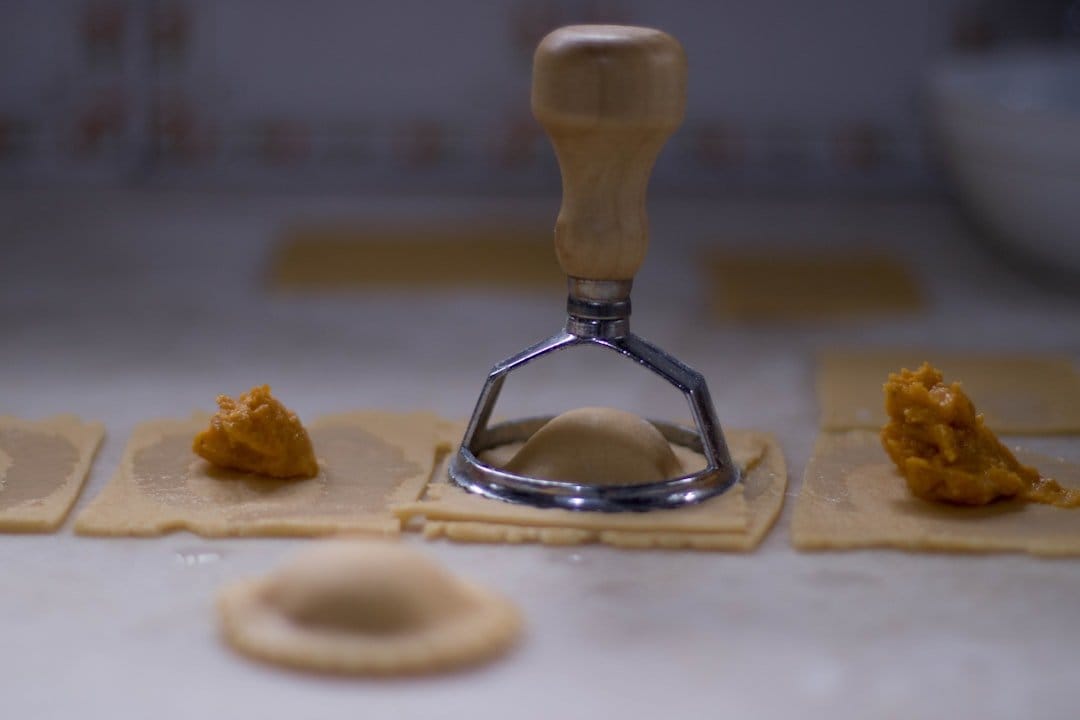
Filled pasta brings moisture and trapped air into the equation. I keep unused sheets covered, leave a clean border and press around each mound before sealing. SBS specifies a 6 mm border for scarpinocc. Lamascolo warns that excess filling and trapped air can burst ravioli.
Wet filling needs time to drain. The Chef Italiano Channel’s pea ravioli recipe drains ricotta for at least four hours, preferably overnight. One extra spoonful of watery ricotta can turn a tray of beautiful ravioli into tiny dairy grenades.
How do I make pasta Alfredo sauce from scratch?
I make pasta Alfredo sauce from scratch by emulsifying 25 grams of butter with hot pasta water, then tossing the pasta off heat with 70 grams of finely grated Parmigiano. I add water gradually until the sauce turns glossy and coats four portions of fresh pasta.
Alfredo-style sauce is an emulsion. Finely grated cheese melts into butter and starchy water. Excessive heat gives me expensive Parmesan gravel.
The Chef Italiano Channel’s light Parmigiano emulsion uses 70 g Parmigiano Reggiano, 25 g butter and up to 160 g hot pasta water. I treat 160 g as a ceiling. Rome has issued no command requiring me to use every drop.
My sequence is simple. I move the cooked pasta into a warm pan with the butter and a splash of water. I take the pan off the heat, add the cheese and toss aggressively. More water goes in by the spoonful until the sauce looks glossy.
People searching how to make Alfredo sauce often expect the richer Italian-American version with cream. I allow a small splash because I enjoy happiness and have zero ambition to join the dairy police. Cream adds richness, though scorched cheese will still ruin the evening.
Lamascolo suggests creamy Alfredo or Parmesan cream for mushroom and spinach ravioli. With fresh noodles, I use a lighter hand. Delicate egg dough disappears quickly beneath a dairy avalanche.
The pea-ravioli recipe uses 300 g of peas, restrained ricotta and a light Parmigiano coating. Its author puts the idea perfectly:
If you want people to remember the peas, every other component must know when to step back.
Excellent sauce knows when to shut up.
When authentic Italian Bolognese recipes work
I pair authentic Italian Bolognese recipes with broad fresh tagliatelle because the ribbons hold a thick meat ragù. Delicate filled pasta gets a lighter sauce so I can still taste the filling.
Fresh pasta loses some matchups. I love sturdy tagliatelle with slow-cooked ragù. For spaghetti aglio e olio, I open the box. Dried pasta has the firm bite that garlic, oil and chili need, and I refuse to perform authenticity cosplay in my own kitchen.
Lamascolo lists thick Bolognese among her ravioli sauce ideas, particularly for substantial meat fillings. Pea ravioli should stay far away from it.
The same logic applies to Mantovana-style scarpinocc filled with pumpkin, Parmesan, pear, amaretti and mostarda. SBS finishes that already-complex pasta with browned butter, sage and balsamic. Adding ragù would turn dinner into a Marvel crossover nobody requested.
I’ll roll tagliatelle by hand for Sunday ragù. On Tuesday, the box opens at 7:14 p.m. without shame. Any Italian who claims otherwise has never been hungry after a late Zoom call.
Frequently asked questions
How do I make pasta from scratch?
To make pasta from scratch, combine 300 grams of 00 flour with 165 grams of beaten whole egg. Knead until smooth, wrap and rest the dough for 45–60 minutes, then roll, cut and boil it in salted water for 2–4 minutes. The recipe makes about four portions.
Why does fresh pasta dough need to rest?
Fresh pasta dough needs to rest because resting relaxes the gluten, making the dough easier to roll. A 45–60-minute rest also helps prevent the dough from snapping back during shaping. Keep the dough wrapped while it rests so the surface does not dry out.
How do I make pasta Alfredo sauce from scratch?
To make pasta Alfredo sauce from scratch, emulsify 25 grams of butter with hot pasta water, then toss the pasta off heat with 70 grams of finely grated Parmigiano. Add the water gradually until the sauce is glossy and coats about four portions of fresh pasta.
Sources
- Homemade Pasta
- Gordon Ramsay’s Homemade Pasta Dough Recipe
- Scarpinocc alla Mantovana
- Step inside the Atlas kitchen with chef Freddy Money’s latest cookbook
- Orecchiette with Broccoli Rabe & Zesty Pangrattato
- Ravioli with Pea, Ricotta & Mint