
Italian sparkling wine regions: Franciacorta shifts talk
Franciacorta’s first DWWA Best in Show forces a smarter conversation about Satèn, Trentodoc, Alta Langa, and Italy’s serious bubbles.
I’ve lost count of how many times someone told me they love Italian bubbles and then meant exactly one thing: Prosecco. That’s the whole problem with how people talk about italian sparkling wine regions. Outside Italy, the category gets flattened into either cheap brunch fizz or “pretty good, for not-Champagne.” Lazy. Wrong. A little insulting, honestly.
This year Franciacorta forced that conversation to grow up. Freccianera Satèn Brut 2022 took Franciacorta’s first-ever Decanter World Wine Awards Best in Show in 2026, and according to La Repubblica, it was also the only Italian sparkling wine in Decanter’s top 50 wines worldwide this year. My reaction wasn’t shock that it won. My reaction was: finally. The wine world needed a trophy this loud to notice what was already in the glass.
And the important part isn’t just that Franciacorta won. It’s what won.
Why are Italian sparkling wine regions getting more attention now?
Italian sparkling wine regions are getting more attention because Franciacorta just earned its first DWWA Best in Show with a Satèn, giving global proof that Italy’s top traditional-method wines belong in the premium conversation. That matters because it shifts the story away from the tired Prosecco-versus-Champagne binary and toward regional identity, food pairing, and quality.
According to Decanter’s DWWA coverage, Champagne took two of the four Best in Show sparkling awards in 2026. So this wasn’t some soft year where everyone politely agreed to spread the love. Franciacorta won in the category where Champagne still walks in like it owns the place.
But the bottle that won was Satèn, which is exactly why this matters.
Satèn is one of Franciacorta’s most distinctive styles. It’s not Italy doing a decent French impression. It’s Franciacorta being unapologetically itself. Lower pressure, softer mousse, more silk than spray. Less “look at me,” more “sit down, dinner’s ready.”
Decanter’s Charles Curtis MW made the key point when he highlighted Satèn’s lower pressure and softer texture, saying it’s especially suited to drinking with food rather than only as an aperitif. That line matters because it cuts through years of bad retail copy and even worse Instagram wine education. Some sparkling wines are built for the pop. Satèn is built for the plate.
I’ve seen this mismatch a million times in the US. Someone orders Champagne because that feels like the serious move, then drinks it with a delicate crudo or a risotto that needed something less sharp, less loud, less desperate to be the main character. Not a worse wine. Just the wrong energy.
That’s the thing people miss. We’ve trained drinkers to think sparkling wine is a prestige ladder when it should be a question of texture and behavior at the table. My nonna would never have said “behavior at the table” about wine because she was from Piemonte and had better things to do, but she absolutely judged bottles by what they did with food. Ruthlessly.
That’s why this award lands for me. Franciacorta didn’t win by imitating prestige. It won with a style that behaves like an Italian wine should.
It wants to eat.
Which Italian sparkling wine regions actually matter?
If you care about serious bubbles, the short list starts with Franciacorta, Trentodoc, Alta Langa, and Oltrepò Pavese, with Monti Lessini as the smart-person wildcard. These are Italy’s key traditional-method regions for texture, acidity, aging potential, and real food pairing, not just easy aperitivo drinking.
These are Italy’s core metodo classico zones. Wines built for texture, acidity, aging, and actual meals. Not just easy sipping. Not just wedding-pour duty.
That framing lines up with Decanter calling northern Italy the “historic heart” of serious metodo classico, which feels exactly right. Trentino, Lombardy, and Piedmont are where the conversation gets serious fast, because the geography does real work. Cooler growing seasons. Alpine influence. Big day-night swings. Slow ripening that preserves acidity instead of turning everything into fruit salad with bubbles.
That’s why Trentodoc matters so much. Decanter points back to Giulio Ferrari making Chardonnay in Alpine conditions more than a century ago and setting an early benchmark for the category. It also identifies Trentodoc as Italy’s first DOC devoted to metodo classico, which is not some cute trivia question for wine nerds. That should be basic knowledge if you claim to care about sparkling wine.
And yet somehow Italy still gets treated like a Prosecco vending machine.
I was born and raised in Ivrea, so I grew up with the northern Italian habit of taking land, weather, and local identity almost absurdly seriously. Regions weren’t abstractions. They had personalities. Alta Langa wasn’t “Italian Champagne.” It was Alta Langa. Different food. Different mood. Different logic. Very Italian, by the way: we share a passport and still act like the next province over is a mysterious foreign power.
Alta Langa brings that Piedmontese severity I secretly love. Oltrepò Pavese has had the raw material to overdeliver forever, if people would bother paying attention. Monti Lessini is the bottle I like mentioning because someone always either lights up or starts pretending they’ve been drinking it for years. Both reactions are funny.
The larger point is simple. If your map of Italian sparkling wine begins with Prosecco and ends there, your map is broken.
What is Franciacorta Satèn, and why does it taste different?
Franciacorta Satèn is a white-only traditional-method sparkling style made at lower bottle pressure, which gives it a softer mousse, creamier texture, and rounder feel than more aggressive sparkling wines. It tastes different because it is designed to be elegant and silky, not sharp and showy.
That lower pressure sounds nerdy until you taste it. Then it’s obvious.
Satèn doesn’t attack. It lands.
The Franciacorta consortium describes the style with roundness, creaminess, silky sensations, floral notes, and yellow fruit, sometimes with vanilla and butter if wood is involved. Marketing language is usually where I start rolling my eyes, but here it’s actually pretty accurate. Satèn feels different in the mouth before you even start playing tasting-note bingo.
And again, Curtis’s point in Decanter is the one that matters most: Satèn is especially suited to food, not just aperitivo. That distinction is huge because Americans are often taught sparkling wine in exactly three settings: brunch, New Year’s, and weddings where the chicken has the texture of a legal dispute.
I say this with love because I live between Torino and Los Angeles, and both places have their own bad habits. In Italy, we can be snobs about categories. In America, people get weirdly rigid about occasion. Satèn doesn’t fit either lazy script. It’s subtle. It asks you to pay attention. Which, fair enough, is not always what people want after one martini and a loud restaurant playlist.
Last month in Milan I had a Satèn with seafood risotto that made immediate, physical sense. No peacocking. No giant autolytic speech. Just this creamy, fine-bubbled texture carrying the dish instead of stepping on it. That’s when you remember how many wine lists still treat serious Italian sparkling wine like the opening act before the “real” bottles arrive.
I’ll admit something mildly humiliating: when I was younger, I underestimated Satèn too. I thought softer meant less serious. Very dumb take. Not my dumbest take, but definitely top ten. What changed my mind wasn’t a tasting seminar.
It was dinner.
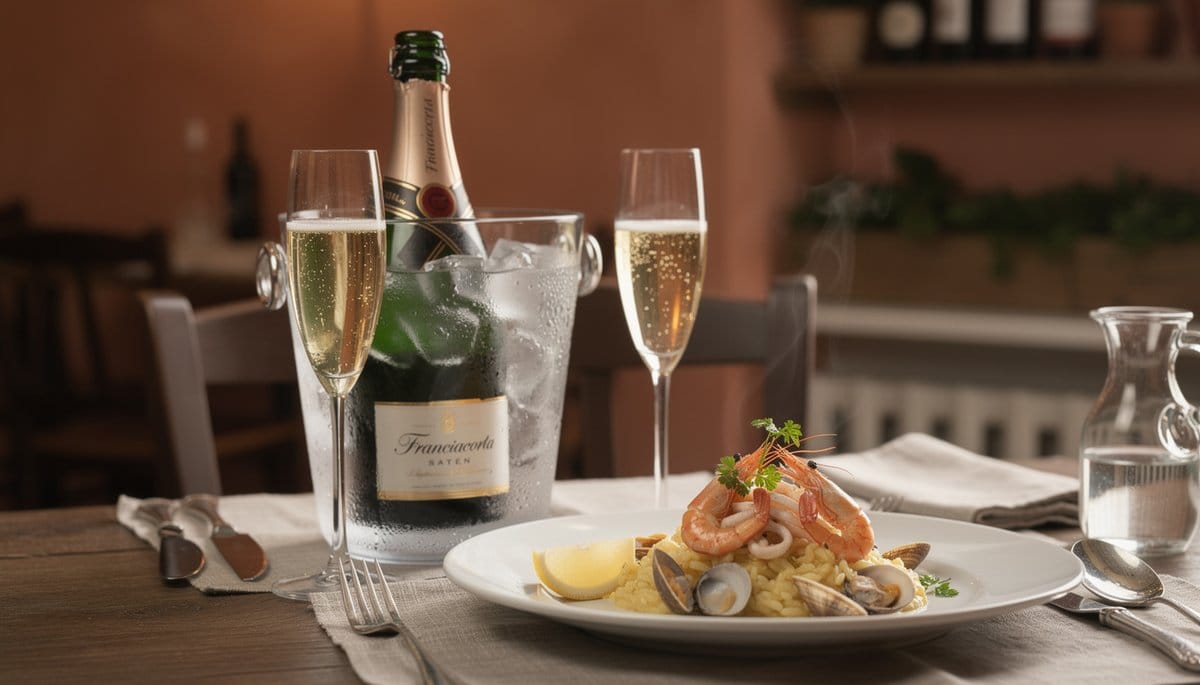
Why does Franciacorta work so well at the table?
Franciacorta, especially Satèn, works with food because it has the acidity and complexity of traditional-method sparkling wine without the kind of aggressive mousse that can bulldoze a dish. It handles richer textures and quieter flavors with more grace than many people expect.
That’s the real story behind the medal. Awards are nice. Restaurant behavior is better. A wine becomes culturally relevant when sommeliers put it on lists people actually order from, especially by the glass or in pairings, not just on page 19 next to the trophy bottles nobody touches unless they’re expensing dinner.
That’s why I paid attention to Decanter’s reporting on the Star Wine List 2026 Global Final, where more than 130 sommeliers, chefs, and restaurateurs from 28 countries gathered in southern Sweden. That’s not random industry theater. That’s where habits get formed.
From those regional competitions, 195 restaurants and wine bars won Gold Stars, and 66 venues were represented in person at the final. Those numbers matter because stores create familiarity, but dining rooms create belief. You can walk past a bottle on a shelf a hundred times and still not understand it. Then one smart sommelier pours it with the right dish and suddenly the whole category clicks.
One quote from Jonathan Gouveia MS stuck with me. The broader framing was about wine lists having soul, which I love. A list with soul doesn’t just stack famous labels like Pokémon cards for rich adults. It makes an argument.
That’s where Franciacorta can win long term. Not as the obvious flex. As the sommelier’s move.
Look at Inddee in Bangkok, a Michelin two-star restaurant that opened in 2023 and still won Best Medium-Sized List for a second straight year. That kind of recognition tells me the global fine-dining scene is rewarding curation, not just inventory. A smart sparkling program exists to make dinner better, not to reassure insecure people that they picked the expensive thing.
And Freccianera isn’t some tiny vanity label that disappears the second demand shows up. According to La Repubblica, the house makes more than 300,000 bottles a year and already has a solid presence in major restaurants and enoteche across Italy and Europe. That’s a useful scale. Big enough to matter. Small enough to keep an identity.
Different world, same lesson: the thing that wins isn’t the thing that demos best. It’s the thing that works beautifully in context. Wine, grazie a Dio, is not software. But the pattern holds.
Franciacorta at its best is a context wine.
Restaurant-native. Food-native. Human.
Is Franciacorta just Italy’s version of Champagne?
No. Franciacorta uses the same traditional method, but calling it “Italy’s Champagne” shrinks the wine instead of explaining it. Its identity comes from Italian terroir, culture, and styles like Satèn that Champagne does not replicate.
The Drinks Business put it well when it described Franciacorta as “often unfairly dubbed ‘Italy’s answer to Champagne’.” Unfairly is the key word. It sounds flattering until you realize it traps Franciacorta inside somebody else’s story, like the nicest thing an Italian sparkling wine can be is French-adjacent.
I hate this framing. It’s lazy intellectually and limiting commercially. It tells drinkers to evaluate Franciacorta by resemblance instead of by what’s actually in the glass. That’s a bad habit in wine and, honestly, in life.
The category is already moving beyond it anyway. According to The Drinks Business, Franciacorta has been showing up at Milan Fashion Week, the Rome Film Festival, and even the Emmy Awards. Yes, there’s some glamour baked into that. Yes, it’s a little glossy. But it also means Franciacorta is building its own cultural language instead of waiting for permission.
One producer quoted there said Franciacorta and the arts both transform complexity into something that appears effortless, timeless and unmistakably Italian. That line could have been unbearable. Annoyingly, it’s kind of true. Italians are very good at making refinement look casual, usually because we’ve spent three hours pretending lunch was spontaneous.
What also matters is scale. The Drinks Business notes Franciacorta’s small production, which makes this visibility shift more interesting. This isn’t a giant category brute-forcing attention with ad budgets and airport displays. It’s a relatively small denomination getting pulled into bigger cultural spaces because the wine and the image finally line up.
For the record, I love Champagne. Deeply. I have made financially irresponsible decisions in Champagne. But not every premium sparkling wine needs to explain itself in relation to Reims like it’s asking a cooler cousin for validation.
Why does this feel like a turning point for Italian sparkling wine regions?
This feels like a turning point because it gives drinkers a globally validated story about Italian sparkling wine regions that is not trapped in the dead Prosecco-versus-Champagne binary. Franciacorta’s win points instead to premium Italian bubbles defined by food compatibility, restaurant credibility, and regional identity.
And the field was real. Decanter notes that Champagne still took two Best in Show sparkling winners in 2026: De Saint-Gall Orpale Blanc de Blancs Brut Grand Cru 2012 and Charles Collin Cuvée Charles Blanc de Blancs 2012. Curtis called 2012 a “five-star vintage” and said it was the best since the epic 2008 vintage. So no, Franciacorta didn’t win because the adults were absent.
England kept pushing too. Decanter highlighted Balfour Blanc de Blancs 2018 from Kent, after Sugrue South Downs The Trouble With Dreams 2009 won the previous year. I like that detail because it reminds you serious sparkling wine is now a genuinely global category. The conversation is no longer France versus everyone else with the occasional polite interruption.
That makes Franciacorta’s breakthrough more meaningful. It didn’t win a provincial contest. It stood out in a field where Champagne remains the benchmark and English sparkling keeps getting sharper.
So here’s my hot take, which is not even that hot if you spend enough time around good restaurant lists: the next big divide won’t be Prosecco versus Champagne.
It’ll be shelf wine versus table wine.
The bottles that win long term are the ones people actually want with dinner, not just the ones they recognize in a store or in a nightclub photo where the lighting makes everyone look like they have a vitamin deficiency. That’s where Satèn, Trentodoc, Alta Langa, and the rest of the serious metodo classico zones have room to grow. They make sense in the place wine matters most: the meal.
People will still start with Prosecco. Fine. I’m not trying to shut down anyone’s spritz hour. I’m saying the category gets much more interesting once dinner starts.
I think the next status bottle in Italian restaurants won’t be the one people recognize fastest. It’ll be the one that makes the meal taste better.
And if Franciacorta really escapes the Prosecco/Champagne binary, this Best in Show won’t look like a random medal from 2026. It’ll look like the moment people finally realized Italy’s best sparkling wine had been sitting at the grown-ups’ table the whole time.
The only question is whether drinkers will figure it out before the algorithm does.
Sources
- Sparkling Glory: DWWA 2026's Best in Show winners
- Where are the world’s best bar and restaurant wine lists? Meet the winners for 2026
- Don’t miss db’s Italy Report 2026, out now
- L’eccellenza italiana delle bollicine
- Franciacorta Satèn
- Freccianera Fratelli Berlucchi