
Before trusting Google’s Orchestrator, check whether its handoffs can be traced
Google’s Orchestrator lets Hydrogen hand a difficult coding task back to Carbon. The savings look promising;…

The short version
- Antigravity’s Orchestrator lets Hydrogen return difficult coding work to Carbon for investigation and revised planning within the same session.
- Google reports 24% lower average quota use and 19% faster completion than Carbon alone, but benchmark version labels conflict.
- Developers evaluating Orchestrator should test handoff visibility and failure recovery directly, rather than treating standalone model benchmarks as workflow validation.
Gemini 4 Hydrogen: I want a receipt for the handoffs
I’d give Google’s Antigravity Orchestrator a stubborn dependency upgrade before permission to ship. A model picker borrowing the periodic table is entertaining; a coding session quietly changing who’s doing the thinking deserves scrutiny.
Gemini 4 Hydrogen interests me because Google’s workflow lets the execution model hand control back to a planner when things get awkward. Half of shipping software is discovering why the apparently simple job was described incorrectly.
But appealing design isn’t proof. Google has promising benchmarks. Independent tests add qualifications. And some information I’d need before trusting automatic handoffs hasn’t arrived.
I’d make Orchestrator deal with a broken plan
In Antigravity, selecting Orchestrator instead of one model delegates a decision: when execution needs more investigation. As Google argues, a long-running task’s complexity can change after a static router handles the opening prompt. Anyone who’s called a migration “just updating a package” can supply testimony.
Google’s example starts with Carbon exploring dependencies read-only, resolving ambiguities and producing a plan with triggers for reconsideration. Hydrogen takes over to edit code, update packages and run tests. Friction returns control to Carbon, which inspects the current state and revises the plan before execution resumes. Switching happens within the session; the initial model assignment needn’t survive every repository surprise. This is Google’s example, not a session I’ve run, and the supplied material establishes no universal escalation threshold.
The return trip catches my attention. A planner that writes instructions and disappears leaves the executor interpreting every surprise. Google’s design lets the planner inspect the changed repository and repair assumptions using evidence unavailable at the start.
I see the appeal during a dependency upgrade: an unrelated-looking test fails after several files have changed, and I need someone to investigate whether the plan was incomplete. Keeping that investigation in-session would spare me reconstructing the situation for another model.
But sensible workflows aren’t necessarily dependable implementations. I want this to work, which makes me keener to test whether Carbon returns at a useful moment and whether its revised plan resolves the failure.
Google also lets developers assign explicit agent roles through the Antigravity SDK. I’d treat that as a separate integration choice: roles configured in advance versus Orchestrator’s switching as the task develops.

My first trial would be a repair with a clear failing test and enough dependency interaction to demand investigation. A happy-path edit tells me little. I want the first plan to encounter evidence against it.
I’d keep the savings attached to Google’s test
Google reports 24% less average quota for Orchestrator than Carbon alone while maintaining near-Carbon task success on Terminal-Bench. It also reports 19% faster average completion against Carbon alone under those conditions. Worthwhile gains, if they survive an actual repository.
The strongest objection sits in Google’s documentation: the launch post names Terminal-Bench 4.0; the Antigravity post assigns the same savings to Terminal-Bench 4.1. The supplied sources don’t reconcile them. I can report the gains, but can’t confidently attach one benchmark version or pretend someone resolved the discrepancy offstage.
I wouldn’t dismiss the result, but I’d ask Google to fix the labels before using it to buy anything. A comparison needs a stable account of what ran, especially when it promises preserved success for less quota. Quota has its own accounting rules, too; that reduction doesn’t translate into an equivalent dollar saving.
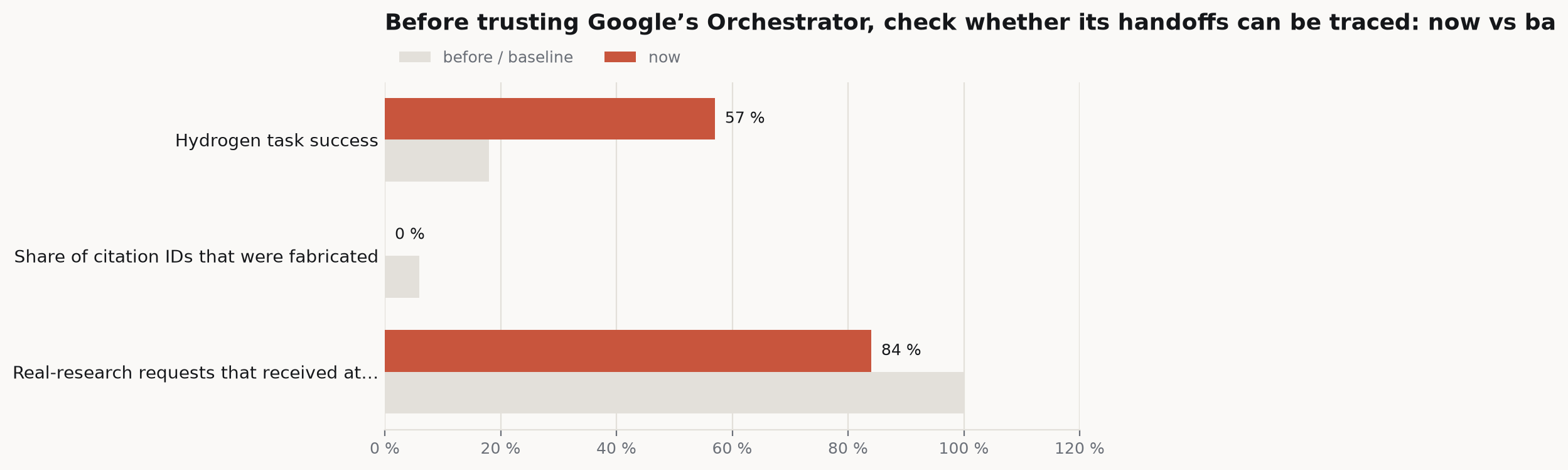
The separate coding result also needs its settings. Google reports 57% task success for Hydrogen against 18% for Gemini 3.8 Flash on Terminal-Bench 4.1, with Hydrogen at default high thinking. That supports trying Hydrogen, not independently trusting Orchestrator’s decisions about bringing Carbon back.
I wouldn’t say “fast” without specifying the workload. Plotly’s data-analysis benchmark measured Hydrogen’s median time per question at 32 seconds against Argon’s 23 seconds. Hydrogen beat Carbon, but Argon finished sooner. Plotly ran each model once: a useful sample, not a stable promise for my workload. Artificial Analysis also describes Hydrogen’s highest-thinking configuration as slower than average per index task.
These results can coexist. Benchmarks measure particular configurations, workloads and harnesses. As AI Coding Daily points out, the harness affects available tools and how tasks proceed. Thinking settings change the arrangement again. Orchestrator adds handoff decisions that standalone Hydrogen tests never exercise. My repository adds its own ways to waste an afternoon. I’d use benchmarks to choose a trial, then measure the workflow I’d buy.
The supplied sources provide no independent replication of Orchestrator’s quota and completion-time tradeoffs across production projects. Those savings remain Google’s reported result.
I trust the citation result more with its awkward detail included
Hydrogen’s independent citation test offers victory-graphic material: no fabricated citation IDs observed. I like it more with the inconvenient detail included.
The independent tester measured 0% fabricated citation IDs for Hydrogen against 6% for Gemini 3.8 Flash across three runs over the same claims. Hydrogen used default high thinking; Flash used default medium. That configuration difference belongs beside the comparison.
Coverage complicates things. Hydrogen returned at least one real citation ID for 84% of real-research requests, against 100% for Flash in the same test. The tester says Hydrogen declined some requests on which other models failed. Cleaner answers came with unanswered requests.
If I count fabricated IDs only among provided answers, declining difficult requests can improve the result without resolving them. Refusal may be exactly right when the alternative is an invented reference. But someone still has to resolve those requests. I’d track that work alongside fabrication rates, rather than congratulate myself while quietly dumping difficult cases on a colleague. Zero observed fabrications also leaves open a nonzero underlying failure rate.
I’ll happily concede I prefer a clear refusal to a confident citation for a paper nobody wrote. My tolerance depends on the job. Exploratory research can turn an unanswered request into another search. A product promising a completed report may instead have failed to deliver.
Safety documentation requires different restraint. Google says its assessment found no material general-capability increase over Argon, so its framework didn’t require the full critical-capability evaluation suite. It nevertheless ran targeted biological and cyber assessments. That explains Google’s evaluation path, not the contents of assessments I haven’t seen.
The supplied model card said the full Hydrogen Safety & Security Report and detailed targeted assessment results were forthcoming. I can acknowledge the process without hiding that gap. Neither side gets certainty: “Google assessed it” doesn’t answer every deployment question; missing detail doesn’t establish an undisclosed failure.
In my trial, declined requests would stay on the results sheet, including what happened afterward and whether a person finished the work. An empty answer can be responsible and still create a bill.
I’d check the context budget, then demand the handoff log
The enterprise context headline also needs conditions. Google documents about one million tokens of unified context, shared across input and output. Generous, until I assign that capacity several jobs at once.
It’s one container: repository files, conversation history, model thinking, function calls and final output all consume it. More source material leaves less room for everything afterward. The advertised limit isn’t an input allowance with another equally large allowance for answers. Longer output also requires continuation beyond a foreground segment; applications needing lengthy generation must handle that path.
That’s why I’m fussy about benchmark conditions. Our local measurements illustrate it without involving Google’s infrastructure.
In our August measurements on an M3 Max with 128GB of memory, both local models used MXFP4 and were fully resident in memory.
There, gpt-oss:20b generated about 74 tokens per second, versus about 51 tokens per second for gpt-oss:120b. That comparison belongs to that hardware and those residency conditions.
The same machine also had an RTX 5060 Ti running image generation through ComfyUI. With its memory occupied, Ollama had about 150MB of VRAM available, and the smaller language model ran entirely on CPU. “There’s an Nvidia card in the box” would have been a spectacularly unhelpful description of the language-model test.
Those measurements say nothing about Hydrogen’s speed. They explain my impatience with model names masquerading as complete performance specifications. I want to know what ran.
For Orchestrator, I’d want to inspect which model handled each action and where control changed hands. Did Hydrogen depart from the plan, did Carbon revise it badly, or was my original instruction ambiguous? Different failures need different fixes. A session-level label won’t necessarily distinguish them.
InfoWorld’s reporting says the documentation doesn’t describe per-action model-attribution logs. Whether Antigravity offers enough detail for enterprise auditing still needs independent testing. That doesn’t mean useful visibility exists nowhere in the product. I’d explicitly test it rather than discover a limitation during a postmortem.
I’d keep the trial small enough to inspect manually: save the initial plan and failing test output, then compare the revised plan with the eventual patch. Could another engineer reconstruct that sequence from Antigravity’s record without my narration?
That’s where I’d put the purchase decision. I’m happy to delegate the handoff. When the patch breaks something, I still have to explain it to a human.
Frequently asked questions
How does Orchestrator switch between Carbon and Hydrogen in Google Antigravity?
In Google’s example, Carbon investigates dependencies and produces a plan, then Hydrogen edits code and runs tests. When execution encounters friction, control returns to Carbon to inspect the changed repository and revise the plan. Switching occurs within the session, but the supplied material establishes no universal escalation threshold.
Does Antigravity Orchestrator reduce costs compared with Carbon alone?
Google reports 24% less average quota use and 19% faster average completion than Carbon alone while maintaining near-Carbon task success. These are benchmark results, not equivalent dollar savings. Google’s posts disagree on the Terminal-Bench version, and the supplied sources provide no independent replication across production projects.
Does Gemini 4 Hydrogen’s citation test prove it never fabricates references?
An independent test observed no fabricated citation IDs from Hydrogen across three runs, but that does not establish a zero underlying failure rate. Hydrogen supplied at least one real citation ID for 84% of real-research requests, versus 100% for Gemini 3.8 Flash, and the models used different thinking settings.
Sources
- Introducing Gemini 4 Hydrogen
- Gemini 4 Hydrogen and Orchestrator
- Gemini 4 Hydrogen: everyday coding and agentic workflows for developers
- Gemini 4 Hydrogen - Model Card
- Gemini 4 Hydrogen | Gemini Enterprise Agent Platform
- Google Search gets a major upgrade with Gemini 4 Hydrogen