
Adversarial Clothing Could Make Privacy Wearable
As facial recognition spreads faster than regulation, adversarial clothing is shifting from art project to practical consumer privacy tech.
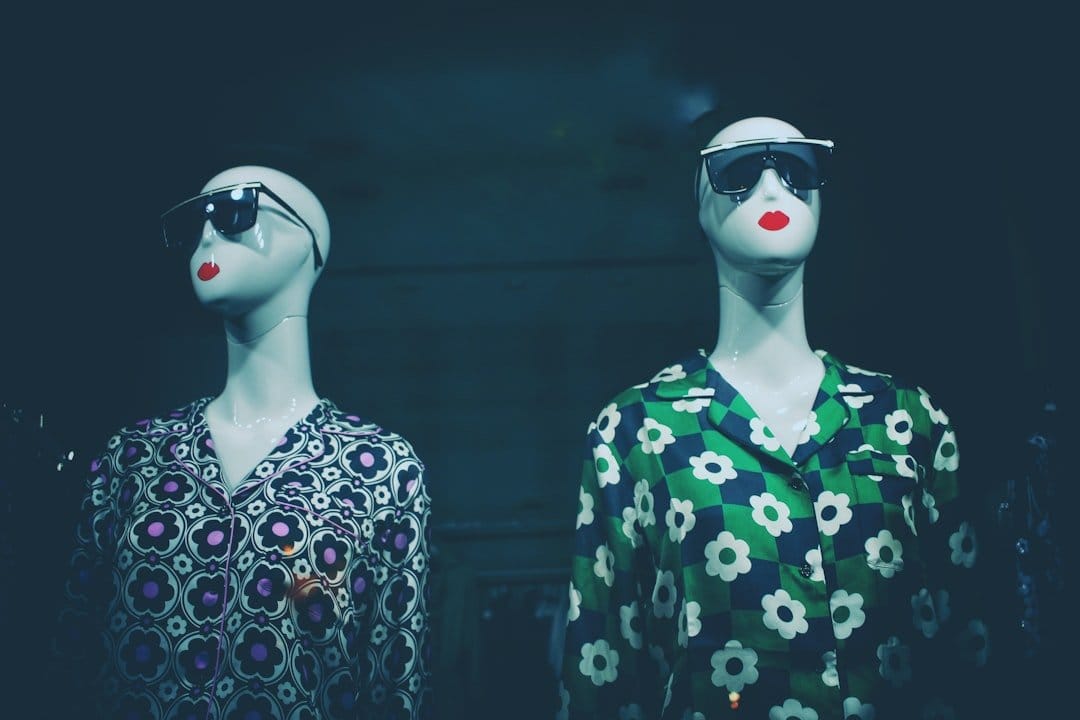
Adversarial clothing sounds like a gimmick until you realize it solves a very modern problem: how to move through a world of ambient facial recognition without being constantly indexed. A black T-shirt that looks ordinary, then quietly interferes with surveillance systems, is no longer just an art-school provocation. It is starting to look like a product.
I used to file this category under clever internet experiments with no real path to adoption. Then I read the CVPR 2026 paper by Jiahuan Long, Tingsong Jiang, Hanqing Liu, Chao Ma, Weien Zhou, Yang Yang, and Wen Yao, and the whole thing felt less niche. Their shirt stays visually plain, then uses thermochromic material and flexible heating to reveal a hidden pattern in under 50 seconds. The reported adversarial success rate is above 80% against both visible-light and infrared surveillance systems.
That is the moment the story changes. Garments designed to confuse facial recognition systems are no longer just privacy theater. They are starting to look like a rational consumer response to surveillance that keeps expanding faster than public trust.
And that is the real story here.
This is not just another lazy “fashion meets tech” trend piece. It is about privacy becoming something people increasingly expect to buy for themselves because they do not trust institutions to protect it in time. So they do what modern users always do: install the extension, tape over the sensor, switch the app, self-host the service, wear the shirt.
Bleak, yes. But also very 2026.
I have spent most of my adult life building products where hardware, software, and cloud all collide. One lesson keeps repeating: strange technology goes mainstream when it becomes frictionless, not when it becomes morally correct.
That is why this matters now.
Why adversarial clothing suddenly looks practical
Early anti-surveillance fashion had one giant problem: it looked like anti-surveillance fashion. Loud patterns, obvious patches, and outfits that practically announced what they were trying to do. If your privacy tool makes you look like a conference demo, mass adoption is not close.
The CVPR paper solves that in the smartest possible way. The shirt is boring by default. That is the breakthrough. It does not ask people to dress like cyberpunk extras. It asks them to wear a black T-shirt.
That may sound superficial, but it is exactly how mainstream adoption works. Most people do not adopt tools because the ethics are persuasive. They adopt tools because the product fits into existing life without demanding a personality transplant.
If anti-facial-recognition clothing looks like a costume, it stays niche. If it looks like something someone could wear to buy groceries or ride the train without attracting attention, it has a real chance.
The performance numbers help. According to the paper, the hidden texture activates within 50 seconds and maintains an 80%+ success rate across varied real-world surveillance settings in both visible and infrared modes. Those are not magic numbers. They are product numbers.
Dark Reading picked up on the same shift in its coverage of Bill Swearingen ahead of Black Hat USA 2026. The framing mattered: less weird hacker fashion, more practical response to biometric systems already spreading into daily life. Once a concept enters Black Hat culture, it stops being just an academic curiosity and starts becoming a tool.
Of course, real-world constraints still matter. If a shirt only works in one lighting condition, from one angle, or while the wearer stands perfectly still, then it is still a demo. But it is no longer safe to dismiss the category.
Convenience changes behavior faster than ideology. If privacy-preserving clothing gets easy enough, people will wear it long before they can explain the machine-learning mechanics underneath.
People buy countermeasures when governance lags
People do not start dressing against the algorithm because facial recognition is flawless. They do it because they do not trust the people deploying it to set boundaries before it becomes normal everywhere.
That is not a fashion story. It is a governance failure.
According to Biometric Update, UK Home Secretary Shabana Mahmood MP acknowledged in the House of Lords that deployment, technological change, and public debate are all moving faster than legislation and policy. The honesty is welcome, but the public takeaway is brutal: the systems are spreading faster than the rules.
Lord Foster of Bath pushed on the same point, asking why progress was taking so long when the consultation had closed months earlier and the government still could not say what would happen next. If the legal scaffolding is missing while the cameras are already going up, people will assume they are on their own.
That assumption is not irrational. The same Biometric Update report says the Metropolitan Police is moving ahead with static live facial recognition cameras in central London. It also reports that one of the UK’s big four supermarkets is tripling its Facewatch deployment. While policymakers are still refining language, the hardware is being installed.
That mismatch is exactly how workaround markets are born.
The UK Home Office launched a 10-week public consultation in December 2025. The government signaled an intention to regulate facial recognition in the King’s Speech in May. Yet months after the consultation closed, lawmakers were still pressing for answers while rollout continued.
If states and major retailers keep expanding biometric systems while the legal framework stays half-finished, the market will do what the market always does when institutions lag: ship a workaround.
That workaround might be a shirt. It might be makeup, infrared accessories, on-device blockers, or software that scrambles identity linkage. The form factor matters less than the signal. Ordinary people are starting to shop for an exit.
Once a population starts shopping for exits, trust is already in trouble.
Ambient facial recognition is the real issue
One CCTV camera on a wall is not what makes this feel inevitable. The real shift is ambient facial recognition: biometric capture becoming portable, embedded, and socially normal.
That is what changes the equation. It does not arrive looking oppressive. It arrives wrapped in convenience, safety, and operational efficiency.
Professor Fraser Sampson, former UK Biometrics & Surveillance Camera Commissioner, made this point clearly in Biometric Update. He wrote that body-worn cameras were introduced in the UK in 2014 for police firearms officers after the shooting of Mark Duggan, and are now “as commonplace in law enforcement as the radio or the Taser.”
Body-worn cameras were introduced in the UK in 2014 for police firearms officers after the shooting of Mark Duggan, and are now as commonplace in law enforcement as the radio or the Taser.
Sampson’s broader point is even more important: body-worn cameras spread beyond policing into firefighting, emergency departments, and private security settings like retail because organizations saw them as practical and preventive. Surveillance normalizes fastest when it presents itself as reassurance.
Tell people a system protects staff, reduces theft, de-escalates incidents, or improves safety, and many stop asking where the footage goes, how long it is stored, whether it is linked across systems, and who gets flagged later.
Then there is consumer hardware. According to WIRED, Meta removed hidden face-recognition code from its smart-glasses companion app one day after WIRED exposed it. The app had been installed on more than 50 million phones. The internal system, called NameTag, was reportedly designed to turn faces captured by the glasses into faceprints, compare them to a local database, and crop, index, and store unrecognized faces locally for later processing.
Meta spokesperson Andy Stone told WIRED, “No final decision has been made on what to do here, if anything.”
No final decision has been made on what to do here, if anything.
But when that machinery is already sitting inside software downloaded by tens of millions of people, the gap between experimental and real starts to feel thin.
This is why anti-recognition clothing makes intuitive sense to normal people. We are no longer talking only about state-owned cameras on poles. We are talking about a world where glasses, apps, store security stacks, and private databases can all become identification layers.
That is a different social contract.
There is also a deeper discomfort here. Admiring elegant systems is easy. Accepting a world where opting out of identification in public requires behavioral hacks is much harder. That is not healthy. It is a tax on ordinary life.
Adversarial clothing does not need perfect invisibility
The science-fiction framing is misleading. These garments do not make anyone invisible. What they do is more interesting: they add friction to systems that rely on thresholds, confidence scores, and acceptable error rates.
NIST’s FRTE 1:N Identification benchmark evaluates facial recognition systems using measures such as FNIR, false negative identification rate, and FPIR, false positive identification rate. One standard comparison point is performance at an FPIR of 0.003.
The practical takeaway is simple. These systems are not magic. They are threshold machines. Humans decide what error tradeoffs are acceptable, when a system escalates to review, and how much uncertainty is tolerable before a candidate list is returned.
So no, a privacy tool does not need to make someone perfectly unrecognizable to matter.
It only needs to create enough uncertainty to break the flow.
If a system cannot confidently match a face, or has to escalate more cases to human review, or starts returning weak candidates often enough to slow the pipeline, that matters. In automated systems running at scale, even small amounts of friction can damage the economics.
That is why the 80% success rate reported in the CVPR paper matters even if it is not universal and even if performance drops outside controlled conditions. A tool that works most of the time in real environments can still be highly disruptive if the incumbent system depends on smooth automation.
A recent paper in Knowledge-Based Systems, “Similar yet different: Robust and transferable face privacy protection via adversarial identity editing,” points in the same direction. The important idea is not the fashion angle. It is that privacy protection is moving toward preserving how humans see a person while disrupting how machines link that identity across systems.
That is the frontier: humans still recognize you, but the machine gets a worse signal. Not invisibility. Selective legibility.
Of course, practical headaches remain. Laundry, sweat, battery life, camera angle, lighting, distance, infrared quality, compression artifacts, manufacturing tolerances, cost, and comfort all matter. Physical products fail in the gap between a clever prototype and ordinary life.
So anti-facial-recognition clothing is not solved. But it does not need to be perfect to become socially important.
If enough people decide probabilistic friction is worth paying for, that tells you something upstream already broke.
Privacy may become another luxury product
This is the bleakest part. Privacy tools usually appear first as premium products, which means the people most exposed to surveillance are often the least able to buy their way out of it.
Meanwhile, the institutional side keeps scaling.
Biometric Update reports that Clearview AI has begun a FedRAMP review for Clearview GovCloud, which could make its facial-recognition platform easier for federal, state, local, and tribal governments to procure. That does not mean automatic approval, but it does mean a cleaner path into government workflows.
The same report says Immigration and Customs Enforcement has used Clearview in criminal investigations, while Customs and Border Protection has used it for tactical targeting and counter-network analysis. Those are serious deployments backed by serious power.
Clearview says its outputs are investigative leads that should be corroborated with other evidence. Even if that is true in many workflows, it does not erase the asymmetry.
Governments and major retailers get industrial-grade identification infrastructure backed by procurement budgets, compliance pathways, and integration teams. Individuals get what? A shirt, maybe special glasses, maybe makeup tricks, maybe the hope they are too unimportant to be indexed.
That is not a balanced market.
It is a defensive consumer layer forming underneath a much more powerful surveillance stack. And once that happens, privacy starts to resemble every other unevenly distributed protection in modern life. The people with money buy insulation from systemic problems. Everyone else gets the raw version.
If privacy becomes something you wear, it risks becoming another class marker.
This pattern is familiar. Platforms centralize power, the harms become obvious, and then the market sells premium fixes back to the same users who lost control in the first place.
Europe should build privacy tech, not just regulate it
Europe cannot keep being the place that writes elegant rules after American and Chinese companies have already shipped the infrastructure. If biometric capture is becoming part of policing, commerce, and consumer hardware, then privacy-preserving technology needs to become a serious product category that Europe actually builds.
That means on-device identity protection, anti-tracking wearables, consent-aware vision systems, privacy-first computer vision, and recognition systems that only activate when the person being recognized has actually agreed to it.
That is not anti-innovation. It is innovation.
The UK situation is a warning: deployment racing ahead while legal clarity lags and public trust leaks out in the process. The broader signal is that adversarial clothing has escaped the civil-liberties niche and entered consumer imagination.
Europe should read that signal correctly.
If the next decade of AI is ambient, then the control layer around that AI matters almost as much as the models themselves. The winners in this space will not just be the companies that recognize faces best. They will be the companies that let people decide when recognition is allowed at all.
That is where founders should aim higher. A black shirt with hidden thermochromic adversarial patterns is clever, useful, and maybe necessary. But it is still a workaround.
The bigger opportunity is building systems where ordinary people do not need workarounds just to move through public life without being constantly indexed.
If adversarial clothing does go mainstream, that is not really a sign the shirt won.
It is a sign the rest of us already lost the argument.
Sources
- Can Clothes Make You Invisible to Facial Recognition?
- Thermally Activated Dual-Modal Adversarial Clothing against AI Surveillance Systems
- Similar yet different: Robust and transferable face privacy protection via adversarial identity editing
- UK Home Secretary pressed over delays to facial recognition legislation
- From body cams to subdermals – what’s next for wearable biometrics?
- Clearview AI FedRAMP bid could ease federal procurement of facial recognition